Wardenclyffe
The last thing Tesla built at full scale stood on the north shore of Long Island for fifteen years. The laboratory beside it is still standing.
At the end of July 1901 Tesla closed on about two hundred acres of flat scrub at Shoreham, in the town of Brookhaven on the north shore of Suffolk County, New York. The land came from James S. Warden, a lawyer who had bought a large parcel there and hoped a radio installation would seed a town; the name Wardenclyffe is his. The commission was Stanford White's, taken on personally; the tower was drawn by his associate William D. Crow. The laboratory is a square brick building about ninety-five feet on a side, with a chimney rising from the centre. Beside it went a lattice tower a little under 190 feet high, topped by a steel cupola about sixty-eight feet across and weighing in the region of fifty-five tons, with a shaft sunk into the ground beneath. The tower was never brought into full operation and it came down in 1917. The laboratory has never come down.
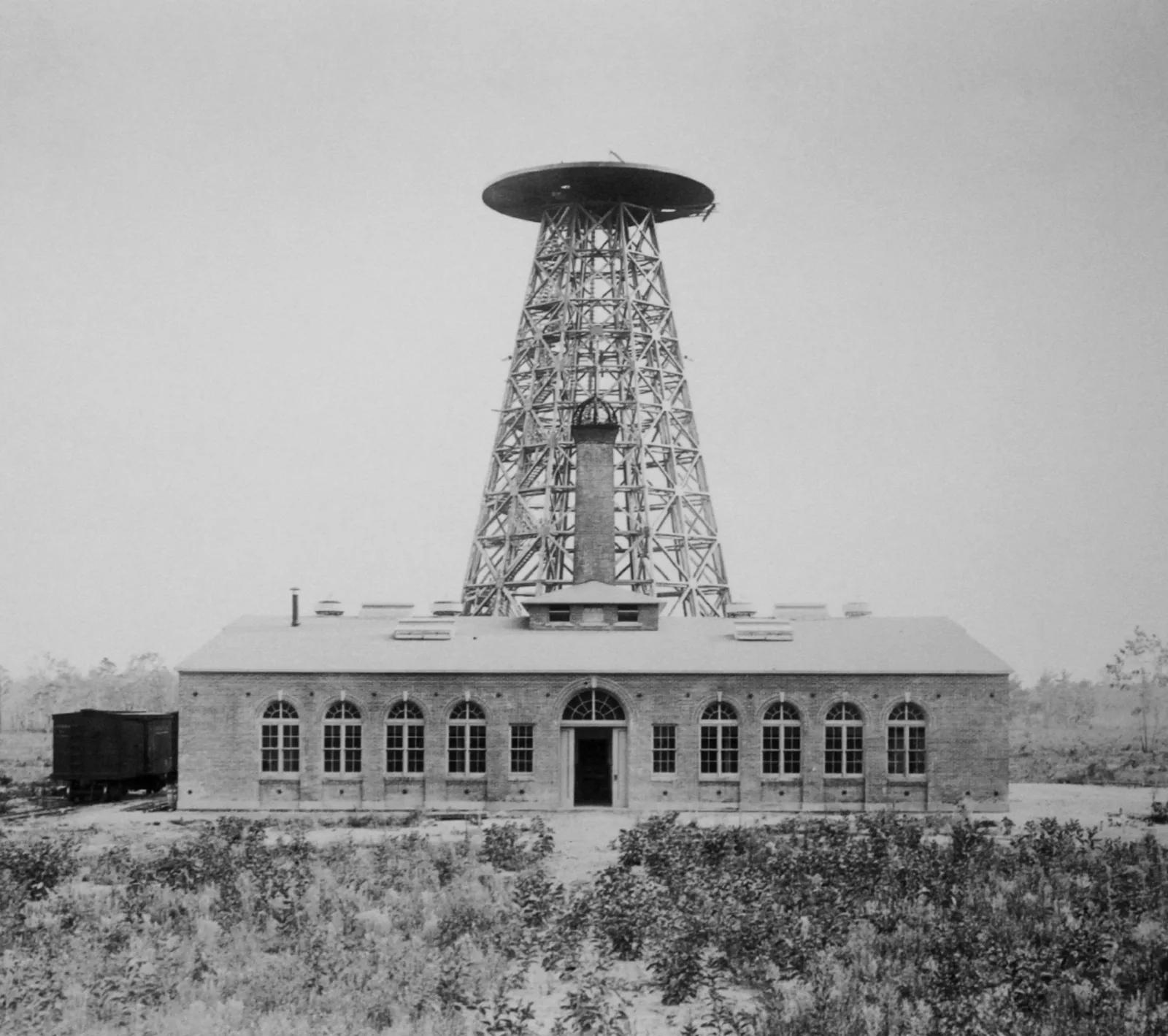

What the site was supposed to do.
The scheme is set out, in the flat and repetitive language of patent claims, in four documents. Two of them were granted before construction began and describe the general arrangement: an oscillator driving a large tuned coil, a raised terminal on a mast, and a good connection to earth, with a matching arrangement at the far end. The third, granted in 1905, is the one that states the physical premise plainly — that the earth itself can be made to carry the current, and the rarefied air above a certain height can carry the return. The fourth, filed in 1907 and granted seven years later, is largely about stopping the charge leaking off the terminal into the surrounding air.
The four documents
US 645,576 — System of Transmission of Electrical Energy. Filed 2 September 1897, granted 20 March 1900.
US 649,621 — Apparatus for Transmission of Electrical Energy. Filed 19 February 1900, granted 15 May 1900.
US 787,412 — Art of Transmitting Electrical Energy Through the Natural Mediums. Filed 16 May 1900, granted 18 April 1905.
US 1,119,732 — Apparatus for Transmitting Electrical Energy. Filed 18 January 1902, renewed 4 May 1907, granted 1 December 1914.
Titles and dates transcribed from the patent faces. All four are out of copyright, and each number above opens the scanned grant.
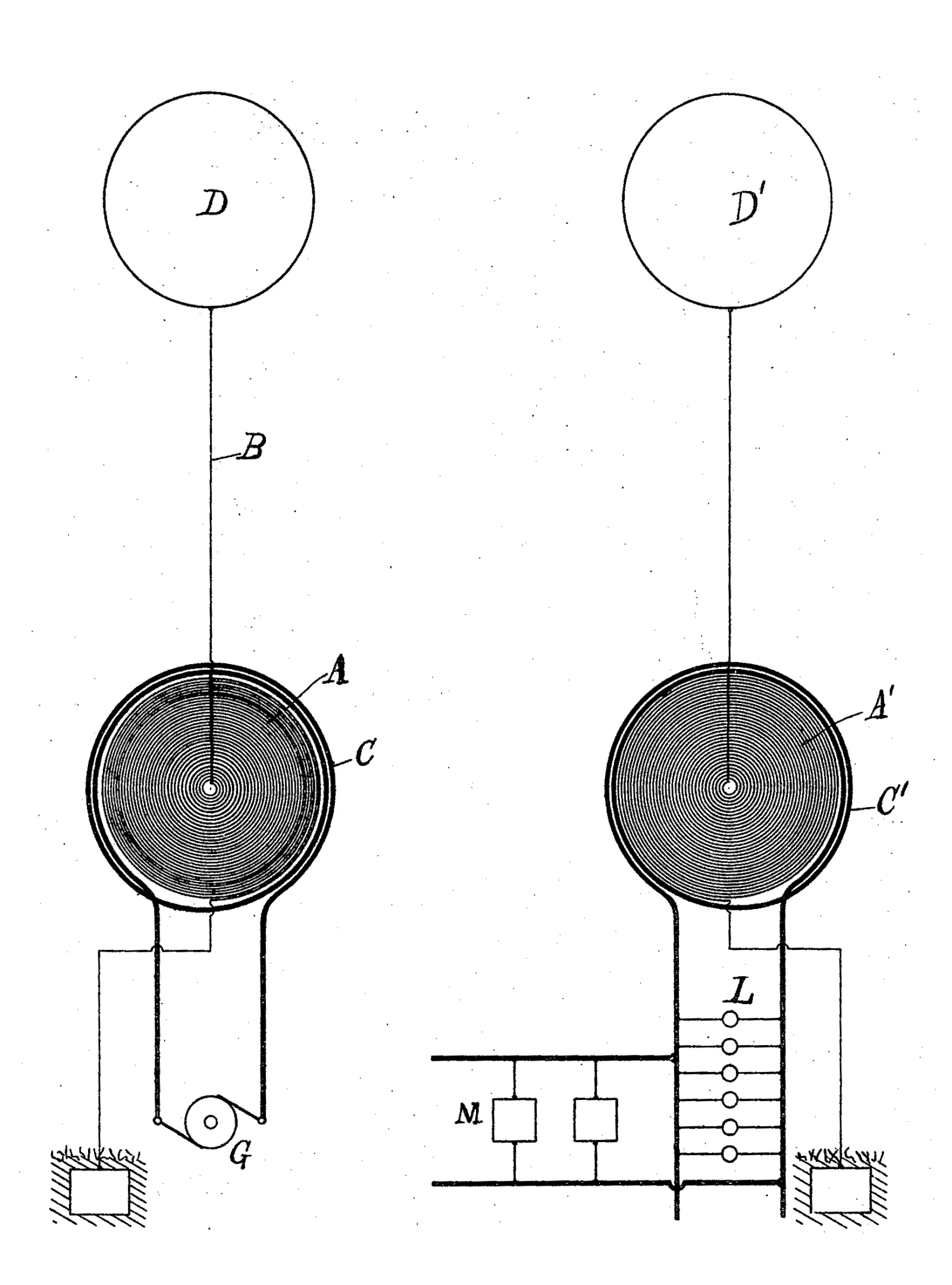

None of the four describes a source of energy. They describe transmission: taking power produced somewhere conventional and delivering it, or a signal, somewhere else without a wire between. On the Shoreham site the conventional something was a coal-fired plant. That single detail is what the popular account of the tower cannot absorb, and it is the reason this publication keeps returning to the documents rather than to the legend.
What the money was for.
In March 1901 J. P. Morgan agreed to advance $150,000. The commercial proposition he was buying was transatlantic wireless telegraphy — messages, and the businesses that hang off messages, including press dispatches and stock quotations. When Tesla asked for more that July, in order to build something larger than the plant Morgan had funded, Morgan declined. In December of the same year Marconi reported receiving a signal across the Atlantic at St John's, Newfoundland, using apparatus that cost a fraction of what Shoreham had already consumed. The commercial argument was effectively over from that point, whatever the engineering merits.
What followed is a debt schedule rather than a conspiracy. Two mortgages, in 1904 and 1908, went to the owner of the hotel Tesla was living in; a machinery judgment followed in 1912, the deed went to the hotel company in 1915, a scrap contractor put dynamite under the tower on 4 July 1917 and was still at it in September, and the appeal against the foreclosure failed in 1922. Wartime rumours that Washington ordered the tower down to deny it to German agents have produced no order, from any department, in a century of looking.
What stands there now.
Sixteen acres and the brick laboratory are what is left, and both New York State and the site's present owner describe it as the only surviving Tesla laboratory anywhere. It is a museum in the making rather than a museum: the Tesla Science Center at Wardenclyffe has held the land since 2013, a fire in November 2023 took the roof and set the restoration back by millions, and a visitor building — an adaptive reuse of the 1920s house next door, and the first building on the site the public will be admitted to — was dedicated on 11 July 2026 but had still not opened as of 16 November 2026. The laboratory itself is closed, and the guided tours are of the grounds only. Dates and opening days have changed repeatedly since the fire, so the centre's own site is the place to check them before travelling. What the National Register counted on the sixteen acres, what the photographic works that occupied them until 1987 left behind, and where the fire actually started are in the article on the site today.
What has been published here.
-
1943 onward · The record since
What is standing at Wardenclyffe, and what is under it
Of the eleven resources the National Register counted on the sixteen acres, two are Tesla's. The rest is a photographic factory — and the dirtiest ground on the property is the middle of his tower foundation.
-
What the tower at Shoreham was for
The contract J. P. Morgan signed in March 1901 bought transatlantic wireless telegraphy, and the plant that ran the tower burned coal.
-
Wireless power, and why “free energy” is not what he was selling
He proposed a way to move energy, never a way to make it — and the way he proposed does not work.
-
1943 onward · The record since
The Supreme Court did not rule that Tesla invented radio
It held the broad claims of Marconi's tuning patent invalid, and the prior art that killed them was mostly somebody else's. US 645,576 is quoted in the opinion.