1943 onward · The record since
What is standing at Wardenclyffe, and what is under it
Of the eleven things the National Register counted on the sixteen acres, two are Tesla's. The rest is a photographic factory — and the dirtiest ground on the property is the middle of his tower foundation.
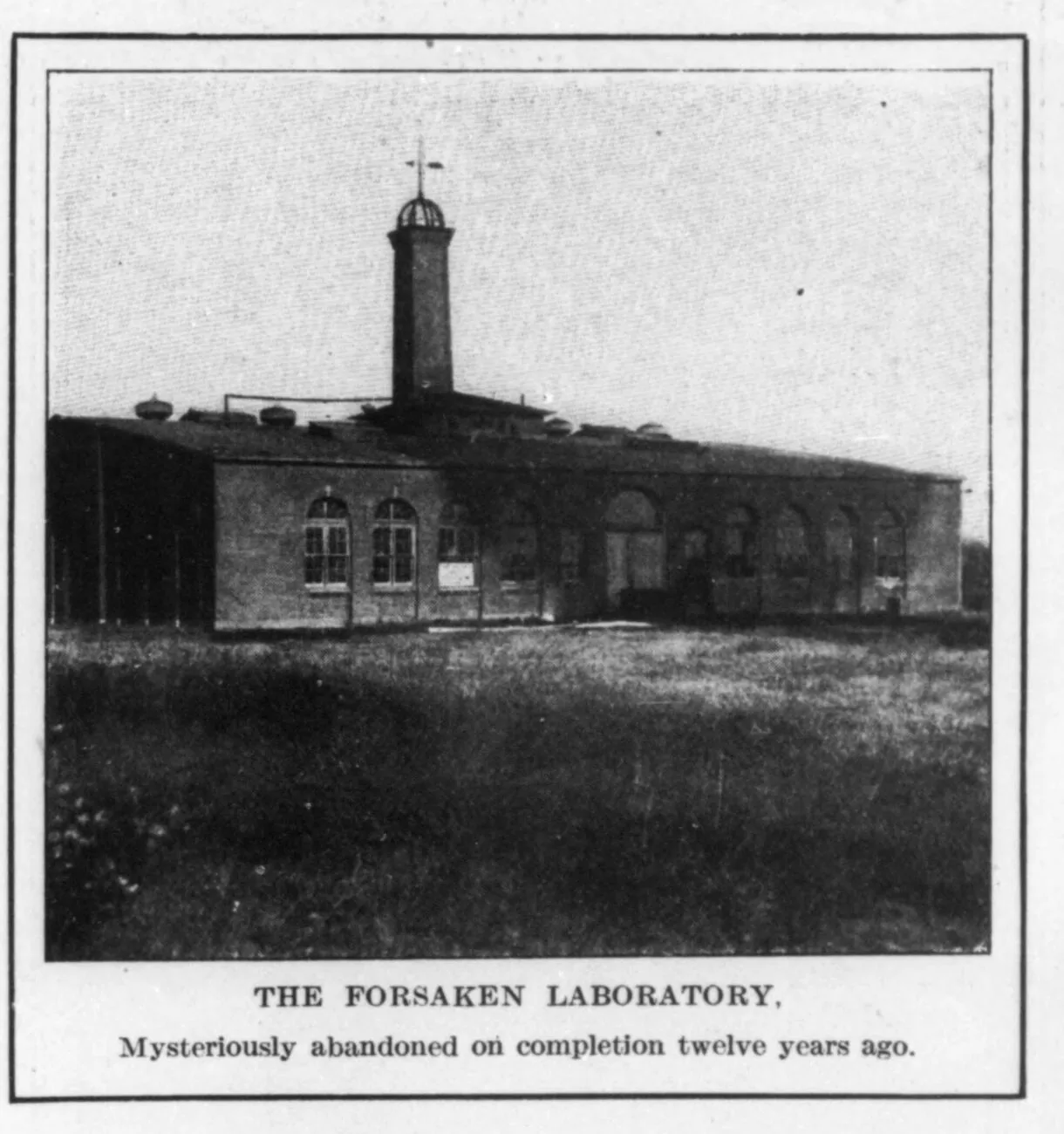
The picture most people carry of Wardenclyffe is a brick laboratory standing by itself in a field, with the ghost of a tower behind it. That is what it looked like in 1902, and roughly what it will look like again if the present plan is carried through. It is not what is there now, and has not been for most of a century.
On 27 July 2018 the site was entered on the National Register of Historic Places as Wardenclyffe Laboratory, reference number 100002744. It is a National Register listing and not a National Historic Landmark, which is a distinction the popular accounts regularly lose. The nomination that got it there is a long document prepared by a preservation architecture firm, and the most useful thing in it is a piece of arithmetic on page 3. A nomination has to count the things on a property and sort them into those that carry the historic significance and those that do not. At Wardenclyffe the count is two contributing resources, nine non-contributing. Two of the eleven things on the sixteen acres are Tesla's.
That ratio is the story of the site since he left it, and almost everything that has happened at Shoreham in the past thirteen years — including the fire of November 2023 — follows from the work of getting the other nine off.
What the Register actually counted.
The two contributing resources are the laboratory and the foundation of the tower. The nine others are a 1920s dwelling, the Bauer House, which Agfa bought from the Bauer family in 1978 and used as an employee break room — hold on to that one, because it has become the visitor centre; a Volatile Material Storage Building of the 1940s with FLAMMABLE STORAGE painted on its east wall; a Maintenance Shed; a Boiler House and an Air Handling Building, both put up between 1966 and 1970 in a courtyard enclosed by the factory; an Administration Building of 1976–80; an Industrial Wastewater Treatment Facility of 1979, enlarged by 1985; a Guard Shack; and a granite statue of Tesla given by the Republic of Serbia in 2013, non-contributing for the ordinary reason that a 2013 object is a century outside a period of significance that ends in 1915.
Two details in that count cut against the way the site is usually described.
The first is that the sixteen labelled additions thrown up around the laboratory between 1939 and about 1984 are not counted separately at all. They are all internally connected to the original building, so "due to their interconnections and complexity, these additions are counted along with the Tesla lab as one building." The single contributing building on the National Register at Wardenclyffe is therefore not Tesla's laboratory. It is Tesla's laboratory with a photographic factory grown through it, listed as one object because by 2018 you could not separate them on paper any more than you could on the ground.
The second is that the nomination cannot keep its own story straight about the tower base. Its resource table records the second contributing resource as a structure; a narrative heading nine pages later calls it a site. A structure is a thing you can point at and a site is a place where a thing used to be, and what survives at Shoreham sits between the two: a visible octagonal ring of concrete and stone about ninety feet across, and the rest underground.
The other entries on the form: areas of significance ENGINEERING and SCIENCE; period of significance 1901–1915; significant dates 1902 and 1906; significant person Tesla, Nikola; architect and builder McKim, Mead & White and William D. Crow. The address is 56 NY-25A and the parcel is 16.43 acres. Two things on that form are worth dwelling on. The first is that it is listed under Criterion B — association with a significant person — and not under the criterion for architecture. Wardenclyffe is on the National Register because Tesla worked there, not as a building. The second is the architect line, which wants three clauses rather than one: the commission was Stanford White's personally, taken on without a fee, and he was still bidding the work in 1901; the tower was drawn by his associate William D. Crow; and the nomination's further suggestion that Crow drew the laboratory as well rests on a single 1943 note that could not be located in any catalogue. "Stanford White designed Wardenclyffe" is the shorthand on the 1976 plaque and in most accounts since. It is not wrong, and it is not the whole attribution either.
The sixty years nobody mentions
Tesla deeded the property to his creditors in 1915; the tower came down for scrap in 1917; and then the site did nothing at all for more than twenty years. Then, at the end of the 1930s, it became a factory. Exactly how is less settled than it looks: the National Register nomination tells the transition three different ways in three places, naming Posi-Print, Peerless Photo and Plantacres, Inc. as the purchaser on pages 6, 9 and 32 respectively, and the only contemporary conveyance notice located — in a local paper of 22 March 1939 — records a sale from Shoreham Farms, Inc. to Plantacres, Inc. for $2,000, dated 6 March 1939. What is not in doubt is the outcome: the land passed to Plantacres, the operating tenant was the Posi-Print Corporation, Posi-Print reorganised as Peerless Photo Products, and the business was manufacturing emulsions for photographic paper.
In the summer of 1939 Peerless converted Tesla's laboratory into a factory, and the nomination's explanation of why that worked is a small piece of praise for the 1901 design: "the open design and brick construction of the Wardenclyffe laboratory allowed for its sub-division with minimal disruption to the original building." The four double-height rooms Tesla had used — the Dynamo Room on the west with its spiral stair, the boiler at the east, the display laboratory to the south, the machine shop to the north — were floored over and partitioned. The brick bearing walls were left where they were, which is the reason there is anything to restore.
Then the accretion, which the nomination dates addition by addition: a twenty-foot extension on the north-west corner in 1939 for coating equipment; a store room, cutting room and packing room in 1942; the "coating alley" lengthened in January 1950; Building Number 4 in 1951, Building Number 5 in 1957, three more structures between 1962 and 1966. In 1969 Peerless was taken over by the Belgian firm Agfa-Gevaert, then a Bayer subsidiary, which carried on the same business and kept building: two more additions by 1978, three more by 1984, plus the wastewater plant and the administration block.
And one consequence of the trade that is almost too neat to be true, except that the nomination says it in plain words. Photographic emulsion cannot be exposed to light. So the factory bricked up the laboratory's windows. On the north elevation all eleven original openings were infilled with concrete block; on the west, the seven that remained after part of that wall was taken out in 1939; on the east only the first bays to the south keep original sash. "Due to the light-sensitive nature of the photographic products being manufactured," the nomination notes, "there are very few windows anywhere in the building." The skylights that had flooded Tesla's double-height rooms are gone entirely.
Agfa ceased manufacturing at Shoreham in 1987. That is forty-eight years of photographic chemistry — the nomination's "approximately 60 years" counts occupation of the building rather than manufacture in it — in a building people visit because of the four years it says Tesla worked there, from 1902 to 1906. Peerless and Agfa are the names the Wardenclyffe story deletes, and they are the reason the site needed saving in the first place.
What went down the well
Tesla's scheme required the earth to be one half of the circuit. The patents say so plainly, and the engineering followed. The description everyone uses comes from one source, and it is worth naming before repeating it: Tesla's own sworn testimony in the foreclosure appeal of 1922. On that account, a shaft went down about 120 feet beneath the tower; two tunnels ran to it from the power house, one carrying compressed air and water mains and the other electrical mains; sixteen lengths of iron pipe ran out from the bottom of it; and a spiral stairway descended the whole way. INFERRED, and it is this article's reading rather than anything in the testimony: the ground connection was built as seriously as the thing above it, because in the premise the scheme rested on, it was the same size job.
That 120 feet is worth labelling, because every account repeats it and nothing has ever measured it. It is Tesla's own figure, given in sworn testimony in the foreclosure appeal of 1922, twenty years after the digging. From there it can be followed link by link into the official record: into a local-history article of 1968, from that article into the state's own building-inventory form of 1976, which cites it; from the form into the permanent historic-preservation file; from the file into the 2016 eligibility determination and the 2018 National Register nomination; and separately into a federal environmental document of 2010. Six repetitions, no measurement at any link. The one direct measurement anybody is recorded as having made is a steel tape dropped down the shaft around 1920, and it came back at 112 feet.
There is one piece of accidental corroboration, and it arrived eighty years late from people who were not looking for it. Tesla's account was that he dug until he reached water. In 2004 the environmental investigation put the water table under the property at about 120 feet. That is the only external support the figure has ever had.
Here is what the National Register nomination says happened to it:
Unfortunately, after the structure was demolished, the deep well below the structure was used a dumping ground for chemical waste products. The top of the site inside the foundation walls is now capped and monitored as a brownfield site.
National Register of Historic Places Registration Form, Wardenclyffe Laboratory, reference 100002744, section 7, resource 2. The typographical slip is in the original.
The contamination is documented, and what is measured has to be kept apart from what is merely reported. MEASURED, from the state and federal environmental record for the site — New York's remediation file, and the federal hazardous-waste record NYD002044139 filed under "AGFA Corporation – Peerless Photo Products": before the wastewater treatment plant was built, Peerless disposed of untreated process water into recharge basins 800 feet long by 25 feet wide, and that water carried cadmium, silver and lead among other compounds. Agfa began a clean-up in 1993 under the New York State Department of Environmental Conservation.
That the shaft itself was used the same way is a much weaker claim, and the nomination's wording is careful about it: the stairwell "may have been used as a disposal site for the wastewater as late as 1973," on a footnote that is not a document at all but a single oral-history interview recorded in 2015 with the granddaughter of the family who owned the house next door. One person's recollection, about a period forty years earlier, is not printed here as a fact.
It does not need to be, because the state drilled. And here two things the nomination says have to be corrected against New York's own environmental file. The first is the label: this is not a brownfield site in the technical sense but a State Superfund site — New York State inactive hazardous waste disposal site 152031, "Peerless Photo Products," listed in 1983 as a Class 2 site, meaning a significant threat to health or the environment, and reclassified after remediation. The second is the claim that the ground under the tower "cannot be investigated." It has been investigated. Three borings — SB-6A, SB-6B and SB-6F, the last of them in the dead centre of the foundation — were driven through the tower base in 1996 and again in 1999, the second time all the way down to groundwater.
What they found is the thing that should be the headline of this whole subject. The most contaminated point on the entire sixteen acres is the middle of Tesla's tower foundation. Peak soil silver at SB-6F measured 11,000 parts per million against a clean-up objective of 137; peak cadmium, 435 ppm; and silver above 1,000 ppm persists down there to at least fifty-three feet. The oral history is weak evidence for what went down the shaft. The borings are not weak evidence for what is there now.
So the state dealt with it, and the remedy is the part nobody writes about. The Record of Decision of 2004 directed excavation "from Tesla Tower Base (APC-10) in a 20 ft diameter area, centered on the location of boring SB-6F, to a depth of approximately 30 ft," followed by "in situ stabilization of soils from 30 feet to 100 feet below grade surface" — Portland cement injected as jet-grout columns into the ground beneath the tower. What was actually built, between 2005 and 2007, was bigger: the excavation ended up about sixty feet across and reached a field-measured twenty-eight feet, yielding 328 cubic yards of spoil, and the grouting ran "between approximately 25 and 100 feet below ground surface." The dig was enlarged because it hit flowing sand and concrete slabs up to two feet thick.
An environmental easement executed on 19 March 2009 gives the tower foundation its own metes-and-bounds description and a more restricted permitted use than the rest of the property. The state's record gives a remedial-action completion date of 22 September 2008 — but there is no certificate to go with it. A consent order of 2020 says in terms that a Certificate of Completion "will not be issued under this Order," and none has been. A rejected alternative, costed at $8,442,000, would have demolished the foundation outright; the reasons given for rejecting it are cost, disruption and technical difficulty, and historic preservation is not among them.
One more thing is worth correcting, because it is repeated confidently and it is not true. Nothing at Wardenclyffe has ever been imaged by ground-penetrating radar below about two metres. The only GPR survey of the site, run around 2010 by a party the published literature does not name, reached less than two metres and was reportedly equivocal. The one credentialed geophysical study — published in a journal of industrial archaeology in 2018 — did not use radar at all but resistivity, electromagnetics, magnetometry and microgravity; it was commissioned and paid for by a television production company; and its own authors write that "some of the data generated may be spurious." So the tunnels have been inferred, never seen.
Which may be why the count keeps changing. The state's inventory form of 1976 describes a well and a shaft and no tunnels at all. The National Register nomination of 2018 says "two tunnels or trenches." The organisation's own state grant application of 2024 says "a well and four tunnels." Nobody has reconciled those, and no excavation has been done that could.
And here is the structural reason none of this was ever an archaeological question. Wardenclyffe has never had an archaeological survey. New York's cultural resource database holds, for the Tesla Science Center's three parcels, zero survey areas, zero archaeological sensitivity buffers and zero recorded sites — against 283 survey areas, 74 sensitivity buffers and 224 recorded sites in the surrounding town, which is the control that makes those zeroes mean something. Both the laboratory and the tower base are classified as buildings, and when the state formally evaluated the property in 2016 it marked the criteria for significance and left Criterion D — information potential, the archaeological one — unchecked. When the 2005 remediation came up for historic review, the archaeology reviewer's decision was "No Response Needed." The ground under the tower has been treated as a hazardous-waste problem and never once as a site.
Which leaves a conclusion bleaker and more interesting than "capped and monitored." Tesla's ground connection — the component his whole proposition depended on, and the only major element of the installation never demolished, never bricked up and never built over, because it is a hole — turned out to be the dirtiest ground on the property, and has been filled with cement from roughly twenty-five feet down to a hundred. Whether the shaft survives inside that is genuinely unsettled, and three sentences in the public record do not agree: the state told the public in 2004 that "no signs of a tunnel system were detected"; the same document describes "debris and void space at various depths"; and a preservation group, Tesla Wardenclyffe, Inc., asserted in a comment letter that "the original concrete and wood-lined central shaft was found." (The owner in 2004 was Agfa, which commented separately.) Nobody has reconciled them, and nobody has looked since. And the word "capped" misleads, in a way worth saying plainly: there is no concrete lid. What a visitor on the tour stands beside is an octagon of grass and topsoil, restored in 2008. The cap is a legal instrument — an easement over the ground — and the cement begins about twenty-five feet underneath it.
How it was bought, and by whom.
The preservation effort is older than the story usually allows. The organisation that owns the site began in 1996 as Friends of Science East, Inc., an offshoot of a school science-museum board in nearby Shoreham-Wading River that wanted larger premises and noticed what was standing empty down the road. It spent sixteen years lobbying before it had any money, and secured a New York State reimbursement grant of up to $850,000 — money released against receipts. It was in hand before the crowdfunding began, but not unconditionally: the organisation said at the time that raising $850,000 was what it needed "to access the full amount" of it. By 2012 the property was boarded up with plywood and, in the nomination's phrase, "almost sold to developers"; the crowdfunding campaign launched that August by a cartoonist raised over $440,000 in its first twenty-four hours — the figure the organisation gave at the time, which its present-day history page rounds up to $450,000 — and closed at about $1.37 million from more than 33,000 donors. The Tesla Science Center bought Wardenclyffe on 2 May 2013 — and both the price and who paid it are worth getting right, because the usual account gets both wrong. $1.6 million is what the property was listed at; the campaign's own page said so while it was running. Two contemporary reports give the price actually paid as $850,000. And the money at the closing table was the crowdfunding: the organisation's tax returns record no government grant income at all in 2013, 2014 or 2015, and $854,981 only in 2017. The state grant was a reimbursement, and it arrived four years after the keys did. On 10 July 2014 the organisation announced that Elon Musk — the car company's chairman, and not, on its own documents, its founder — had pledged $1 million toward a museum, plus an electric-vehicle charging station on the grounds. The million is acknowledged in the organisation's 2019 annual report. The charging station was never built.
The fire did not start in Tesla's building
The nomination of 2018 states the owner's plan in one sentence: restore the laboratory to its Tesla-era appearance, and "remove non-contributing buildings in close proximity" to it. That demolition has occupied the site ever since, and it is the context the fire happened in. On 30 October 2023 the organisation announced that it was "tearing down the non-historic, condemned warehouse structures; allowing Tesla's laboratory to once again be a free-standing structure." That was twenty-two days before the fire.
On 21 November 2023 fire broke out at Wardenclyffe — the organisation's release says the afternoon, its own page says the night. The only time attributed to a public-safety agency is 4:49 p.m., when Suffolk County police logged the call; the organisation's own account rounds that to "around 5 PM." The blaze was knocked down late that night and then reignited twice before morning, at about 2:30 a.m. and again at about 7:30 a.m. — the organisation's own page says "around 7 AM" — from embers in the structure. One firefighter was hurt. The 1901 building held. What burned is usually given as a bundle — "the roof, chimney and cupola" — and the bundle hides three different outcomes. The roof, original to 1901, was destroyed. The cupola was severely damaged. The chimney is still standing full height in sound brick, and photographs published since show the iron crown still on top of it. Worth knowing before quoting either: the organisation has described the loss both ways, as "significant damage" in its 2023 annual report and as "destroying critical features of the 1901 building, including its roof, chimney, and iconic cupola" in a release of January 2025 written while it was appealing a denied insurance claim. The two most photographed elements of that skyline had, in any case, only just been restored.
The organisation's fire page says they "had been replaced in 2019"; its renovations page dates that emergency work to February 2020, funded by the Robert David Lion Gardiner Foundation and the Musk Foundation, and its own video of the job says the work finished in September 2020, when the chimney's original 1,200-pound iron wellhead — repaired by a local blacksmith rather than replaced — was craned back onto its 1902 position. So the brickwork that burned was about three years old, and the ironwork on top of it was Tesla's, mended.
The brickwork itself came through: all four walls stood, and the centre's historical architect put it bluntly — "Nikola Tesla's original building was pretty much fireproof." No artefacts or archives were lost, because there were none in the building: the organisation says the artefacts are "presently" stored off site, and its September 2025 release describes the new visitor centre as "our first exhibition and preservation space for artifacts and archives." Damage was put at more than $3 million, a figure worth labelling accurately: it is the organisation's own repair estimate, first given as a rough one a week after the fire, and no adjuster's or fire-service loss figure has ever been published.
How many people fought it is a smaller question with a more useful answer, because the figure moved inside its own source in the space of a week. On the morning of 22 November the centre's own letter said "over 100 firefighters from eleven departments." Its press release of 28 November said "more than 100 firefighters, from seventeen local fire departments and ambulance corps" — a wider category than the first — and seventeen is the number it has used ever since, including on the page that is live today. Two outlets reporting that same press event printed "more than 200 firefighters" — and one of those sentences is otherwise a word-for-word copy of the press release with a single numeral changed, which looks more like a transcription slip than a second count. The defensible statement is that well over a hundred firefighters, from between eleven and seventeen departments, answered it; anyone quoting one number is quoting one week of one organisation's own arithmetic.
Where it started is the part that is rarely reported. MEASURED, as the owner's own published characterisation — the underlying report is not public — from its answer to its own frequently asked question: "According to the fire investigators report, the fire originated in the Northwest area next to the original laboratory building." Not in Tesla's laboratory. In the condemned twentieth-century fabric beside it. (That the origin point was itself inside the demolition zone is an inference, and not one any published source makes in terms.) Note the cruelty of the geometry: the building that then burned was the 1901 one, and the warehouses the fire began among were the ones already scheduled to come down.
On the cause, the organisation itself keeps the two halves apart, and so should anyone quoting it. MEASURED, again as the owner's published wording: "the official cause remains undetermined." A statement of 13 December 2023 adds that the report "is pending. However, arson has been excluded as a cause" — an exclusion attributed at the time to the Rocky Point fire chief rather than to the fire marshal. INFERRED, and the inference is the owner's own: "evidence points to demolition contractor error." A release of 28 January 2025 puts a mechanism to it and attributes that to a named person — its then executive director — rather than to any investigator: "Sparks from contractors using blowtorches likely ignited the fire." Three years on, no official determination has replaced the word undetermined.
And the wording has hardened while the official finding has not, which is worth watching in real time rather than only in hindsight. Archived captures of the organisation's own frequently-asked-questions page show that as late as 19 March 2025 it read that "the use of flammable cutting equipment by the demolition contractor could not be ruled out." By 15 April 2025 the same answer read "evidence points to demolition contractor error," which is what it still says today. Nothing in the official record changed between those two captures. A double negative about what could not be excluded had become a positive claim about where the evidence pointed.
It did not stay a matter of opinion. That same January 2025 release carries a section headed "Update on the Fire Investigation and Insurance Dispute," and its two sentences are the most concrete thing published about the aftermath: "While the nonprofit organization's insurance company has issued a payout, it falls short of covering the damage. Tesla Science Center has removed the contractor responsible for the work and is actively appealing the contractor's insurance denial of liability." So the building's own insurer paid less than the loss, the contractor's insurer refused the claim, the contractor is gone, and the question of who is responsible was still being argued more than a year after the fire. No payout figure, no insurer and no contractor has been published. Reported but not verified here: that in November 2025 the organisation sued a Bohemia demolition firm for $3.5 million in Suffolk County Supreme Court. The only source located for that is a Newsday report behind a subscriber paywall, which was not read; both of New York's public case-search portals are captcha-gated and the docket could not be reached, so no index number, defendant or outcome is offered above. It is set down as a lead, not a fact.
Two further facts explain more about the condition of the site than any description could. There were no smoke detectors, and the reason given is not negligence but arithmetic: the campus holds "about 110,000 sq. ft. … of dilapidated buildings without water or power," where, the organisation says, detectors "were not feasible"; a monitoring system is planned "once demolition is complete and core and shell construction begins," and once the laboratory has power. And the insurance position as stated in December 2023: "While there is an insurance policy for the site, the Wardenclyffe Laboratory is an empty building without a certificate of occupancy, so coverage under the policy is still being determined."
A fire in a derelict plant under demolition is an ordinary event; what makes this one matter is that the plant was wrapped around a landmark. The photographic works that had to be removed to reveal Tesla's laboratory was also what put the laboratory at risk while it was being removed.
Three years on
The clearest way to describe where the project stands is to put the organisation's own published targets in date order and let them speak.
- 21 May 2025, announcing that construction was about to start: "Construction is projected to take six to eight months. The visitors center should be open to the public early in 2026."
- 23 May 2025, in the 2024 annual report published two days later: donors' contributions "supported the development of the Eugene Sayan Visitor Center, set to open in 2025." Two statements two days apart, naming different years; and ground had not been broken for either.
- 5 September 2025, announcing the groundbreaking: "TSCW anticipates opening the Visitor Center to the public on Fridays and Saturdays starting in early summer 2026."
- 15 September 2026, announcing an exhibits grant: the money will fit out "the soon-to-open Sayan Visitor Center, planned for late 2026" — called by the organisation's executive director "the first physical building to open on our 16-acre site."
- 16 November 2026, its home page, read the day this article was published: "The full site is still in development." The only public access offered is a scheduled guided tour; the office hours in the footer are "By appointment only."
The 2,200-square-foot building was dedicated on 10 or 11 July 2026 — the Town of Brookhaven says the 10th, the local paper previewing it says the Saturday, which was the 11th — during the annual Tesla birthday expo, and the local paper that covered the dedication called it a "preview center" for the larger campus. The record is not perfectly tidy here and should not be made to look it: the Town of Brookhaven described that July event as a grand opening. But dedicating a building and opening it to the public are different things, the organisation's own most recent word on it is "soon-to-open," and the practical test settles it — as of 16 November 2026 the centre's website carries no page for the building, no opening hours and no admission price, and the only access it advertises is the outdoor tour. This publication's own Wardenclyffe page said the building had opened, until today, and has been corrected.
And it is not a new building. The announcement of 21 May 2025 that construction was about to start describes the project as "the adaptive reuse of the 1920s Bauer House, development of a sustainable parking area, and ongoing site enhancements" — funded by Suffolk County and New York State's Empire State Development, on an architectural concept donated by a practice whose principal sits on the organisation's own construction committee. So the first building at Wardenclyffe that the public will be admitted to is the house Agfa used as a staff break room: resource number three on the National Register's list of things that do not count.
The money is harder to read than it looks, because the organisation's website carries two different scoreboards at once. One page calls it "a $20 million project" with "approximately $10.2 million" raised; the capital campaign page gives $24,000,000 against $14,500,000, and attributes the increase to "the additional fire damage and adjustments for inflation." A release of September 2022 adds a third point: "$11 million of the $20 million." Documented grants along the way include $500,000 from the federal Save America's Treasures programme in 2022 and $500,000 from New York State's Environmental Protection Fund — and those two are one transaction rather than two, the state award being the required match for the federal one. The 2024 annual report contains no financial statement at all — sixteen pages, one dollar figure.
There is also a mechanical reason a funded project can stall, and the organisation has stated it plainly: much of the money is grant money that arrives as reimbursement for work already done. Its 2023 annual report puts it plainly: government funds "are typically released as reimbursements, often aligned with the completion of project milestones." Money counted as raised is therefore not necessarily money available to spend, which is a distinction the scoreboard on the website does not make. The same interview gives the former executive director's summary of why all of this takes so long — a listed building standing on contaminated ground makes it "the most complicated museum project in the country right now" — a phrase the paper prints without attributing it, in an article whose only interviewee is the then executive director.
The audited picture is in the tax returns, and it points the other way. The owner is legally still Friends of Science East, Inc., the 1996 preservation group — a 501(c)(3) since January 1997, EIN 11-3327144, with "Tesla Science Center at Wardenclyffe" as a trade name rather than a separate corporation. Its Form 990 filings show net assets peaking at $4,830,284 on 31 December 2022, the last full year before the fire, and standing at $3,826,835 at 30 June 2025 — a fall of just over a million dollars. The last three reported periods are all deficits. Contributions and grants dropped 60.5 per cent in a single year, from $927,311 in 2022 to $365,870 in 2023, while expenses went on rising to an all-time high of $905,273 in 2024. One caveat, because it matters: the period ending 30 June 2025 is a short transition period after a change of fiscal year, not a twelve-month year, and should not be compared with the full years above it.
The clearest single measure of what the fire did to the fundraising is the appeal launched to answer it. The 2012 campaign that bought the site raised $1.37 million from more than 33,000 people. The Mission Rebuild emergency appeal that followed the fire, run on the same platform, closed at $69,171 from 467 backers against a stated goal of $3,000,000 — a little over two per cent. (The closed page displays "100.00% of the $69,171 goal," which is a platform artefact of a reset target and not a result; it should not be quoted as one.) Lightning did not strike the same site twice.
What a visitor actually gets, as of today.
Precisely this, from the organisation's own tour page. The 2026 season ran from Friday 20 March to Sunday 15 November — it closed the day before this article was published. Tours ran Fridays, Saturdays and Sundays at 9:30 a.m. and 1:30 p.m., lasted about ninety minutes, cost $35 a head, took a maximum of eight people, and had to be booked in advance by telephone. They are walking tours: "Tours explore the exterior grounds of the historic campus." What you see is the brick laboratory from outside, the octagonal tower base, the 2013 Serbian statue, a plaza of engraved bricks, and a segment of the North Shore Rail Trail. The entrance is on Randall Road, in the same position as the one Tesla's people used — though the fence is modern and there is a guard shack of about 1960 beside it.
You cannot go inside Tesla's laboratory. Nobody has been able to since well before the fire, and three years on the roof has still not been replaced. The organisation set a $2.5 million target for securing and weatherproofing it in May 2025; the local paper reported in January 2026, and again in April, that no repair timeline had been announced. The museum inside the laboratory is currently projected for 2028.
What is left standing
This is not a decline story and should not be written as one. The building is up. It survived two decades abandoned, forty-eight years as a chemical works, a quarter-century derelict again, a near-sale to developers and a fire that took its roof, and its 1901 brick bearing walls are where the bricklayers put them — the nomination's judgement is that the configuration of those walls "remains almost completely intact to its original, c. 1901 design and construction." A small local charity has held that result together for thirteen years, and a visitor building is finished and waiting to open.
But the honest description of Wardenclyffe in November 2026 is narrower than the one in circulation. It is a State Superfund site with a listed building on it, closed to the public, in the middle of a demolition that its owner believes set it on fire. The laboratory and the tower base are two resources out of eleven. The chimney in the famous silhouette was rebuilt in 2019 and burned in 2023. The building the public will finally be let into is the one the National Register counted as a non-contributing 1920s house, and the photographic company's break room before that. And Tesla's connection to the earth — the component his entire proposition depended on, and the thing a visitor stands beside without being able to see — is the most contaminated ground on the property, and it has been filled with cement to a hundred feet.
The document
The spine of this article is the National Register of Historic Places Registration Form for Wardenclyffe Laboratory, reference number 100002744, stamped as received by the National Park Service on 19 June 2018 and prepared by Lacey Thaler Reilly Wilson Architecture & Preservation, LLC. It is a public federal document and the whole of it — form, narrative, photograph log, figures and maps — can be downloaded from NPGallery. Every resource count, dimension, and chain-of-title statement above was read from it.
Two other document families carry the parts the nomination gets wrong or leaves out, and both are public. The first is New York State's environmental file for site 152031 — the Record of Decision and the Remedial Action Report — which is where the borings, the contamination figures, the excavation and the grouting are, and which contradicts the nomination on the status of the site and on whether the ground beneath the tower can be examined. The second is the Tesla Science Center at Wardenclyffe's own website and press releases, read in full on 16 November 2026: where this article quotes the organisation, it is quoting something the organisation published itself, and where it reports a figure drifting, both versions come from that same body of material.
The search log
- An official cause for the fire of 21 November 2023. NOT LOCATED, three years on. The owner of the building states that "the official cause remains undetermined" and, separately in December 2023, that "arson has been excluded as a cause." No determination by any fire marshal, by the county police or by any other authority has been located in the public record — and which office produced the report is itself unstated: the organisation refers only to "the fire investigators report", and no document is cited by the organisation for either statement beyond "the fire investigators report," which has not been published. The inference that follows it in the same sentence — "evidence points to demolition contractor error" — is the property owner's, is labelled as such above, and should not be read as a finding by anybody official.
- “Cannot be investigated.” THE NOMINATION IS WRONG ABOUT THAT, and this article said it too before the state's own file was read. The ground beneath the tower has been bored through three times (1996, and again in 1999 to groundwater), excavated in a twenty-foot-diameter shaft to about thirty feet, and injected with Portland cement grout from roughly thirty feet down to a hundred, between 2005 and 2007. All of it is in the New York State Department of Environmental Conservation's Record of Decision and Remedial Action Report for site 152031. And the nomination's label is wrong too: Wardenclyffe is not a brownfield site in the regulatory sense but an inactive hazardous waste disposal site — a State Superfund site — listed Class 2 in 1983. The EPA identifier the nomination's own sources cite, NYD002044139, is a federal corrective action number; the site has never been on the federal National Priorities List. Both errors were repeated here from the nomination in good faith and are corrected rather than quietly dropped.
- The fire marshal's report itself. IT EXISTS, AND IT HAS NEVER BEEN PUBLISHED. A fire marshal's report was produced and released to the building's owner — the Town of Brookhaven is the likeliest office, assembled from the owner's own statements of November and December 2023, but no published source names it, and the organisation refers to "the fire investigators report" when stating where the fire originated. It is not on the Town's website and not on Suffolk County's. Site-restricted searches of both domains return nothing on the fire, and the control that makes that mean something is that the same query shape on the Town's domain does return its July 2026 item about the visitor centre — so the search works, and the document is simply not posted. Obtaining it would require a freedom-of-information request, which was not made. Everything above about where the fire started is therefore the owner's characterisation of a document no member of the public has read.
- A citation for the claim that the shaft was used for chemical dumping. NOT LOCATED — and the nomination asserts it anyway. Its section 7 states flatly, with no footnote at all, that "the deep well below the structure was used a dumping ground for chemical waste products." Elsewhere in the same document the claim is hedged to the stairwell having "may have been" so used "as late as 1973," and that sentence does carry a note — to an oral-history interview recorded in 2015 with a neighbour's granddaughter. So the strongest version of the claim is the one with no source behind it. What is independently documented is the recharge basins, their dimensions and the metals in the effluent, which are in the state and federal environmental record; and the borings, which are the reason this article does not need the dumping story at all.
- “Wardenclyffe” in the American newspaper corpus after 1910. EFFECTIVELY ZERO, and the control is what makes that mean something. The Library of Congress newspaper collection returns 86 pages for the word across 1900–1910 and 1 across 1911–1930; for 1915–1922, the window in which Tesla lost the property and the tower came down, it returns 0. The same corpus does carry the demolition, but under other words: a search for Tesla, tower and Shoreham over 1915–1925 returns 7 pages, including The Sun of New York for 19 July and 5 August 1917. So the zero is a fact about the name, not about the coverage — the place stopped being called Wardenclyffe in print long before it stopped existing. Measured 16 November 2026.
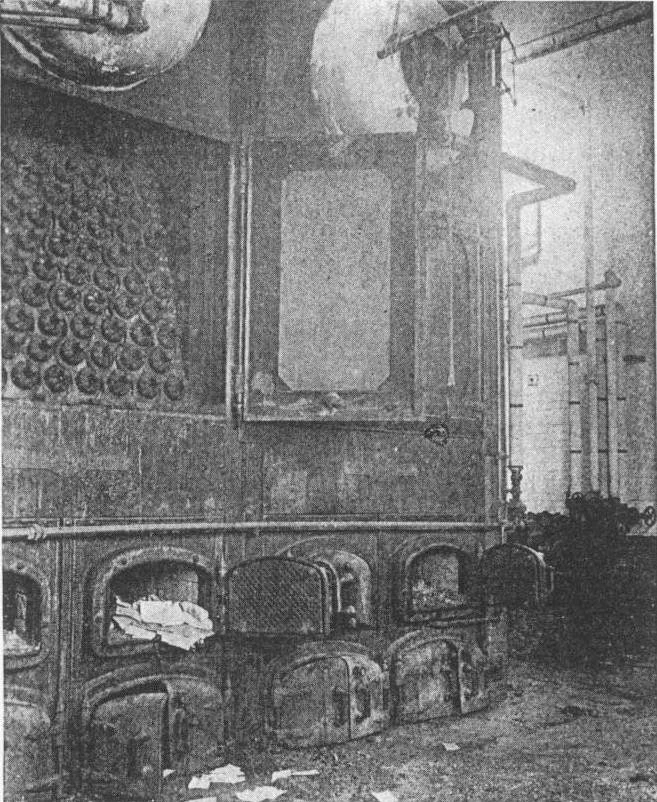
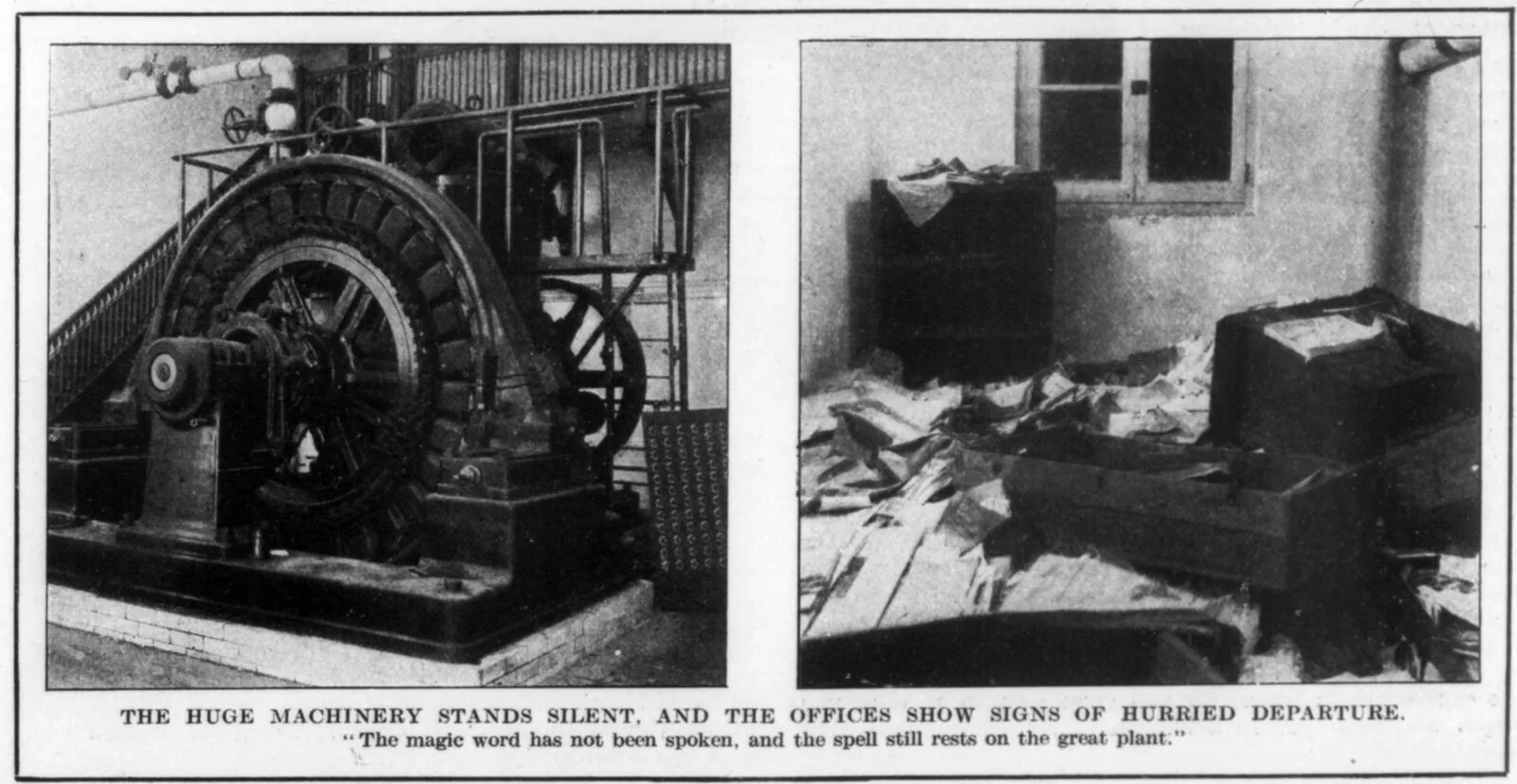
- A photograph of this site that is public domain in the United States and shows it AFTER 1929. NOT LOCATED — every figure above is from 1916, and that is a licence outcome rather than an editorial choice. The candidates fail for specific and instructive reasons. The National Register nomination is a federal publication, but its photographs are not public domain: its own photo log credits named staff of a private preservation firm, and contractor work is not a work of the United States Government under 17 U.S.C. §105. A public-domain container does not make its contents public domain. The nomination's Tesla-era interior figures are credited to the museum in Belgrade, whose uploads carry a CC BY-SA licence that is over this publication's bar; its one photograph of the laboratory under Peerless ownership is dated only "circa 1940s" with no publication stated. Every good modern photograph of the site on Wikimedia Commons — including the whole post-fire set — is CC BY-SA. The site has never been documented by the Historic American Buildings Survey, so there is no federal photographic record of it at all. What clears the bar is the 1916 magazine story, three times over, because American publication before 1929 ends the question without any renewal search. One caveat kept rather than smoothed: the boiler-room photograph in Fig. 2 is attributed to Export American Industries by the nomination, and that magazine is not digitised anywhere reachable — but the Literary Digest story that carries Figs. 1 and 3 names Export American-Industries for March as its own source, which corroborates the attribution without confirming the page.
- A financial statement for the Tesla Science Center in its 2024 annual report. NOT PRESENT. Sixteen pages carry one dollar figure. Revenue, expenditure and net assets appear nowhere, so the campaign figures quoted above are the organisation's own promotional statements rather than audited numbers, and are described that way. The audited numbers are in the Form 990 returns instead, and finding them requires knowing something the organisation does not advertise: there is no corporation called "Tesla Science Center." The filer is Friends of Science East, Inc., EIN 11-3327144. Several federal award databases return zero rows for the trade name and several for the legal one, so a search under "Tesla Science Center" alone produces a false negative.
- “The site's first purpose-built visitor facility.” FALSE, and this publication printed it. Both the Wardenclyffe article and the hub page on this site described the Eugene Sayan Visitor Center that way until 16 November 2026. The organisation's own construction announcement of 21 May 2025 describes the project as "the adaptive reuse of the 1920s Bauer House" — a building already standing on the parcel, and one of the nine resources the National Register counted as non-contributing. Both pages have been corrected rather than quietly amended, and the error is recorded here because it came from assuming that a new facility meant a new building.
- A single reliable figure for the response to the fire. THERE ISN'T ONE, and the drift is inside the owner's own statements. 22 November 2023: "over 100 firefighters from eleven departments." 28 November 2023: "more than 100 firefighters, from seventeen local fire departments and ambulance corps." A reporter at the second of those events published "more than 200 firefighters." Seventeen is what the organisation's live page says today. The spread is reported above rather than resolved, because nothing located settles it. The one figure carrying an agency attribution is the 4:49 p.m. alarm, from Suffolk County police.
- A date trap, logged because this article cites the outlet that fell into it. Three 2026 reports in the Times Review papers date the fire to 15 November 2023 — two in the Riverhead News-Review, of 20 January and 23 April 2026, and one in the Suffolk Times of 21 January. They are by the same reporter whose July 2026 dedication story is cited above; that story gets it right, giving only "the November 2023 fire." The fire was on 21 November 2023, which is confirmed by Suffolk County police the same evening, by the organisation's own press release of 28 November 2023, and by its website today. 15 November was the day before the centre's annual gala. The dedication reporting is sound; the fire date in those same papers is not, and should not be copied.
- The 2013 purchase price. THE CIRCULATING FIGURE IS THE ASKING PRICE, and this publication printed it. $1.6 million appears everywhere, including on this site's own Wardenclyffe article until 16 November 2026. It is what the property was listed at — the Indiegogo campaign page said so while the campaign was running: "The property is listed at $1.6 million, and this non-profit has received a matching grant from New York State of up to $850k." Two contemporary reports give the price paid as $850,000, independently of each other: Long Island Business News on 2 May 2013, the day of the closing — "purchased from Belgian photo giant AGFA Gevaert for $850,000" — and the Riverhead News-Review on 8 May, quoting the organisation's president, which adds that the state reimbursement grant "will cover the full cost of the purchase, allowing the remaining funds to go toward clearing the property." A third outlet, the Long Island Press on 3 May, reported that Agfa's counsel "declined to say what the final sale price was." Limits, stated: no deed or county instrument was consulted, so this rests on newspaper reporting rather than the record of title; and $850,000 was also the Indiegogo goal and the state match, so a conflation is conceivable. What makes it more than conceivable is the buyer's own tax return for 2013, which carries land and buildings at a basis of $882,004 — consistent with an $850,000 purchase plus costs, and not with $1.6 million.
- Newsday's coverage of this site. GATED, and deliberately not circumvented. Several of the organisation's own citations point at Newsday reports — a 2016 physics-society designation, a vandalism incident of September 2020, and the visitor projections attributed to the former executive director — and all sit behind a subscriber paywall. A paywall blocks a human reader exactly as much as anything else, so it was left alone. The consequence is smaller than it first looked: the figure of 180,000 visitors a year that circulates for this project turns out not to need Newsday at all — it is in the non-paywalled TBR News Media interview of April 2025 cited above, where it is attributed to the organisation's board members rather than to any one officer. What remains genuinely gated is the reporting of the November 2025 lawsuit.
- A quotation for the checker. NONE, and none added. This article adjudicates no statement attributed to Nikola Tesla — the quotations in it are a preservation architect's, a chief executive's, a federal nomination form's and a non-profit's own web copy — so the quote checker is unchanged by it.
Primary documents
- Wardenclyffe Laboratory, National Register of Historic Places Registration Form, reference number 100002744, Suffolk County, New York; prepared by Mark Thaler, Justin Hoin and Aaron Wilson, Lacey Thaler Reilly Wilson Architecture & Preservation, LLC; received by the National Register 19 June 2018. Resource counts and classification at section 5; the tower foundations and the "capped and monitored" sentence at section 7, resource 2 — which this article corrects; the Peerless and Agfa chronology at section 8, "Later History of the Wardenclyffe Site"; the photograph log at section 10. The full nomination.
- United States Environmental Protection Agency, "Hazardous Waste Cleanup: AGFA Corporation – Peerless Photo Products in Shoreham, New York," EPA I.D. NYD002044139 — the federal record cited by the nomination for the recharge basins and for the cessation of manufacturing in 1987.
- Building-Structure Inventory Forms for the laboratory (USN 103-02-0414) and for the tower foundation (USN 103-02-0415), prepared 25 June 1976 and received by the state historic preservation office on 22 July 1976 — the earliest documentation of either resource, the source of the "120 feet" as it entered the official file, and the form that records the chimney ornament: "A cast iron ornament adorns the top of the brick tower of the building. Called a wellhead, it was designed by Stanford White, and inspired by a similar detail from mid-Italy."
- William K. Hutchinson and John J. Balog, "The Subsurface Mysteries of Wardenclyffe Revealed," IA: The Journal of the Society for Industrial Archeology, vol. 42 no. 1 (2016), pages 55–67 — the only credentialed geophysical survey of the site, its own disclosure that it was commissioned for a television programme and that "some of the data generated may be spurious," and its note that the single earlier ground-penetrating-radar attempt, around 2010, "imaged to a depth of less than 2 m."
- New York State Office of Parks, Recreation and Historic Preservation, Cultural Resource Information System — the two resource records for the property, USN 10302.000414 ("Wardenclyffe Laboratory") and USN 10302.000415 ("Foundation of Tesla's Tower"), both classified as buildings; the resource evaluation of 5 July 2016, which leaves Criterion D unchecked; the four project reviews touching the site, of which the 2005 remediation review records an archaeology decision of "No Response Needed"; and the spatial record showing no archaeological survey, sensitivity buffer or recorded site on any of the three parcels.
- New York State Department of Environmental Conservation, Record of Decision for inactive hazardous waste disposal site 152031, "Peerless Photo Products," Shoreham, 2004 — the Class 2 listing of 1983; the borings SB-6A, SB-6B and SB-6F through the tower base in 1996 and 1999; the selected remedy for area APC-10, "Tesla Tower Base" ("a 20 ft diameter area, centered on the location of boring SB-6F, to a depth of approximately 30 ft … in situ stabilization of soils from 30 feet to 100 feet below grade surface"); the rejected $8,442,000 alternative that would have demolished the foundation; the response "No signs of a tunnel system were detected" alongside the technical description of "debris and void space at various depths."
- New York State Department of Environmental Conservation, Remedial Action Report for the same site, covering the works of 2005–2007 — the volumes excavated and stabilised at APC-10, and the concrete fragments encountered. Remedial action complete 22 September 2008; environmental easement recorded 19 March 2009.
- Groundwater Technologies, "Chronology of Site Development," 13 January 1993 — the consulting engineers' site chronology, cited in the nomination for the development sequence.
- Oral-history interview with Nancy Bauer Night, granddaughter of Robert Bauer, conducted by Jane Alcorn in 2015 — the nomination's sole cited authority for the suggestion that the shaft was used for wastewater disposal, and the reason that suggestion is reported here as weak.
- Tesla Science Center at Wardenclyffe, "Fire at Wardenclyffe," including the frequently-asked-questions panels on the circumstances of the fire and on health and safety. The page, read 16 November 2026.
- "Tesla's Million-Dollar Mystery," The Literary Digest, vol. 52 no. 18, 29 April 1916, pages 1213–14 — the source of Figs. 1 and 3, reprinting photographs it credits to Export American-Industries of New York for March 1916, and describing the laboratory standing open and abandoned with "chairs, desks, and papers in businesslike array". The issue.
- Lisa Finn, Patch (Riverhead), 28 November 2023 — the centre's press event six days after the fire: the historical architect's "Nikola Tesla's original building was pretty much fireproof," the "more than 200 firefighters" figure, and the 2:30 a.m. and 7:30 a.m. rekindles. Two other outlets at the same event render the architect's remark as "fireproof for the most part."
- Ars Technica, 29 November 2023 — the exclusion of arson, attributed there to Rocky Point fire chief Sean McCarrick rather than to the fire marshal.
- WSHU, 30 November 2023 — the fire out by about midnight and rekindled twice "by unseen embers," and a fourth combination of the response figures ("over 200 firefighters from around 11 departments").
- Lisa Finn, "Fire Rips Through Tesla Science Center On LI," Patch (Riverhead), 21 November 2023, 7:11 p.m. — Suffolk County police giving the alarm as 4:49 p.m., which is the only time in the record attributed to a public-safety agency. The report.
- Tesla Science Center at Wardenclyffe, letter of 22 November 2023 ("over 100 firefighters from eleven departments") and press release via PR Newswire, 28 November 2023 ("more than 100 firefighters, from seventeen local fire departments and ambulance corps") — the two statements, six days apart, that the circulating response figures come from.
- "Fire at Tesla's Lab: Immediate Restoration Needed," the Mission Rebuild campaign on Indiegogo — final result $69,171 from 467 backers against a stated $3,000,000 goal, read from the campaign page on 16 November 2026. The campaign. The "100.00% of the $69,171 goal" line on the closed page is the platform restating the sum raised as the target, not a result.
- Archived captures of the Tesla Science Center's "Fire at Wardenclyffe" page in the Internet Archive — the answer reading "the use of flammable cutting equipment by the demolition contractor could not be ruled out" on 19 March 2025, and "evidence points to demolition contractor error" by 15 April 2025.
- Tesla Science Center at Wardenclyffe, "Update on Fire at Wardenclyffe," 13 December 2023 — the pending cause report, the exclusion of arson, and the certificate-of-occupancy problem with the insurance. The announcement.
- Tesla Science Center at Wardenclyffe, press release of 28 January 2025, "Tesla Science Center awarded $500,000 grant from New York State Parks" — the section headed "Update on the Fire Investigation and Insurance Dispute," the blowtorch-spark attribution, the short insurance payout, the removal of the contractor and the appeal against the denial of liability, and "$14 million has been raised" against a $24 million cost. The release; it was republished by TBR News Media on 15 February and covered by the Riverhead News-Review on 7 February, and the later dates are often quoted as the original.
- Sabrina Artusa, TBR News Media, 11 April 2025 — the former executive director on the brownfield, on "the most complicated museum project in the country right now," on the previous contractor who "fell through and denied the insurance claim after the fire," and on the board's projection of 180,000 visitors a year.
- Tesla Science Center at Wardenclyffe, "TSCW Set to Begin Construction on Visitor Center at Historic Wardenclyffe Site This Summer," 21 May 2025 under a dateline of 16 May — "the adaptive reuse of the 1920s Bauer House," the six-to-eight-month build, the "open to the public early in 2026" target, and the Suffolk County and Empire State Development funding. The announcement.
- Internal Revenue Service Form 990 returns of Friends of Science East, Inc., EIN 11-3327144, fourteen fiscal periods from 31 December 2012 to 30 June 2025, read through ProPublica's Nonprofit Explorer — the net-asset peak of $4,830,284, the three consecutive deficits, and the 60.5 per cent fall in contributions. The filings.
- Tesla Science Center at Wardenclyffe, "Breaks Ground on Eugene Sayan Visitor Center," 5 September 2025 — the 2,200 square feet, the funders, and the "early summer 2026" opening target. The announcement.
- Tesla Science Center at Wardenclyffe, "Awarded Grant from The Robert David Lion Gardiner Foundation," 15 September 2026 — "soon-to-open … planned for late 2026," and the executive director on the first building to open on the site. The announcement.
- Tesla Science Center at Wardenclyffe, Annual Report 2024, published 23 May 2025 — "set to open in 2025," the $500,000 Environmental Protection Fund grant, and the absence of any financial statement. The report.
- Tesla Science Center at Wardenclyffe, "TSCW Receives $500,000 Save America's Treasures Grant," dated 11 October 2022 over a release of 9 September 2022 — the National Park Service grant, and "$11 million of the $20 million." The announcement.
- Tesla Science Center at Wardenclyffe, capital campaign page ($24,000,000 goal, $14,500,000 raised, fire damage and inflation) and renovations page ($20 million project, approximately $10.2 million raised, the February 2020 chimney and cupola work funded by the Robert David Lion Gardiner Foundation and the Musk Foundation). Both live on 16 November 2026.
- Tesla Science Center at Wardenclyffe, "Tours of Wardenclyffe" — the 2026 season of 20 March to 15 November, the times, the $35 ticket, the limit of eight, and the exterior-only scope. The page, read 16 November 2026.
- Brendan Carpenter, "Tesla Science Center to dedicate new visitor center after Wardenclyffe fire," Riverhead News-Review, 8 July 2026 — the dedication of 11 July, the "preview center" description, and the funders. The report.
- Paul Squire, "Former Tesla lab finally purchased after fundraiser nets $1.4 million," Riverhead News-Review, 8 May 2013 — the completed sale, "which sold the 16-acre property for $850,000," and the state reimbursement grant covering "the full cost of the purchase."
- "Let's Build a Goddamn Tesla Museum," the Indiegogo campaign of 15 August – 29 September 2012 — the $850,000 flexible goal, the final total of about $1.37 million from more than 33,000 funders, and the page's own statement that "the property is listed at $1.6 million." Read from Internet Archive captures of the campaign while it was running.
- Library of Congress, Chronicling America newspaper collection — the counts for "Wardenclyffe" by decade and the 1917 reports in The Sun (New York) of 19 July and 5 August. The collection.
Further reading
- What the tower at Shoreham was for — the patents, the Morgan agreement, the 120-foot shaft as Tesla built it, and the coal-fired plant.
- Wireless power, and why "free energy" is not what he was selling — why the earth-conduction premise that required the shaft does not scale.
- Is the car company named after Nikola Tesla? — the 2014 pledge, and the charging station at Shoreham that was never built.
- Wardenclyffe — the hub page, and everything published here about the site.
The record on this article
- Misleading “Wardenclyffe is Nikola Tesla's laboratory.” Two of the eleven resources the National Register counted on the sixteen acres are his: the laboratory building and the tower foundation. The other nine are a photographic factory and its fittings. The one contributing building is not the 1901 laboratory on its own either — the nomination counts the 1939–1984 additions as part of it, "due to their interconnections and complexity."
- Unverifiable “The 2023 fire was caused by X.” The official cause remains undetermined three years on, and no investigating authority's determination has been published. Arson was excluded by December 2023. The building's owner states that "evidence points to demolition contractor error," and in February 2025 attributed a mechanism — "sparks from contractors using blowtorches" — to its own executive director rather than to an investigator. The contractor was removed and its insurer denied liability; the organisation was appealing. That is a dispute, not a finding.
- False “The visitor centre at Wardenclyffe opened in July 2026.” The Eugene Sayan Visitor Center was dedicated on 11 July 2026, which is not the same thing. On 15 September 2026 the organisation still described it as "soon-to-open … planned for late 2026," and on 16 November 2026 its home page read "The full site is still in development." The published opening target has moved from 2025 to early summer 2026 to late 2026.
- False “The Tesla Science Center bought Wardenclyffe for $1.6 million.” $1.6 million is what the property was listed at, and the Indiegogo campaign page said so while the campaign was running. The contemporary report of the completed sale, quoting the organisation's president, gives the price paid as $850,000 — the amount of the New York State reimbursement grant it already held, which covered the purchase and left the crowdfunded money for clearing the site. No deed was consulted, so this rests on that report rather than on the record of title.
- True “The site is contaminated.” Peerless Photo Products discharged untreated process water containing cadmium, silver and lead into recharge basins 800 feet by 25 feet; Agfa began remediation in 1993 under the New York State Department of Environmental Conservation; and the worst readings on the whole property — silver at 11,000 ppm against a 137 ppm objective — came from a boring in the dead centre of the tower foundation. The ground beneath it was excavated and then injected with cement grout from roughly twenty-five to a hundred feet down. It is a State Superfund site, number 152031, listed Class 2 in 1983.
- True “The laboratory survived the fire.” The 1901 structure held and its brick bearing walls remain almost completely intact. What burned was the roof — original to 1901 — together with a chimney and cupola that had been replaced in 2019. The fire began not in Tesla's building: the owner reports the investigators placing its origin in "the Northwest area next to the original laboratory building," among the condemned twentieth-century structures.