1943 onward · The record since
Is the car company named after Nikola Tesla?
Yes — and the decision belongs to one man, in 2003, for one engineering reason. Nearly everything else people believe about the link is wrong, in both directions. Including the belief that the inventor never worked on cars. He did, and it shipped.
The claim
CLAIM — “Tesla the car company is connected to Nikola Tesla. Elon Musk founded it and named it after the inventor, who had already built an electric car himself.”
STATUS — MIXED, and wrong in both directions. The name is a genuine and openly stated homage, but it was chosen in 2003 by a man who is no longer at the company and is rarely named in its story. Nothing of the inventor's — no patent, no estate, no heir, no permission — reached it; he had been dead for sixty years and had left no will. And the premise that he never touched the motor car is itself false.
EARLIEST TRACE — The corporate record begins on 1 July 2003, when a certificate of incorporation was filed with the Secretary of State of Delaware under the name Tesla Motors, Inc. Elon Musk's own documented relationship with that corporation begins about nine months later, as chairman of its board, in April 2004.
RESTS ON — For the name: a deliberate engineering tribute, stated by the man who chose it and published on the company's own website from 2006. For the rest: a 1994 trademark owned by somebody else entirely, a 1946 Czechoslovak state enterprise with a prior claim to the word, and an inventor whose real automotive work was a speedometer.
Begin with the part that is simple. Nikola Tesla died in room 3327 of the Hotel New Yorker on 7 January 1943. The company was incorporated in Delaware on 1 July 2003, sixty years and nearly six months later. There is no shared person, no inheritance and no licence between them, and the company has never claimed one. What there is, is a name chosen on purpose — and once you follow the paperwork, the interesting thing is how little of the popular story survives it.
Who named it, and why
The company's own answer was published for four years and then quietly taken down. A page at teslamotors.com/learn_more/why_tesla.php, headed “Why the Name ‘Tesla’?”, was live from 22 July 2006 to 26 May 2010, and read:
The namesake of our company is the genius Nikola Tesla, an inventor, electrical engineer, and scientist. Among his life's many inventions (and over 700 patents) are the induction motor and alternating-current power transmission. Without Tesla's vision and brilliance, our car wouldn't be possible…
Tesla Motors, Inc., “Why the Name ‘Tesla’?”, archived 22 July 2006. The page as it stood. The parenthesis is wrong, and wrong in the ordinary way — the United States grants number 112, and no route through the foreign filings reaches 700.
The decision itself was Martin Eberhard's, and he has stated the reason consistently for twenty years. He and Marc Tarpenning incorporated the company; teslamotors.com was registered on 3 April 2003, three months before the Delaware filing. On 18 October 2006, writing on the company's own blog as its chief executive, Eberhard set out the lineage in one paragraph and then landed it:
Rewind all the way to 1888: Nikola Tesla invented the polyphase AC induction motor… Here's the cool thing: if you handed one of our motors to Nikola Tesla, he'd recognize it immediately as his own invention. Nice job of optimization, but clearly his. That's why we're Tesla Motors.
Martin Eberhard, “Motor City”, Tesla Motors blog, 18 October 2006. The post lists six patent numbers, beginning with US 381,968. The post.
Musk's account agrees on the substance and is the earliest recorded version in his own voice — and the framing runs opposite to the way it is usually told. In a filmed oral history of 26 June 2008 he was not asked about the name at all. He was asked whether he had studied Edison's life, and volunteered it: “the reason it's called Tesla is because we use an AC induction motor, which is an architecture that Tesla developed. And the guy probably deserves a little more play than he gets in current society.” The much-quoted Edison line is the next sentence of that same answer — so it is the prompted half, not the unprompted one — and it continues, where it is usually cut: “on balance, I'm a bigger fan of Edison than Tesla, because Edison brought his stuff to market.” A decade later he said in public that “we didn't actually come up with the Tesla Motors name,” though that sentence is doing less work than it appears to: it is the opening of a post about buying a trademark, it does not mention Eberhard, and twenty-two minutes later he posted that “we wanted to name our company after Tesla.”
The name was not theirs to take, and that is documented too.
The word had already been a registered American trademark for cars, owned by somebody else, for most of the preceding decade. Bradley D. Siewert, an individual in California, registered TESLA in international class 12 on an application filed 11 July 1994 — the goods, in that filing's own slightly mangled wording, “automobiles, automobiles engines, suspension systems for vehicles, and automobiles structural parts, namely bodies, fenders and frames.” It issued on 2 January 1996 and was cancelled on 5 October 2002 when the declaration of continued use was not filed. He had already refiled, on 30 August 2002, five weeks before the cancellation caught up with the older mark, and that second application took registration 2,755,676 on 26 August 2003 — two months after the Delaware incorporation. Which produces a detail the usual telling misses entirely: on 1 July 2003, the day the company was formed, there was no live TESLA registration for motor cars at all. The gap between Siewert's two registrations is ten and a half months wide, and Tesla Motors was incorporated inside it.
The Patent and Trademark Office's file shows how it ended, and it is not what the story says. On 27 January 2005 a request for total surrender under section 7 was filed against that registration; it was cancelled on 3 May 2005. Two weeks after the surrender request, on 10 February 2005, Tesla Motors filed its own first applications — TESLA MOTORS and TESLA ROADSTER — nineteen months after incorporating. (A third case record carries that same filing date, which is where the figure of three applications comes from, but it is a divisional of the first, created by a request in December 2007 and inheriting its parent's date. Two marks were filed that day.) There is no recorded assignment of the Siewert mark to anyone. Money changed hands by Musk's own account — “bought trademark off Brad Siewert for $75k in late 2004” — but what the federal register records is a registrant giving his registration up, not transferring it.
Nor was Siewert unusual. Fifteen United States applications containing the word TESLA were filed before 2004, two of them his; and of the registrations that came out of the other thirteen, three are still live today, in hands with nothing to do with cars: Tesla Engineering Limited of the United Kingdom, registered 1990; Tesla Industries, Inc. of Delaware, registered 1996; and a Korean guitar-pickup maker's TESLA for amplifiers, filed in November 2002 and registered in 2005. The name was never reserved to the inventor, and the law has never treated it as his.
The company that got there fifty-seven years earlier
The best corrective to the idea that the car company has a special relationship with the inventor is that a far larger company took the same name in 1946, for what looks like the same reason, and nobody has ever thought it was his.
By a notice of the Czechoslovak Minister of Industry dated 7 March 1946 and effective 18 May, seventeen numbered transfers of assets were consolidated into a single state enterprise. Fifteen of the seventeen are whole firms; items 16 and 17 take only a single Prague plant and a shareholding. Among them are Philips and Telefunken-Praha, and the Czechoslovak property of firms seated in Berlin, including Siemens & Halske and Blaupunkt. The contemporary trade report counted sixteen rather than seventeen, and listed them — which is a useful reminder that the round number in a secondary account is usually somebody's edit of a longer schedule. The notice fixes the name as “Tesla, slaboproudé a radiotechnické závody, národní podnik”: Tesla, low-current and radio-engineering works, national enterprise. The short style TESLA, národní podnik, which is what the company is usually called and what this article called it in an earlier draft, is not the 1946 wording — it arrives in a notice of 7 January 1948. The enterprise was ceremonially constituted on 10 August 1946 at the Mikrofona works in Strašnice, with the deputy Yugoslav minister of industry Branko Zlatarič and the Macedonian industry minister Georgi Vasiljev present. The radio trade journal Radioamatér reported that the naming of the enterprise “after the brilliant Slavic engineer documents the effort towards rapprochement and cooperation among all Slavic nations” — translated here from the Czech, where the word is technik, which in 1946 usage means an engineer or technical man rather than the narrower English “technician”. Note what that sentence does and does not do: it points unmistakably at a person, in a room containing the Yugoslav industry minister's deputy and his Macedonian counterpart, but it does not print the words Nikola Tesla — not, at any rate, in the only text of that page available to this article, which is a transcription made in 2001 from an issue that has never been digitised. Its Czechoslovak trademark was filed and registered on 26 October 1946. It is still valid: it was renewed on 22 October 2026, and now runs to 2036.
There is a wrinkle worth recording because it is a perfect miniature of how attribution decays. Czech sources commonly say the name is an acronym of TEchnika SLAboproudá, “low-current technology,” and usually date that reading to a director's circular around 1960. It is older than that: a Czech linguist stated it flatly as the word's etymology, with no mention of any person, in the journal Naše řeč in 1949 — three years after the founding, and one year after the Tito–Stalin split. The founding instrument contains no acronym, and the 1946 report of the ceremony points unmistakably at a man without ever naming him. The backronym is genuinely attested, and it is still a retrofit. One caution about the symmetry of that argument: the acronym story and the 1946 ceremony report reach us from the same page by the same author — Martin Hájek's 2001 compilation at oldradio.cz. This article treats the circular sceptically and the 1946 quotation as evidence, which is defensible only because the second is presented there as a transcription of a dated journal and the first as recollection. It is worth knowing that both rest on one enthusiast's page.
That older company then collided with the newer one. Tesla Motors' 2010 prospectus carries it as a risk to the business: “Two of our trademark applications in the European Union remain subject to four outstanding opposition proceedings… brought by two prior owners of trademarks consisting of the word Tesla.” By the following year it was three applications and six oppositions. The Czech holder's oppositions — three of them — were withdrawn in November 2010 within six days of each other, and the register's own event log gives the reason as withdrawn due to limitation: Tesla Motors had restricted the goods its European applications covered. The class 7 specification still ends “all the aforesaid goods being components for use in automotive powertrains and/or electric vehicles.” Tesla Holding's general director, Robert Němec, confirmed the settlement to MarketWatch, and the Czech motoring press carried it from there: the American company had amended its application “to reflect the different business focus of our companies.” Not one of those three applications has ever registered. They remain pending to this day, held up now by oppositions from an unrelated Bulgarian owner of a still earlier Tesla mark, and under appeal as recently as December 2025.
What the inventor actually left, and to whom.
Tesla died intestate. The New York Times of 22 January 1943 reported the filing in the New York County Surrogate's Court the previous day: he “left no will and no estate except research data and models,” letters of administration went to his nephew Sava N. Kosanović, the petition listed the estate as of “value unknown,” and it named six nephews and nieces as heirs, all living in Yugoslavia except one in Toledo, Ohio. The effects were impounded by the Office of Alien Property and in due course released to Kosanović, and eventually shipped: they reached the port of Rijeka aboard the Srbija in September 1951. The Nikola Tesla Museum was established by a resolution of 5 December 1952 and opened to the public on 20 October 1955. What it holds is paper. The museum's own history page claims over 160,000 original documents — documents rather than pages, a distinction that tends to get lost as the figure is repeated — and the archive is inscribed on the UNESCO Memory of the World register.
So the estate is an archive, owned by a state, and nobody holds rights in the name. The nearest thing on record to a family claim is a letter of 12 May 2014 to Elon Musk from William H. Terbo, Angelina Tesla's grandson, written on Tesla Memorial Society letterhead — and it asserts kinship in order to give the name away. He opens “Frankly put, I am the closest living relative of Nikola Tesla,” and “as his grandnephew I carry the very same blood as the inventor from whom your motor company takes its name.” Then: “I have no problem with seeing the Tesla name on an automobile of outstanding quality and ingenuity as proven by your Company.” What he asks for is not a royalty. It is a museum.
Letter to Elon Musk on Tesla Memorial Society, Inc. letterhead, Scotch Plains, New Jersey, 12 May 2014, published in facsimile by the cartoonist Matthew Inman at the end of his Model S review and read here from that scan.
The speedometer, which is the part nobody tells you
The premise underneath the whole question — that Nikola Tesla and the motor car were strangers until a company borrowed his name — is simply false, and the evidence has been sitting in the automobile trade press for a century.
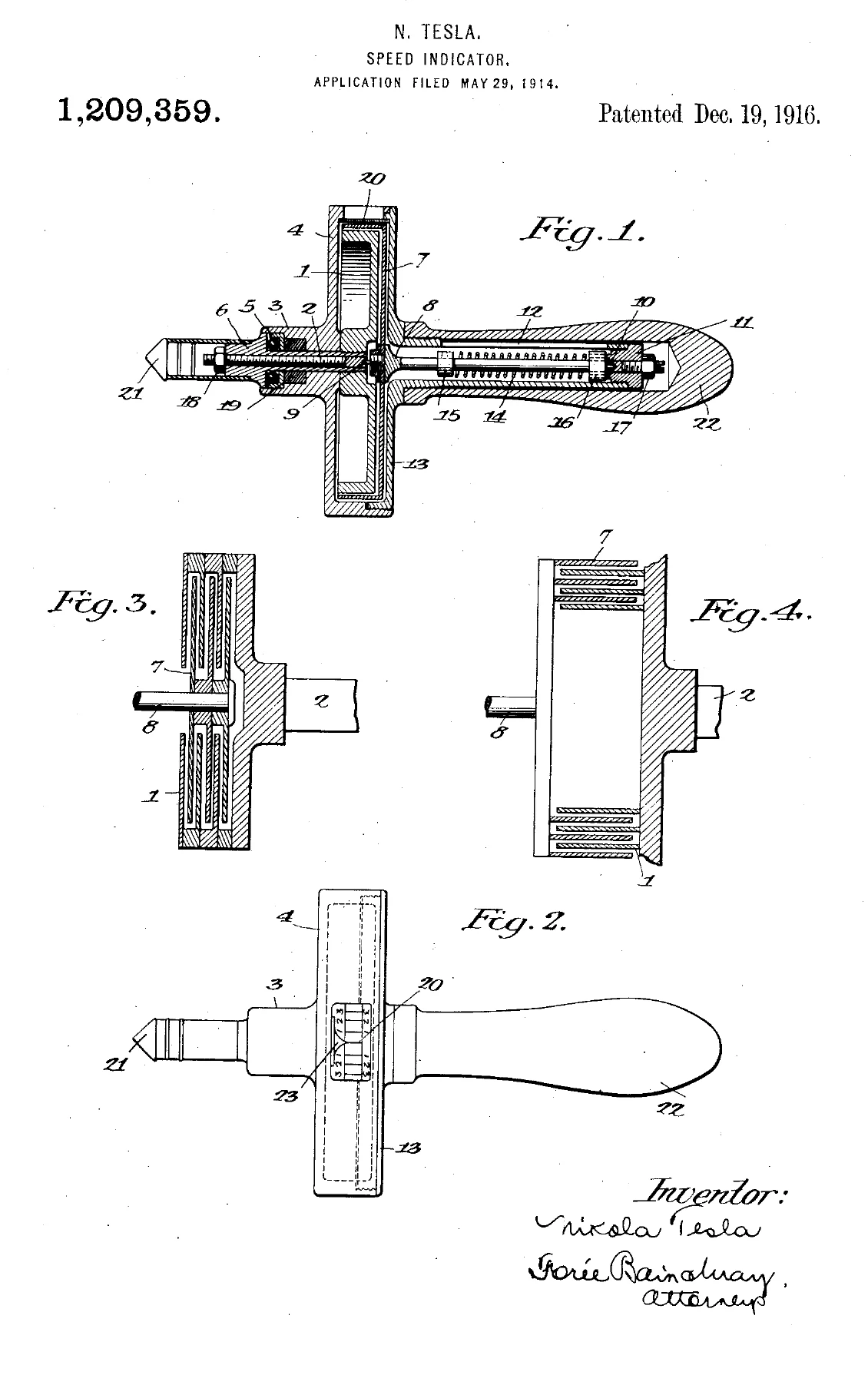
Between 1914 and 1916 Tesla filed five applications that all carry the same line across the top of the specification: “NIKOLA TESLA, OF NEW YORK, N. Y., ASSIGNOR TO WALTHAM WATCH COMPANY, OF WALTHAM, MASSACHUSETTS, A CORPORATION OF MASSACHUSETTS.” Four of them — a ship's log, a flow meter, a frequency meter and a second speed indicator — were filed on a single day, 18 December 1916, under consecutive serial numbers. The first and most important, US 1,209,359, Speed-Indicator, was filed on 29 May 1914 under Serial No. 841,726 and granted on 19 December 1916. Its own specification names the application:
When using the indicator in the manner of an ordinary vehicle speedometer, as in an automobile, the shaft 2 is rigidly or flexibly geared to the driving axle or other suitable part and readings are made in miles per hour, as is customary.
US 1,209,359, specification. The companion, US 1,274,816, is blunter still: “specific reference to a form of speed indicator designed for use on an automobile is adequate.” Across the rest of his patents there is no other mention of a car — the bladeless-turbine patents of 1913 do not contain the word.
The instrument works by air friction. Two sets of closely spaced discs run inside one another with a thin gap between them; the driven set drags the other round through the viscosity of the air alone, against a hairspring, so the deflection is proportional to speed with no gears, magnets or centrifugal weights to wear out. There is nothing electrical in it.
It was not a prototype. The Jewelers' Circular-Weekly reported from Boston on 18 March 1916 that Waltham had “perfected a superior kind of speedometer, which will shortly be placed upon the market,” that “contract has been made with the Packard Motor Co., and deliveries are expected to commence next month,” and — a sentence worth holding on to — that “the patents are owned by the concern.” Twelve days later Motor Age ran the engineering description and added: “Production already has begun, the first lot of 25,000 is going through the factory.” By 25 January 1917 the same magazine recorded that “the Packard Motor Car Co. has adopted and is using a Waltham speedometer for standard equipment on its 1917 cars.”
And now the part that belongs on this site.
Waltham sold Nikola Tesla's speedometer for five years before it told anybody whose it was. MEASURED: a sweep of 469 full-text issues of Motor Age across 1911–12 and 1915–21 finds his name fourteen times, and not once in connection with the speedometer before 1921. The 1916 product announcement describes his mechanism exactly — concentric cups, an air gap, a hairspring — and credits “patents controlled by the Waltham company.” Of the Jewelers' Circular-Weekly, 366 issues from 1915 to 1922 were searched, out of the 410 the archive holds for those years — a shortfall stated plainly here because the Motor Age figure above is 469 of 472 and the two ought to be read the same way — and he is named in none of them. That journal did not, though, cover the instrument heavily, which an earlier draft of this article claimed: across a 175-issue subsample Waltham appears in 151 issues and speedometer in only 21, twenty-four times in all. The firm is omnipresent in that trade press. The instrument is not. A search of the Library of Congress newspaper corpus for Waltham, speedometer and Tesla together across 1914–1920 returns zero. Two controls are what make that zero mean something. Drop his name and the same search over the same years returns several hundred pages, so the corpus is thick with Waltham speedometer copy. Put his name back and run it against 1921 alone, and it returns two — the same query, the same corpus, the same settings, with only the date window moved. His name enters that corpus exactly when the advertising campaign does, and not before.
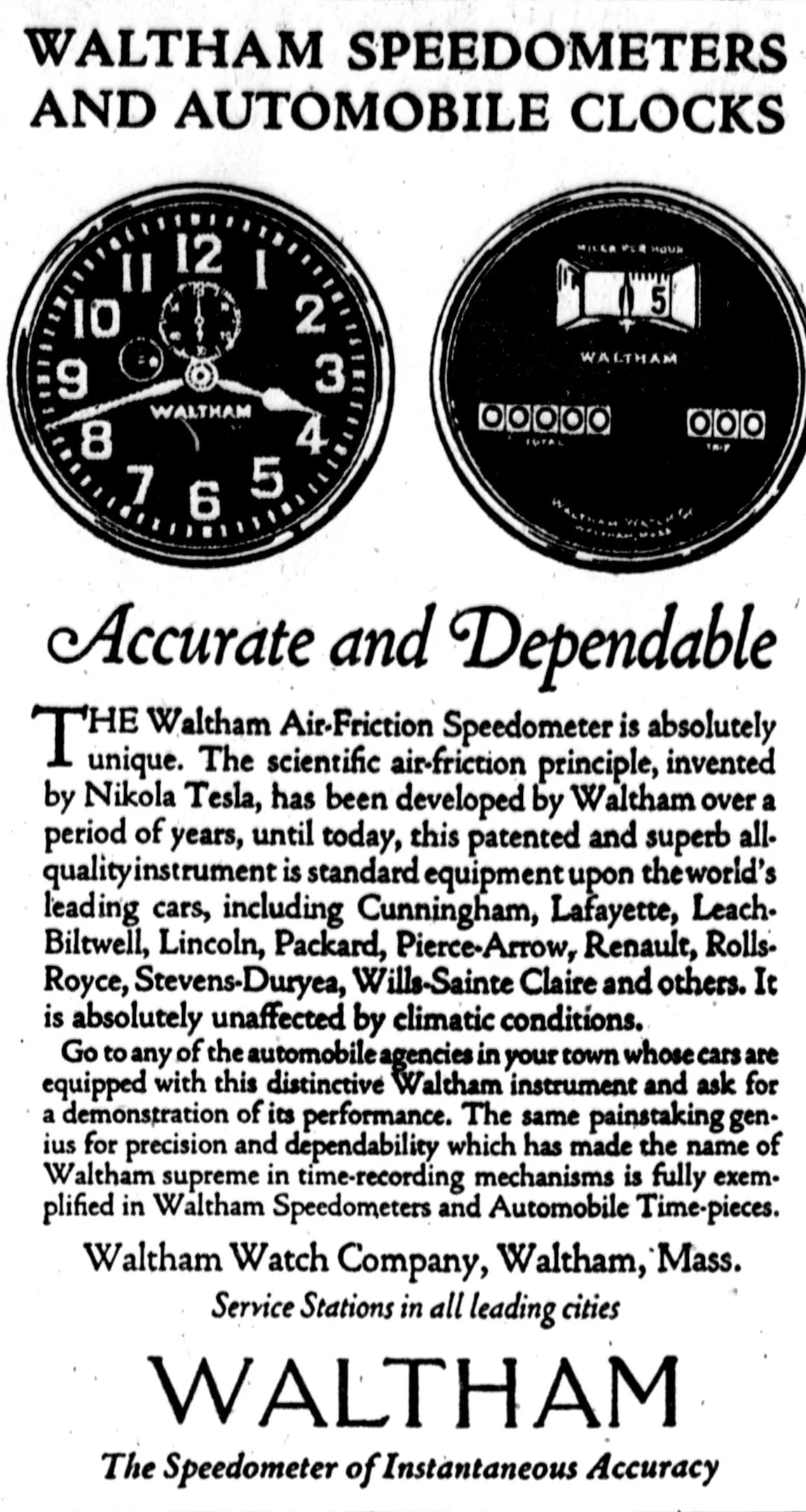
Then, in April 1921, the advertising changed — in the trade press first. The earliest credit located is an Automotive Industries advertisement of 21 April 1921 — “It was invented by the world famed Nikola Tesla, and improved and perfected by Waltham” — with a differently worded Motor Age advertisement a week behind it, on 28 April. Two different ad texts ran in the same month, which is worth knowing if you go looking: quote the one you actually read. His name reached a newspaper too, and Figure 1 is that advertisement; but it is worth being exact about how thin the newspaper trail is, because the temptation is to call it a national campaign. The Library of Congress corpus returns exactly one page carrying Waltham, speedometer and Tesla together across 1921 and 1922, and Figure 1 is that page. The dial, meanwhile, had got there first, by at least nine months: Waltham's own advertisement in Automobile Topics of 10 July 1920 illustrates the oval combination speedometer-and-clock, Model No. 1101, with TESLA PATENT DEC.19 1916 curved around the bottom edge of the dial face — and Tesla's name nowhere in the copy, only on the instrument. The round speedometer-only head is a different story: Waltham's advertisement in the Saturday Evening Post of 6 January 1917, three weeks after the patent issued, shows that dial carrying two lines and visibly blank face below them, and the earliest dated artefact showing a third line there is a dealer's catalogue of 19 December 1923. INFERRED, and labelled as such: by 1921 Tesla had become a name worth printing, and a company that had been content to own the patents found it was also useful to own the inventor. Nothing located here states Waltham's reason, and the firm's own files have not been consulted.
One complication, and it is the strongest objection to this section. Tesla was not the only man with a speedometer patent at Waltham. Stead A. Asquith filed US 1,093,166, Speedometer, on 5 December 1913 — nearly six months before Tesla's filing of 29 May 1914 — and held a second grant besides. A Waterloo, Iowa paper of 18 September 1916 reports him contracting manufacture with the Waltham Watch Company, and the Los Angeles Times of 26 November 1920 calls him “the inventor of the speedometer now used on the Packard car.” Waltham's own 1916 wording was plural and stayed plural: “patents controlled by the Waltham company.” So the instrument was built on a portfolio. Tesla's air-friction mechanism is described in the 1916 announcement and is unmistakably his, and his is the patent that went onto the dial — but Nikola Tesla's speedometer, unqualified, claims more than the record will carry. It was a Waltham speedometer using a Tesla patent, made by a firm that had bought several.
He also tried, hard, to sell the car industry something much bigger, and failed. His 1909 claim for the bladeless turbine is often quoted as a pitch to the car trade, and it is broader and vaguer than that: announcing an air-blast installation for a coal and iron company at the incorporation of the Tesla Propulsion Company, he said the new principle “is applicable to air, steam, gas or water power, and may be used for locomotives, automobiles or any form of power production.” Cars are one item in a list. In a Motor World interview syndicated in December 1911, though, he went as far as a man can go in print: “I am so sure that I would make a contract today to build gas turbines and equip automobiles with them.” The Automobile gave him two pages that November and checked his efficiency claim against a real engine. Motor Age, asked by a reader in the same week whether the Tesla motor would supplant existing types, answered: “It is impossible to prophesy as to the future of the Tesla motor, but it is improbable that it will supplant the above types.” It did not. The turbine patents, when they issued in 1913, do not mention a car.
A footnote on the one story everybody does know. The claim that Tesla ran a Pierce-Arrow on power drawn from the air in 1931 is worked through in full elsewhere on this site, where it comes out as unverifiable rather than false: the whole thing descends from one typescript summarising a 1967 interview, circulated in the 1980s. What is worth adding here is the irony. There is a documented Tesla–Pierce-Arrow connection, and it is in Figure 1 — Pierce-Arrow is on Waltham's own list of cars fitted with his speedometer.
What is actually inside the cars
The name rests on one claim: that the motor in the car is Tesla's motor. That claim was once close to true, has been weakening for a decade, and the company's own documents are the place to watch it go.
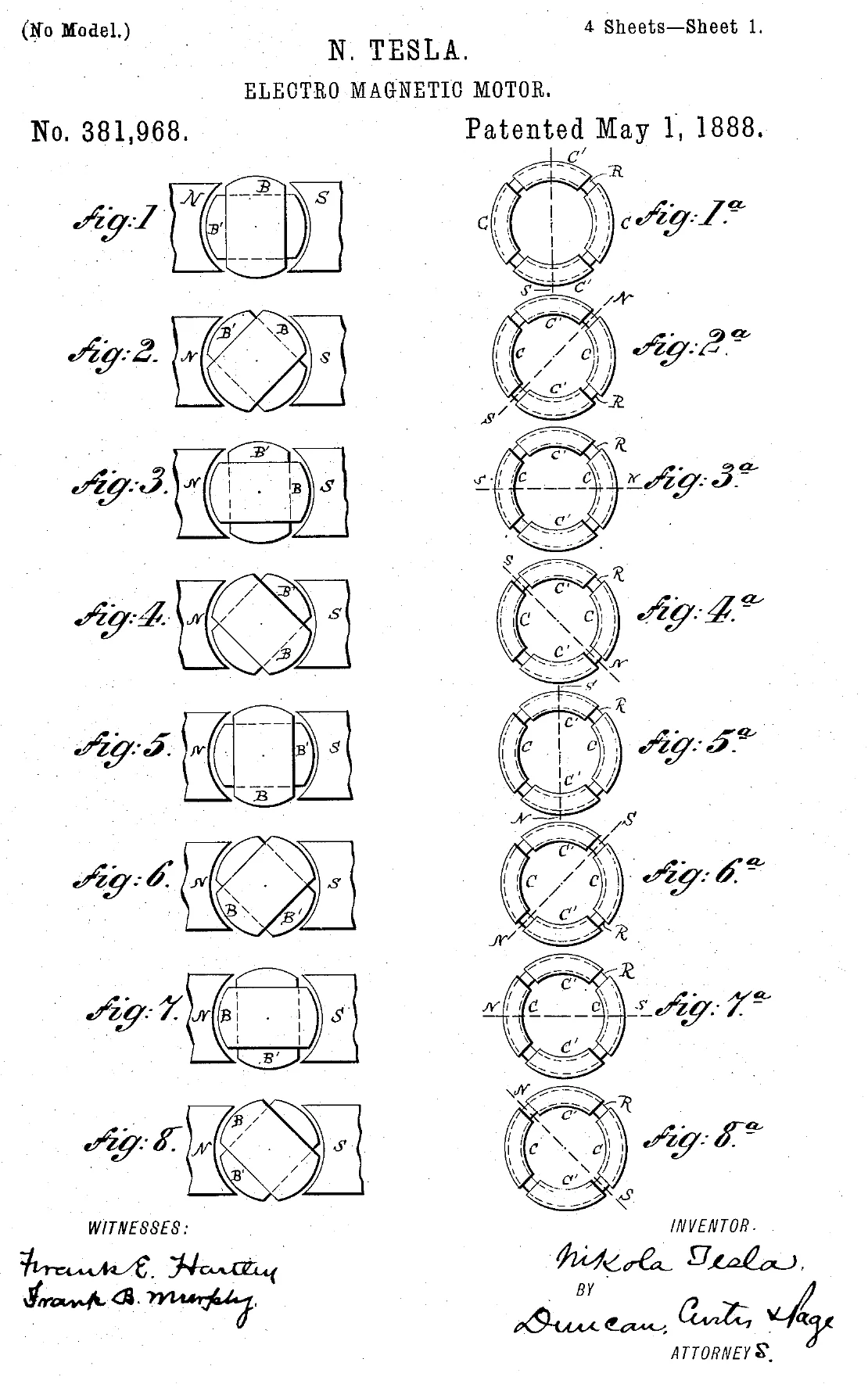
The 2008 Roadster used an air-cooled alternating-current induction motor at 375 volts, fed by a variable-frequency drive. Tesla Motors' own engineering page said so and said why: “The AC Induction motor was first patented by Nikola Tesla in 1888… Some motors use permanent magnets, but not the Roadster motor — the magnetic field is created completely from electricity.” The “four-pole” figure usually attached to that description is not on the production page; it comes from the earlier pre-production spec, which also lists a two-speed gearbox that never shipped. The Model S carried the same architecture, described on the company's own spec page as a “three phase, four pole AC induction motor with copper rotor” — a form of words present in captures from September 2012 to December 2014, and gone by February 2015. The Model X was never documented in those words at all; its manuals say only “AC induction motor, liquid-cooled, with variable frequency drive.”
Then it drifted. Taking the dates from the manuals' own cover pages rather than from when a crawler happened to archive them: the Model S manual 2018.48.12, dated 17 December 2018, still specifies one motor type, induction, on both axles; the manual 2019.16.1.1, dated 16 May 2019, specifies a permanent-magnet machine at the front and induction at the rear. From model year 2021, Model S and Model X contain no induction machine at all. The Model 3 and Model Y never had one at the rear: the earliest archived Model 3 manual, of 8 November 2019, reads “Rear motor: AC permanent magnet synchronous motor… Front motor: AC induction motor,” and the Model Y's first archived manual, of 17 March 2020, says the same. Two cautions, because the stronger version of that sentence is false and this article printed it in an earlier draft. Tesla removed the motor specification entirely from the Model 3 manual for the whole of 2020 — the 2020.20 manual runs to 259 pages and contains neither induction nor permanent magnet anywhere — so there is no unbroken run of manuals saying this. And the qualifier “(AWD vehicles)” that later editions attach to the front motor is absent from the 2019 and 2020 texts; it appears from 2021. What changed, precisely: a permanent-magnet synchronous machine still runs on a polyphase rotating field, and that field is Tesla's contribution. What it does not do is induce the rotor's own currents and then run behind the field it is chasing — and that slip, rather than the rotating field, is the thing in an induction motor that is distinctively his.
This is not a decline story and should not be written as one. Induction is still shipping: the Cybertruck's top trim carries two induction motors at the rear and a permanent-magnet machine at the front, and the company was still being granted patents concerned with induction motors as recently as this year. That last point needs narrowing to survive contact with the document, though: there is exactly one such grant among the company's fifty-five of 2026 — US 12,602,525, Enhanced techniques for analyzing induction motors, granted 14 April — and it is a finite-element simulation method rather than a motor, resting on a provisional application of November 2019. But the honest statement of the engineering inheritance is narrower than the name implies, and it runs like this. From Tesla's patents: the rotating field made by polyphase currents, the absence of a commutator, and — from US 382,279 rather than the famous one — a rotor carrying currents induced in it, slipping behind the field and pulling harder as it slips. Not from his patents: the squirrel-cage rotor of bars in slots joined by end rings, which is Deutsches Reichspatent 51083, filed for the Allgemeine Elektricitäts-Gesellschaft from 8 March 1889 and issued 19 April 1890, the work of Mikhail Dolivo-Dobrovolsky; the variable-frequency inverter without which the whole thing is useless in a car, which is Herbert Stemmler's at Brown Boveri, Swiss priority 24 April 1964; and field-oriented control, the mathematics that makes the torque obey the pedal, which is Karl Hasse's Darmstadt dissertation of July 1969 and Felix Blaschke's Siemens filing of August 1969. Tesla's patent gives you a field that turns. Three generations of other people made it drive a car.
MEASURED: across eight of the company's motor patents, the references cited reach back no further than 1966, and not one cites a Nikola Tesla patent. INFERRED, and the inference is weak enough that it is worth disowning: it is tempting to present this as the company's own examiners agreeing with the paragraph above, and it is not good evidence for it. Examiners cite the art they need in order to reject a claim, and expired nineteenth-century patents are rarely useful for that. The count is real; the gloss is not worth much.
The silence in the filings.
Here is the measurement that surprised this article most. A full-text search of every document Tesla, Inc. has filed with the Securities and Exchange Commission — more than twenty years of registration statements, annual reports, proxies, charters and bylaws — returns zero occurrences of the phrase “Nikola Tesla.” The control matters: the same search unrestricted returns 756 filings across the Commission's corpus, so the index and the filter both work. The 2010 prospectus that took the company public does not contain the word “Nikola” anywhere in its 2.36 megabytes. The Delaware charter does not. The Texas charter the company adopted on 13 June 2024, when it converted out of Delaware, does not either.
The attribution has lived in marketing and in what individuals have said, never in the documents that bind the corporation — and even in marketing it has flickered. The “Why the Name” page went down around 2010 and the company's About page carried no mention of him at all through captures of 2011, 2012, 2013, 2014 and the first week of January 2015. The sentence crediting “the inventor who inspired the company's name” is absent from the capture of 9 January 2015 and present in the capture of 15 January 2015, and it has stayed since. Musk has said it directly on his own account more than once. The corporation, speaking in the documents that bind it, never has.
Which leaves one place where the two things touch materially, and it is a personal act rather than a corporate one. On 10 July 2014, after a crowdfunding campaign run by a cartoonist had raised $1.37 million from 33,253 people to buy the Shoreham site, Musk pledged $1 million to the Tesla Science Center at Wardenclyffe and promised an electric-vehicle charging station on the grounds. The museum's 2019 annual report lists both, and distinguishes them precisely: “Donated $1M and pledged the construction of an EV charging station.” MEASURED, 9 November 2026: the company's own published list of 17,530 locations worldwide contains no charger of any kind in Shoreham, New York. The nearest is seven miles away, at Manorville. Twelve years on, the car company's only physical mark on Nikola Tesla's laboratory is the one that was never made.
What is left standing
The name is real, honest and narrow. One engineer chose it in 2003 because he had chosen an induction motor, has said so in public ever since the company began speaking publicly at all — the earliest statement on record here is his blog post of October 2006 — and the company published the reason on its own website for four years. That is a better provenance than most origin stories have.
Everything stacked on top of it is the usual sediment. The founder of the company is not the man who named it. The trademark was bought from a private individual in California, not inherited from an inventor. A Czechoslovak state enterprise had the name first by fifty-seven years and still holds the mark. The estate is 580 boxes of paper in Belgrade and has never been asked for anything. And the one place where Nikola Tesla genuinely met the automobile is a mechanical instrument, sold in lots of twenty-five thousand, fitted as standard to 1917 Packards — including, for a while, to Pierce-Arrows.
The document
Two patents are the spine here and both were read from the patent faces. US 1,209,359, Speed-Indicator, filed 29 May 1914 under Serial No. 841,726 and granted 19 December 1916, with WALTHAM WATCH COMPANY printed as assignee on the specification's first line — the one place in his portfolio where a Tesla patent names an automobile and a manufacturer actually shipped the result. And US 381,968, Electro-Magnetic Motor, filed 12 October 1887 and granted 1 May 1888, the first patent Eberhard cited when he explained the name. Both are on the patent list. The corporate spine is Tesla Motors, Inc.'s Form S-1 of 29 January 2010, SEC accession 0001193125-10-017054, whose Exhibit 3.1 carries the Delaware incorporation date and whose Exhibit 4.2 defines “Founder” by a list of two names.
The search log
- “Nikola Tesla” in the company's SEC filings, 2001 to date. ZERO. Full-text search of every filing by the registrant with Central Index Key 0001318605 returns no occurrence of the phrase in any form, in any year. The single hit for “Nikola” alone is not about the inventor and not a supply agreement: it is item 27 of Schedule 4 — Ineligible Assignees to a Second Amended and Restated Loan and Security Agreement of 28 August 2020, filed as Exhibit 10.2 to a Form 10-Q on 26 October 2020, and it names Nikola Corporation. Controls: the same unrestricted query returns 756 filings across the Commission's corpus, and “Roadster” restricted to the same registrant returns 200 — so both the index and the filter demonstrably work, and the zero means what it says. Note the coverage limit: the Commission's full-text index begins in 2001, which is before this company existed, so nothing is missed at the early end.
- An assignment of the Siewert trademark to Tesla Motors. NOT LOCATED. The federal trademark assignment database, which covers 1955 onward, was queried six ways — by both serial numbers, by both registration numbers, and by assignor name twice. Every query returned zero rows. The two “Siewert” rows that exist in the database concern a fence product and a woodworking business. What the register does show is a request for total surrender under section 7 filed on 27 January 2005 and the registration cancelled on 3 May 2005. Unresolved: whether a private agreement accompanied it. The surrender paper itself sits behind a captcha on the office's document viewer and was not read.
- Waltham crediting Tesla before 1921. ZERO, and this is the article's own measurement. 469 full-text issues of Motor Age (1911–12, 1915–21) and 366 of the Jewelers' Circular-Weekly (1915–22) were searched. Tesla is named fourteen times in the former and never in the latter; the only items linking him to the speedometer are the Waltham advertisements of April 1921 and later. The Library of Congress newspaper corpus returns zero for Waltham, speedometer and Tesla together in 1914–1920, measured 9 November 2026. Two controls, because a bare zero from that corpus is worthless. The strong control is the identical three-term search with only the date window moved: against 1921 alone it returns 2. Same query, same corpus, same settings — so the search demonstrably finds Waltham–speedometer–Tesla pages when they exist. Both figures are stable under repetition: five consecutive calls on 9 November 2026 returned 0, 0, 0, 0, 0 and 2, 2, 2, 2, 2. The weak control is the same search with his name dropped, which returns several hundred pages across 1914–1920 and shows the corpus is full of Waltham speedometer copy that could have named him. No exact figure is quoted for that one, because it does not reproduce — three consecutive calls returned 302, then 265, then 261. Large result sets from this endpoint evidently come back capped or partially sharded; small ones do not. Anyone re-running these should repeat the call before trusting a large count, and should not trust a bare zero from this corpus without a positive control beside it. That the count falls to zero when a term is added also demonstrates the search is behaving as an AND here, which is the only thing that makes the negative readable; earlier notes on this corpus have described
qas OR-ish, and on this query it is not. Caveat: three Motor Age issues have truncated text derivatives at source and were not searchable, so the sweep is 469 of 472. - A dated example of the Tesla line on a Waltham dial before 1923. LOCATED, at the second attempt, and this article got it wrong twice in opposite directions before it got it right. The earliest dated artefact found is Waltham's own advertisement in Automobile Topics, vol. 58, 10 July 1920, page 939, which illustrates the oval combination speedometer-and-clock Model No. 1101 with TESLA PATENT DEC.19 1916 around the lower edge of the dial. The string was read off the halftone twice by different methods — de-rotating the arc at 14× and an elliptical unwrap of the text annulus — which agree:
TESLAandPATENTare fully legible and the day digits19are unambiguous, though whether the gap before1916is a space or a worn period cannot be resolved at that resolution. Tesla's name appears nowhere in the advertisement's copy; the dial is its only home on the page. The correction history matters here, so it is recorded. The first draft asserted the line was on the dial “by 1920” with no source behind it. A check reported it unsupported and it was cut, on the strength of Waltham's 1916 catalogue and its Saturday Evening Post advertisement of 6 January 1917, both showing only WALTHAM WATCH CO. / WALTHAM, MASS. at the lower edge. The 1920 page — already sitting in this project's own notes, and never seen by the check — then resolved it, and the claim was restored. The negative evidence was not wrong; it was about a different instrument. Those advertisements show the round, speedometer-only head, and on that family the earliest dated document showing a third line at all is the dealer catalogue price-listed 19 December 1923, in which the line is too coarse to read. Two inscription forms exist: surviving oval heads of the mid-1920s read TESLA PATENT DEC. 1916. with the day dropped, round Model 300 heads TESLA PATENT DEC.19.1916. Caveats: the 1920 dial is a retouched photographic halftone of the instrument in its manufacturer's own advertisement, not a photograph of a surviving dial; and no systematic search was made of Waltham advertising before 1920, so July 1920 is the earliest located, not demonstrably the first. - A Tesla, Inc. patent citing a Nikola Tesla patent as prior art. NOT LOCATED. The references cited on eight of the company's motor patents, including two expressly about vector-controlled induction machines, were read in full. The oldest reference reached by any examiner is 1966. Limitation, and it is a real one: the eight patents are not individually listed here, so this figure cannot be re-run by a reader. It should be treated as weaker than the Motor Age and SEC counts in this list, both of which name their corpora exactly and have been reproduced independently.
- A document naming five co-founders. NOT LOCATED, and the primary record says two. The company's own Fifth Amended and Restated Investors' Rights Agreement of 31 August 2009, filed as Exhibit 4.2 to the prospectus, defines the term “Founder” by reference to an exhibit whose entire content reads: “FOUNDERS: Martin Eberhard, Marc Tarpenning.” The phrase “one of our founders,” applied to Musk, is absent from the original S-1 of January 2010 and first appears in the amendment of 29 April 2010. The five-name formulation in general circulation is consistent with the reported settlement of Eberhard v. Musk — San Mateo County Superior Court, case CIV484400, filed 26 May 2009, dismissed 7 August 2009 — but no settlement agreement or terms appear in the court file, and the court's own document viewer returns a configuration error for every document in the case.
- The original 1 July 2003 certificate of incorporation, and the incorporator's name. NOT LOCATED — a real paywall, not a gap. The company's filings with the Commission begin in February 2005; Delaware's free entity lookup gives the name, the file number (3677166) and the date, and gates filing history and document copies behind a fee. It was not paid.
- The New York Times of 22 January 1943, as a page image. NOT READ — a real paywall, and the gap is real. The paper's own archive is behind a paywall, which is a block on a human reader exactly as much as on anything else, so it was not circumvented. The report is cited here from a transcription and without a page number, which makes it a weaker citation than the rest of this article rests on: the “left no will and no estate except research data and models” wording, the petition date of 21 January, and the six heirs with one in Toledo are all unverified at source. The sibling article on the estate discloses the same limit in the same terms.
- An attestation of the Czechoslovak acronym earlier than 1949. NOT LOCATED. The founding notice of 7 March 1946 contains no acronym and the trade-press report of the constitution ceremony attributes the name to a person. The earliest expansion found in print is Miloš Helcl, “Zkratková slova,” Naše řeč 33 (1949), 161–170. The widely repeated story of a director's circular “around 1960” rests on one enthusiast's recollection published in 2001 and cannot be the origin, since the acronym was in a scholarly journal eleven years earlier.
- A quotation for the checker. NONE FOUND, and none added. This article adjudicates no statement attributed to Nikola Tesla, so the quote checker is unchanged by it. The quotations here are Eberhard's, Musk's, a trade journal's and an advertisement's.
Primary documents
- Nikola Tesla, Speed-Indicator, US 1,209,359, filed 29 May 1914, Serial No. 841,726; granted 19 December 1916; assignor to Waltham Watch Company. Full document.
- Nikola Tesla, Speed-Indicator, US 1,274,816, filed 18 December 1916, Serial No. 137,691; granted 6 August 1918; same assignee. Full document.
- Nikola Tesla, Electro-Magnetic Motor, US 381,968, filed 12 October 1887, Serial No. 252,132; granted 1 May 1888. Full document.
- Nikola Tesla, Electro-Magnetic Motor, US 382,279, filed 30 November 1887, Serial No. 256,561; granted 1 May 1888 — the closed-circuit rotor. Full document.
- Waltham Watch Company advertisement, Evening Public Ledger, Philadelphia, 18 May 1921, Night Extra, page 9 — Figure 1. The page.
- Waltham Watch Company advertisement, “The Waltham Automobile Clock — More Than a Quarter-Million Now in Use as Standard Equipment”, Automobile Topics, vol. 58, 10 July 1920, page 939 — the oval combination head, Model No. 1101, carrying TESLA PATENT DEC.19 1916 at the lower edge of the dial. This is the earliest dated appearance of the inscription located here. Tesla is not named in the copy. The page.
- “To Make Speedometers — Waltham Watch Co. to Go Ahead on New Products Despite Litigation”, The Jewelers' Circular-Weekly, vol. 72 no. 8, 22 March 1916, page 61 — the Packard contract. The item is a Boston dispatch datelined 18 March, four days before the issue.
- “Waltham Develops New Speedometer — 3 Years in Evolution”, Motor Age, vol. 29 no. 13, 30 March 1916, pages 36–37 — the mechanism, the first lot of 25,000, and no mention of Tesla. The issue.
- Motor Age, vol. 31 no. 4, 25 January 1917 — the Packard Motor Car Co. “has adopted and is using a Waltham speedometer for standard equipment on its 1917 cars.” The issue.
- “Recent Incorporations”, Motor Age, vol. 22 no. 7, 15 August 1912, page 56 — “Chicago—Tesla Auto Light Co.; capital stock $6,000; to manufacture motor car supplies; incorporators, Charles B. Stafford, Harry C. Lovinson, Albert Jacobs.” The same notice ran in The Automobile, vol. 27 no. 7, 15 August 1912, page 357, and The Motor World, vol. 32, page 10. The company is in the Illinois Secretary of State's Biennial Report … 1910–1912, page 147, licensed 1 August 1912. The issue.
- “Tesla Illuminated Number Plate”, Motor Age, vol. 22 no. 14, 3 October 1912, page 49 — the sole located appearance anywhere of the “Tesla Transparent Steel Number Plate Co., of Chicago”. It is absent from the Illinois corporation register that lists the Tesla Auto Light Company, and the same product is attributed to that company a year later. The issue.
- Chilton Automobile Directory, October 1913, page 186 — “Tesla Auto Light Co., 1324 Michigan Ave., Chicago, Ill. ‘Tesla.’ (Illuminated number plate.)” — the name in use as a trade mark. No registration for it has been located.
- “Tesla's New Mechanical Principle — Wide Field for Efficiency Increase in Motor Practice”, The Automobile, vol. 25 no. 22, 30 November 1911, pages 950–951. The issue.
- “Gas Turbine — Tesla's Invention Now Ready to Install In Automobiles”, Daily Kennebec Journal, Augusta, Maine, 6 December 1911, page 6, reprinting a Motor World interview via the Boston Herald. The page.
- Stead A. Asquith, Speedometer, US 1,093,166, filed 5 December 1913, granted 14 April 1914 — the other speedometer inventor at Waltham, filing nearly six months before Tesla. Full document.
- “Gas Turbine — Tesla's Invention”, The Watchman and Southron, Sumter, South Carolina, 26 May 1909, page 4, dateline New York 20 May — the incorporation of the Tesla Propulsion Company and the air-blast installation for the Alabama Consolidated Coal and Iron Company, with the “locomotives, automobiles or any form of power production” sentence in its original setting. The page.
- Elon Musk, oral history interview by Barry Hurd for Collecting Innovation Today, The Henry Ford, 26 June 2008, transcript pages 49–50 — the Edison question, the induction-motor answer and the “bigger fan of Edison” sentence in full. The transcript.
- Elon Musk, post of 8 December 2018 — “Tesla history trivia: we didn't actually come up with the Tesla Motors name. Bought trademark off Brad Siewert for $75k in late 2004.” Both sentences quoted in this article come from this single post; a further post twenty-two minutes later reads “we wanted to name our company after Tesla.”
- United States Patent and Trademark Office trademark files, read through the office's own search backend: serials 74547697 and 76445559 (Siewert), 78565103 and 78565112 (the company's first two marks), 73595296, 74683130 and 76473237 (the three pre-2004 registrations still live), and the fifteen pre-2004 applications containing the word.
- Tesla owner's manuals, taken from the dates on their own cover pages: Model S 2018.48.12 of 17 December 2018 and 2019.16.1.1 of 16 May 2019; Model 3 from 8 November 2019, including the 2020.20 edition that carries no motor specification at all; Model Y from 17 March 2020.
- Tesla Motors, Inc., Form S-1 Registration Statement, SEC accession 0001193125-10-017054, filed 29 January 2010 — Exhibit 3.1 for the incorporation date, Exhibit 4.2 for the definition of “Founder”, and the European trademark opposition risk factor. Exhibit 3.1.
- Tesla Motors, Inc., Form 8-K, SEC accession 0001564590-17-000802, filed 1 February 2017 — the change of name to Tesla, Inc., adopted without a stockholder vote under section 242(b)(1) of the Delaware General Corporation Law. The filing.
- Tesla Motors, Inc., “Why the Name ‘Tesla’?”, company website, live 22 July 2006 to 26 May 2010. Archived copy.
- Martin Eberhard, “Motor City”, Tesla Motors blog, 18 October 2006. Archived copy.
- “Tesla Left No Will — Nephew Says Only Estate Consists of Research Data, Models”, The New York Times, 22 January 1943 — the Surrogate's Court petition of 21 January and the list of heirs.
- William H. Terbo, letter to Elon Musk, Tesla Memorial Society, Inc., Scotch Plains, New Jersey, 12 May 2014 — reproduced in facsimile in Matthew Inman, “What it's like to own a Tesla Model S”, part 2. The page; the scan itself.
- Vyhláška ministra průmyslu č. 1313/1946 Ú. l. I, 7 March 1946, effective 18 May 1946, establishing Tesla, slaboproudé a radiotechnické závody, národní podnik. The notice. Note for anyone checking this: the short style TESLA, národní podnik belongs to vyhláška č. 117/1948 Ú. l. I of 7 January 1948, and a consolidated view of the 1946 notice can show the later name against the earlier date.
- Report of the constitution of the national enterprise, Radioamatér, vol. 25 (1946), no. 10, page 264 — the ceremony of 10 August 1946 at the Mikrofona works, and the sentence about “the brilliant Slavic engineer”. Quoted here in translation from the Czech: “Pojmenování podniku po geniálním slovanském technikovi dokumentuje snahu po sblížení a spolupráci mezi všemi slovanskými národy.” Provenance, stated plainly, because it is the weakest link in this article. That volume is not digitised — not in Kramerius, ndk.cz or digitalniknihovna.cz — and page 264 was never seen. The text reaches us through a single unattributed transcription signed Martin Hájek, 2001, at oldradio.cz, which cites the issue but does not say whether it was scanned, retyped or OCR'd, and which is demonstrably imperfect at the word level. A 2012 secondary book gives the sentence with different case endings. So the claim that the 1946 report does not print Tesla's forename holds for the text as transcribed, and would need a print holding to be made stronger.
- “Americká Tesla Motors vs. česká Tesla Holding: Známkoprávní spor zažehnán”, Auto.cz, 6 December 2010 — Robert Němec confirming the settlement. The quotation originates in John Letzing's MarketWatch report of 5 December 2010, carried into Czech by ČTK; the Czech motoring press is reprinting it, not interviewing him. The article.
- Miloš Helcl, “Zkratková slova”, Naše řeč, vol. 33 (1949), nos. 9–10, pages 161–170 — the earliest located appearance of the technika slaboproudá reading. The article.
- Anker für Wechselstrommotoren, Allgemeine Elektricitäts-Gesellschaft, Deutsches Reichspatent 51083, patented from 8 March 1889, issued 19 April 1890 — the squirrel-cage rotor, copper bars through the core joined by copper discs at both ends.
- Herbert Stemmler, Inverter Circuit for Supplying Current to Polyphase Motors, US 3,346,794, assignor to Brown, Boveri & Cie., Swiss priority 24 April 1964; granted 10 October 1967. Full document.

Further reading
- Did Tesla invent alternating current? — what US 381,968 actually claims, and who else was working on the rotating field.
- Wireless power, and why “free energy” is not what he was selling — including the 1931 Pierce-Arrow story, traced to its single source.
- The patent list — where the two speed indicators sit among the 112 United States grants, and where the figure of 700 comes from.
- Did Tesla die penniless? — the estate, the Westinghouse arrangement, and what the 1943 press actually said.
- Wardenclyffe — the Shoreham site, and what became of it.
The record on this article
- True “The car company is named after Nikola Tesla.” Deliberately, and the company said so itself. A page headed “Why the Name ‘Tesla’?” ran on its website from 22 July 2006 to 26 May 2010: “The namesake of our company is the genius Nikola Tesla.” The reason given, then and since, is the alternating-current induction motor.
- False “Elon Musk founded the company and named it.” The certificate of incorporation was filed in Delaware on 1 July 2003; Musk's documented relationship with the corporation begins as chairman of its board in April 2004. The naming was Martin Eberhard's, and Musk has said so in public: “we didn't actually come up with the Tesla Motors name.” The company's own 2009 investors' rights agreement defines “Founder” by a list of two names, and neither is his.
- False “Nikola Tesla never had anything to do with motor cars.” He held five patents assigned to the Waltham Watch Company, one of which — US 1,209,359, granted 19 December 1916 — is an automobile speedometer and says so in its specification. Waltham contracted with Packard in March 1916, put the first lot of 25,000 through the factory that spring, and had it as standard equipment on 1917 Packards. The dial face of the instrument carries his name: the company's advertisement of 10 July 1920 shows the oval combination head reading TESLA PATENT DEC.19 1916 around the lower edge, and surviving oval dials of the mid-1920s read TESLA PATENT DEC. 1916.
- False “Nobody used the name Tesla for a company until 2003.” A Czechoslovak state electrical enterprise was constituted as Tesla, slaboproudé a radiotechnické závody, národní podnik on 10 August 1946 and registered the trademark on 26 October 1946; it is still valid. Fifteen United States trademark applications containing the word were filed before 2004, two of which remain registered to unrelated companies. A Chicago company was incorporated in Illinois on 1 August 1912 as the Tesla Auto Light Company — capital $6,000, three incorporators, none of them named Tesla — and sold “Tesla” tail lamps and illuminated licence plates from 1324 Michigan Boulevard while Tesla was alive and living in New York. A second Chicago name, the Tesla Transparent Steel Number Plate Co., appears once, in Motor Age for 3 October 1912.
- Unsupported “The company has some relationship with Tesla's estate or his family.” He died intestate on 7 January 1943; letters of administration were granted to his nephew Sava Kosanović on a petition filed 21 January 1943, and the estate — research data and models — went to Belgrade, where it is 580 boxes of paper. Nothing of the kind has been located, and the phrase “Nikola Tesla” does not occur in any document the company has filed with the Securities and Exchange Commission.
- Partly true “The cars run on Tesla's motor.” The 2008 Roadster and the early Model S and Model X did: three-phase, four-pole induction machines, which is his principle. From model year 2021 the Model S and Model X contain no induction motor at all, and the Model 3 and Model Y have never had one at the rear — a permanent-magnet synchronous machine does not work on his principle. Induction still ships in the Cybertruck. And what makes any of it work in a car — the squirrel-cage rotor of 1889, the inverter of 1964, field-oriented control of 1969 — is not in his patents.