Did Tesla die penniless?
He owed one hotel four hundred dollars, drew several hundred a month from the Yugoslav government, and was buried by a state five days later. The documents do not describe a penniless man, and they do not describe a rich one either.
The claim
CLAIM — “Nikola Tesla died penniless, alone and forgotten in a New York hotel room.”
STATUS — MIXED, and wrong in its strongest word. He died alone in a room and he died in debt. He did not die without income, and he was not buried as a forgotten man: his body lay in state, and the Yugoslav government-in-exile gave him a state funeral five days later.
EARLIEST TRACE — The word penniless is first found in print in a radio eulogy delivered on 16 January 1943 and published four days later by a Serbian-American weekly — the same paper that had reported his state funeral the week before. It is the only occurrence of the word in the Library of Congress's entire 1943 Tesla coverage.
RESTS ON — A true observation, that he had no capital, hardened into a stronger word no accounting supports — because no accounting of his estate has ever been published.
Nikola Tesla was found dead in his rooms at the Hotel New Yorker on 8 January 1943, having died the previous night. The maid who cleaned the rooms every day found the body. The New York Police Department logged a dead-on-arrival call at Room 3327 at twenty past midnight.
What happened to his money can be answered better than almost anything else about his last years, because three separate arms of government took an interest in his belongings within a fortnight and all three wrote things down. The Alien Property Custodian seized the lot. The Bureau filed teletypes. The Surrogate's Court of New York County opened an administration. None of those documents says he was penniless.
The word in the record is not the word in the legend.
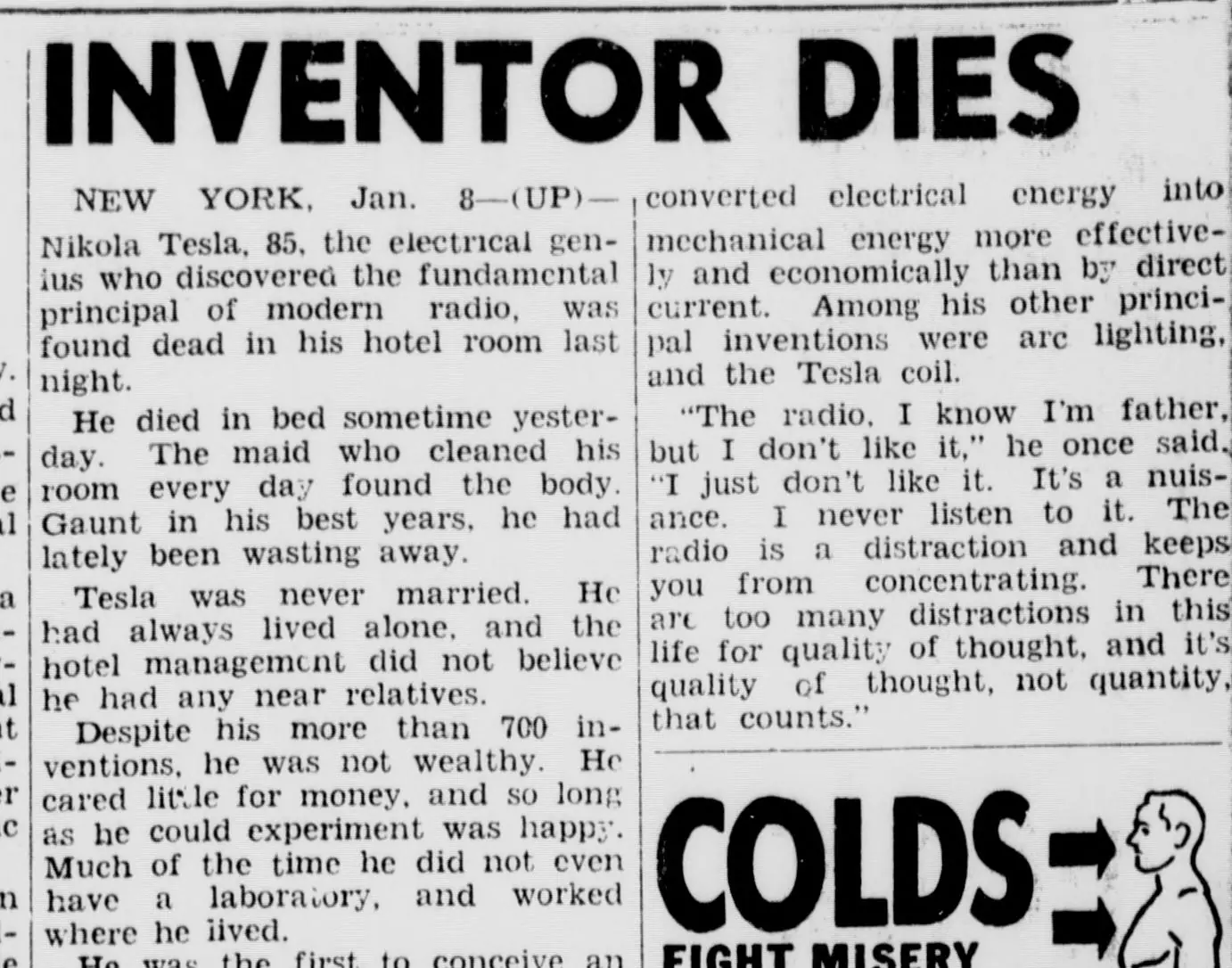
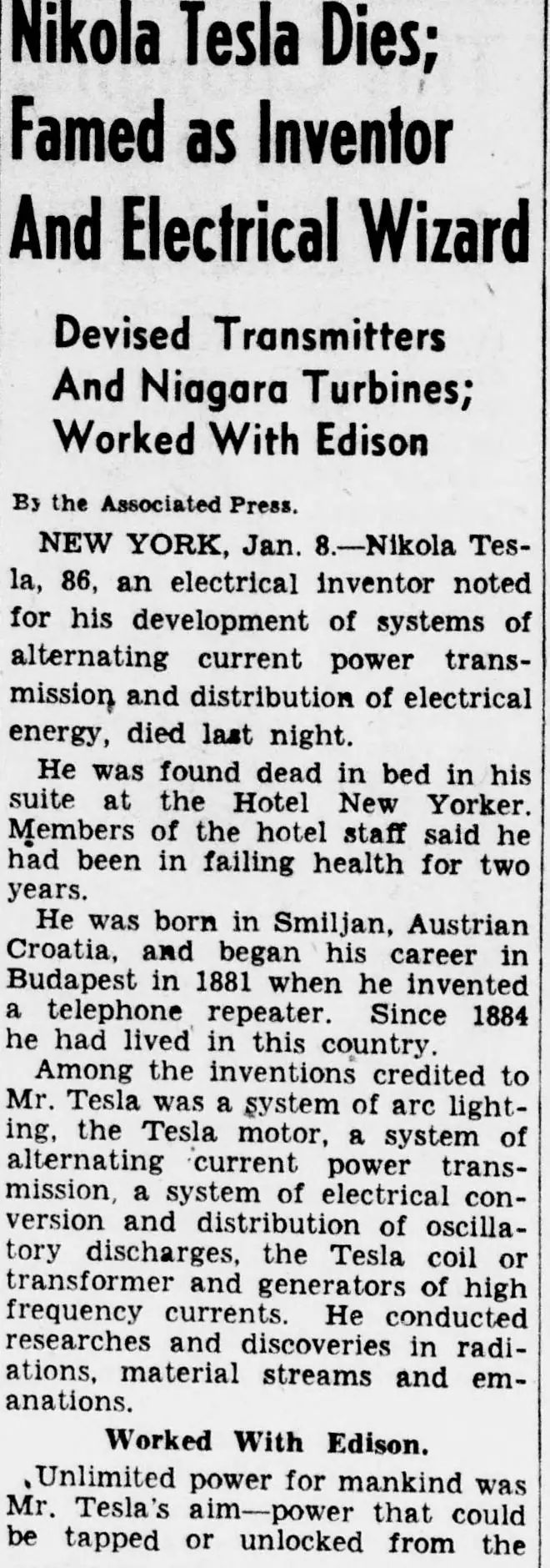
Both wire services carried an obituary on 8 January, and they differ. The Associated Press version does not mention money at all — not his wealth, not his debts, not an estate. It is two columns about alternating current, Niagara and Edison, and the only domestic detail is that he “was found dead in bed in his suite at the Hotel New Yorker”.
The United Press version does address it, in one sentence, and the sentence is the origin point of everything that followed:
Despite his more than 700 inventions, he was not wealthy. He cared little for money, and so long as he could experiment was happy. Much of the time he did not even have a laboratory, and worked where he lived.
United Press, “Inventor Dies”, Imperial Valley Press, El Centro, California, 8 January 1943, page 6.
Not wealthy is true, and modest. It is not penniless, and the distance between those two words is the subject of this article.
The word destitute does appear, once, and it is worth quoting exactly because the sentence it sits in refutes itself. A Bureau memorandum written on 9 January, recording a statement by an informant, reads:
Of recent years TELSA became more or less destitute, and for the past three or four years the government of Czechoslovakia has been paying him a subsistance of $500 per month, a part of which was used to pay the rental for the warehouse accomodations.
“Memorandum for Mr. Foxworth”, Federal Bureau of Investigation, New York, 9 January 1943. Bureau file, Nikola Tesla Part 03, page 4. Spelling and capitalisation as in the document.
Read it twice. A man receiving $500 a month, every month, for three or four years, is not destitute; he is a man on a modest fixed income. The memorandum makes both claims in one breath, and the second is checkable while the first is an impression.
Two cautions, in opposite directions. Czechoslovakia is almost certainly an error for Yugoslavia — the Bureau had his nationality wrong from the first hour — but the document says what it says and is quoted as written. And the figure is hearsay, an agent's note of an informant's words rather than a bank record. A separate Bureau interview puts it at “approximately $600.00 per month” and calls it “a sort of pension”: three sources, three numbers, one arrangement.
The standard telling gets two further things slightly wrong. The scholarly account of the stipend is that the Nikola Tesla Institute in Belgrade — not the government — arranged it, from 1939 rather than the 1936 usually given, 1936 being the year the Institute was founded. And there was a second income: in 1934 Westinghouse Electric put Tesla on its payroll as a “consulting engineer” at $125 a month. It is not called a consulting fee in the scholarship, it did not cover his rent, and the reason given is not that Tesla refused charity — it is that Hugo Gernsback warned Westinghouse it would embarrass Westinghouse if it got out that the man who made its fortune was nearly penniless.
So the first correction is simple. The documented picture is of a man with a small regular income and no capital, which is a different condition from having nothing.
The one debt anybody wrote down
He did owe money, and the amount is known to the dollar — for one hotel, and only one.
On 12 January 1943, the Bureau's New York office sent Washington a teletype summarising five days of enquiries. Among them:
TESLA ALSO HAD SOME PROPERTY … TO BE A WORKING MODEL OF AN INVENTION IN A SAFE DEPOSIT BOX IN GOVERNOR CLINTON HOTEL IN NY. INQUIRY SHOWS THAT THIS WAS PLACED HERE BY TESLA IN NINETEEN THIRTY TWO AS SECURITY FOR FOUR HUNDRED DOLLARS OWED HOTEL. THIS BILL IS STILL OWED AND HOTEL APPEARS UNWILLING TO RELEASE THIS PROPERTY TO ANYONE AT LEAST UNTIL … DEBT IS PAID.
P. E. Foxworth, Special Agent in Charge, New York, to the Director, teletype, 12 January 1943, file 100-2237-2. Bureau file, Nikola Tesla Part 01, page 6.
Four hundred dollars, owed since 1932, still owed in 1943, secured by a box. That is the entire documented debt of Nikola Tesla, and it is eleven years old at the time of his death. It is also the origin of a better-travelled story — the sealed box at the Governor Clinton said to hold a device that would destroy itself if opened. The box was collateral on a hotel bill, and the reviewer who opened it three weeks later found “standard electrical measuring instruments in common use several decades ago”, which is told elsewhere on this site. The same file names the Hotel New Yorker some twenty times and never states a sum owed to it.
| Amount | What the document says it is | Where it comes from | What it is not |
|---|---|---|---|
| $400 | Owed to the Hotel Governor Clinton since 1932, secured by a box, unpaid at death | Bureau teletype, 12 Jan 1943 | Not a total. The only itemised debt in the record |
| $500 / month | “Subsistance” from a foreign government for “the past three or four years” | Bureau memorandum, 9 Jan 1943, informant statement | Not a bank record. The document names the wrong country |
| ~$600 / month | “A sort of pension” from the Yugoslavian Government | Bureau interview, a different informant | Probably the same arrangement, differently remembered |
| ~$15 / month | Warehouse rental on the stored effects, paid by an agent acting for the administrator | Bureau report, 17 Oct 1945 | An expense of the estate, settled by someone else |
| Value unknown | The estate, as declared in the petition for letters of administration | Surrogate's Court, New York County, Jan 1943 | Not a valuation. It is the absence of one |
That table is the whole of it. Every figure is quoted from a named document, and none is an appraisal of what he left.
The estate nobody has ever put a number on.
He left no will, and the search for one is itself documented: his nephew went into the rooms on the night of 8 January with a locksmith and two friends, watched by three assistant managers of the hotel and representatives of the Yugoslav consulate. None was found.
On 22 January the New York Times reported the consequence: “Tesla Left No Will — Nephew Says Only Estate Consists of Research Data, Models”. Letters of administration went to Sava N. Kosanović. The petition listed the estate as of “value unknown” and said “several years will be required in cataloguing, indexing and examining papers and data to ascertain the scope, meaning and significance thereof”. Five other nephews and nieces were named as heirs.
“Value unknown” is not a polite way of writing nothing. It is what a court writes when the principal asset is a warehouse full of paper whose worth cannot be stated until somebody reads it — and the petition says reading it would take years.
A full-text search of the Bureau's released file — three parts, 351 pages — for every appraisal, inventory, valuation and creditor term, and every dollar figure in it, returns no valuation of the estate at all. Nor does any reported court decision. The number everybody wants has never been published, and this article does not supply one.
Alone, and the Yugoslav ambassador at the funeral
The second half of the sentence — alone and forgotten — fails faster than the first, and the person it erases has a name.
The United Press obituary stated that Tesla “had always lived alone, and the hotel management did not believe he had any near relatives”. That was wrong on the morning it printed. His nephew Sava Kosanović was in New York, was in the rooms the next morning, and within a fortnight was the court-appointed administrator. What the hotel management believed is a record of what the hotel management believed, and it has been reprinted for eighty years as a finding.
Kosanović is the second protagonist here and is almost always missing. A Yugoslav politician, later his country's ambassador to the United States, he is the reason there is any estate record at all — and the reason for the oddest document in the file. On 21 January 1943 Bureau headquarters suggested that Kosanović and the two men who went in with him “may have committed a burglary violation” by using a locksmith on a dead man's safe, and that the matter be put to the State's Attorney “with a view to locating Kosanovich and apprehending him on a burglary charge”. Nothing came of it, but the administrator of the estate spent his first fortnight being considered for arrest.
As for forgotten: the day after Tesla died, the Associated Press moved a second story.
The body of Nikola Tesla, the inventor, will lie in state until Tuesday when the Yugoslav government-in-exile will give him an official state funeral, the Yugoslav information center has announced. … The government of Yugoslavia, in which country Mr. Tesla was born, will be represented at the funeral by its Ambassador, Constantin Fotitch.
Associated Press, “Body of Nikola Tesla, Inventor, to Lie in State”, Evening Star, Washington, D.C., 9 January 1943, page 21.
That Tuesday was 12 January, and what happened on it is reported in detail in a place almost nobody looks: the English-language Wednesday edition of a Serbian-American daily published in Pittsburgh. Its banner headline the next morning counted the room.

The service was held at the Cathedral of St John the Divine and conducted in Serbian by priests of the Serbian Orthodox Church. It was, the report says, “held as an official State function of the Yugoslav Government”, with Ambassador Fotitch leading the mourners past the coffin before it was closed. The honorary pallbearers included the President of the New York City Council, the inventor of the Alexanderson alternator, the inventor of frequency modulation, and Westinghouse's research director. Telegrams came from three Nobel laureates in physics and from the White House. The one from the President's wife, in full:
The President and I are deeply sorry to hear of the death of Mr. Nikola Tesla. We are grateful for his contribution to science and industry and to this country.
“2,000 Attend Tesla Rites in New York”, Amerikanski Srbobran, Pittsburgh, 13 January 1943, page 1.
Two thousand people, a state function, an ambassador, a cathedral and a telegram from the White House. Whatever that is, it is not a forgotten man, and the word forgotten should be retired from the sentence along with penniless.
One small domestic detail in the same report bears on the first word too. Tesla died “in his hotel suite, which he also used as a laboratory”, and his meals, “strictly vegetarian-style, were especially prepared for him by the chef”. A hotel does not put its chef on a guest who is not paying.
The same follow-up is where the familiar figure enters the record at wire speed: it says he “held more than 700 basic patents”. The Nikola Tesla Museum publishes the list of his United States grants and it runs to 112. The number had hardened into a fact within forty-eight hours of his death.
The seizure, and the sentence the government wrote about itself.
One more thing in the file is worth taking away, because it is a government agency contradicting the story usually told about it — in its own favour. On 9 January, two days after the death, the Office of Alien Property Custodian went to the hotel and seized everything: “about two truckloads of material”, sealed and moved to the Manhattan Storage and Warehouse Company, where roughly thirty barrels and bundles of his had already been sitting since about 1934. That much is the familiar story.
What is not familiar is what the Custodian said about its own authority, in writing, three days later:
IN VIEW OF FACT TESLA IS A US NATURALIZED CITIZEN, ALIEN PROPERTY CUSTODIAN FEELS THAT ITS JURISDICTION OVER PROPERTY IS DOUBTFUL.
Foxworth teletype, 12 January 1943. Bureau file, Nikola Tesla Part 01, page 5. Capitals as in the original.
Tesla had been a United States citizen since 1891 — the Nikola Tesla Museum holds the certificate, dated 30 July of that year. The agency charged with enemy property took a citizen's belongings, recorded in writing that its jurisdiction was doubtful, and acted inside the two days before a probate administrator could be appointed.
That is a sharper and better-sourced criticism than the one usually made. It is not evidence that anything was confiscated and hidden: the technical reviewer the Custodian appointed recommended three weeks later that the property be given back, and the effects were in due course released to Kosanović and went to Belgrade. It is evidence that the seizure rested on speed rather than on statute, and the government said so itself.
Where the word comes from.
The Library of Congress's whole digitised newspaper collection was searched for 1943, and penniless occurs in connection with Tesla exactly once — not in a wire report, not in a New York daily, but in a radio address given over a Chicago station on 16 January and carried four days later by the same Pittsburgh weekly that had reported the funeral:
In fact, he made many billions of dollars, and distributed them unevenly throughout America, and the rest of the world as well. So unevenly in fact, did he distribute his wealth, that he even forgot or perhaps did not want to leave any riches for himself, and his posterity. He died alone in a New York hotel, a penniless old man at the age of 86.
“Serb Radio Hour”, text of an address of 16 January 1943 over station WGES, Chicago. Amerikanski Srbobran, Pittsburgh, 20 January 1943, page 3.
That is a eulogy, and eulogy is where the word belongs: it arrives already fused to the billions he supposedly gave away, which is the form the legend still takes. Nine days earlier the New York Times obituary had used the milder poverty, and used it carefully — he “probably could have become a rich man had he chosen to become an employe of a large industrial concern, but he preferred poverty and freedom”. That is a claim about a lifelong preference, in the conditional, and it is the last time the distinction is observed.
By 1950 the finished article is in circulation: a syndicated piece reprinted that December has him selling alternating current to Westinghouse for a million in cash and dying penniless “whereas he might have left an estate of more than $150,000,000”. Every figure in it is wrong. The hedge wore off, as hedges do.
What the answer actually is
Penniless is a word for a man with nothing. The documents describe someone else: a man of eighty-six with no capital and no property, living in a hotel suite on several hundred dollars a month from the Yugoslav government, his meals cooked to order, carrying an eleven-year-old unpaid bill of four hundred dollars at a different hotel, with thirty barrels of papers in storage and the rent on them paid by somebody acting for his nephew. He died in a room by himself and was found by the maid. Five days later two thousand people came to the cathedral, and a state buried him.
Every part of that is duller than the legend and none of it is softer. The correction is not that he died comfortable. It is that the word has been doing work the evidence never supported, and the actual condition — no capital, a small income, one old debt, and an estate of paper nobody has ever valued — is both sadder and more specific.
The document
The Federal Bureau of Investigation's released file on Nikola Tesla, in three parts totalling 351 pages, is the spine of this article. The passages quoted here are at Part 01 pages 5–6 (the Foxworth teletype of 12 January 1943, on the seizure, the citizenship problem and the $400), Part 01 page 167 (the burglary suggestion of 21 January 1943), Part 01 page 177 (the warehouse, the tax seal and the storage rental), Part 01 pages 178–179 (the technical review of 30 January 1943) and Part 03 page 4 (the memorandum of 9 January 1943 containing the word destitute). The file, at the Bureau's own reading room.
Read alongside the two wire obituaries of 8 January 1943 and the follow-up of 9 January, which are reproduced above and are free to read as page images at the Library of Congress, and the New York Times report of the grant of letters of administration, “Tesla Left No Will”, 22 January 1943.
A note on how the Bureau's file was read. The Vault refuses direct downloads to anything that is not a browser, answering 403; the file was therefore taken from an Internet Archive mirror whose byte count — 46,181,214 bytes for Part 01 — matches the Vault's own stated figure exactly. Quotations marked as transcribed from page images were read from rendered pages rather than from the optical character recognition, which on 1943 teletype carbons is unreliable.
The search log
Run 19 October 2026. Corpora: the Library of Congress Chronicling America collection, searched through the collections interface and read as page images and as optical character recognition; the Bureau's released Tesla file, read as page images; the opinion database at CourtListener; and the published transcriptions at Tesla Universe.
- “Penniless”, applied to Tesla, in the American press of 1943. Nothing. Thirteen pages from eight titles carrying Tesla items in 1943 were pulled in full text and searched for penniless, destitute, poverty, pauper, impoverished, estate, debt and owed within six hundred characters of any mention of him. Not one of those words is applied to Tesla on any of the thirteen pages. The single occurrence of destitute in the set belongs to a sorority's Christmas-party caption on an adjacent column of the Atlanta Daily World of 13 January 1943. Two qualifications, so the negative is not read wider than it is: the New York Times is not in this collection at all, and it does use the word poverty (see below); and a later page of the Srbobran, outside this thirteen, reprints that Times sentence.
- A valuation of the estate, in the Bureau's file. Nothing. The full 351-page release was searched for appraisal, inventory, net and gross value, insolvency, creditor and claim terms, and for every dollar figure, and every hit read in context. No valuation of the estate appears anywhere in it. This is the central negative of the article.
- A reported Surrogate's Court decision on the estate. Not located. A search of CourtListener for a Tesla estate matter returns nothing; a search on the administrator's surname returns eleven opinions, none of them related. The only Tesla cases in the database are patent and contract suits from his lifetime. A caution on that negative: whether the database covers New York Surrogate's Court for the 1940s at all was not established, and a null result in a reporter that is not held is not an absence.
- A figure for the Hotel New Yorker bill. Not located, despite roughly twenty references to that hotel across the file. A St Regis debt. Not located; the single St Regis mention in the file refers to a different man entirely.
- “Penniless”, 1943, across the whole collection. One occurrence, the radio eulogy of 16 January quoted above. The word is in no wire report and no New York daily in that year. The milder poverty appears once more, in the New York Times obituary of 8 January, as a claim about a lifelong preference rather than about his death.
- The Westinghouse arrangement. Established, with three parts of the standard telling removed. The scholarly account gives 1934, the payroll title “consulting engineer”, and $125 a month. It does not say the money was called a consulting fee, does not say it covered his rent, and does not give Tesla's refusal of charity as the reason. The surviving hook is a letter of 2 January 1934 from the president of Westinghouse Electric, held on microfilm at the Library of Congress and not digitised — so it cannot be linked, only cited. Whether the payment was still running in 1943 is not established; the Bureau's file never mentions it.
- An Alien Property Custodian vesting order naming Tesla. Searched to a conclusion, and there is none. The Federal Register for 1942–1950 was searched in full text for the surname alone. Three issues match and all three are something else: a San Francisco firm called the Tesla Clay and Sand Corporation, authorised in the issue of 2 February 1943 to sell crude fire clay at $9 a net ton; a subdivision called Tesla Place in St. Louis County, Missouri; and a scanner's misreading of the Artesia oil pool in New Mexico. The same corpus returns 148 issues carrying the phrase “vesting order” for 1943 alone, so the silence is the corpus answering rather than failing to be asked. The distinction matters, because property merely held and property formally vested are different things, and the absence of a vesting order fits the Custodian's own written doubt about its jurisdiction.
- The New York State estate-tax appraisal. Not located. Its existence is inferred from the tax seal recorded in October 1945, not established. If any document fixes what the estate was worth, it is this one.
- The New York Times of 22 January 1943, as a page image. Blocked, and the gap is real. The paper's own archive is behind a paywall, which is a block on the human flow as much as on anything else. The report is therefore cited from a transcription and without a page number, and that is a weaker citation than the rest of this article rests on.
- Where the detail actually is. A positive result worth recording as loudly as the negatives: the fullest account of the funeral in any freely readable American paper is in the ethnic press, not the metropolitan dailies. The Amerikanski Srbobran of 13 January 1943 names the pallbearers, the clergy and the senders of the telegrams; the Washington Evening Star gave the same event four sentences on an inside page. Anyone researching an immigrant's death in America should search the community papers first, and the Library of Congress has digitised a great many of them.
- A caution for anyone repeating the newspaper searches. Chronicling America's long-documented API at chroniclingamerica.loc.gov has been retired and now redirects to a 404. The working endpoint is the collections interface at www.loc.gov, where the parameter is q and not qs — the latter is accepted and silently ignored, returning an unfiltered result set that looks like a successful search. Coverage now runs to 1963, which is why 1943 is searchable at all.
Unresolved: the exact figure and the exact start date of the Yugoslav payment, which three sources give three ways; whether Tesla was naturalised in 1891, as the certificate in Belgrade says, or in 1889, as one much later Bureau summary says; and the page number of the New York Times report of 22 January 1943.
Primary documents
- United Press, “Inventor Dies”, Imperial Valley Press, El Centro, California, 8 January 1943, page 6. Digitised page, Library of Congress.
- Associated Press, “Nikola Tesla Dies; Famed as Inventor And Electrical Wizard”, Evening Star, Washington, D.C., 8 January 1943, page 14. Digitised page, Library of Congress.
- Associated Press, “Body of Nikola Tesla, Inventor, to Lie in State”, Evening Star, Washington, D.C., 9 January 1943, page 21. Digitised page, Library of Congress.
- “2,000 Attend Tesla Rites in New York”, Amerikanski Srbobran, Pittsburgh, 13 January 1943, page 1 — the fullest account of the funeral, with the pallbearers and the telegrams. Digitised page, Library of Congress.
- “Serb Radio Hour”, text of an address of 16 January 1943 over station WGES, Chicago. Amerikanski Srbobran, Pittsburgh, 20 January 1943, page 3 — the earliest located appearance of the word penniless. Digitised page, Library of Congress.
- “Nikola Tesla Dies: Prolific Inventor”, The New York Times, 8 January 1943 — the obituary that uses the word poverty, of a lifelong preference. Page number not established; cited from a transcription. Transcription.
- La Gaceta, Tampa, Florida, 13 January 1943, page 1 — the same funeral reported in Spanish, with the ambassador named and “más de 700 patentes básicas” in print within the week. Digitised page, Library of Congress.
- “Tesla Left No Will; Nephew Says Only Estate Consists of Research Data, Models”, The New York Times, 22 January 1943 — page number not established. Transcription.
- P. E. Foxworth, Special Agent in Charge, New York, to the Director, teletype, 12 January 1943, file 100-2237-2 — the seizure, the doubtful jurisdiction and the $400. Bureau file, Nikola Tesla Part 01, pages 5–6.
- “Memorandum for Mr. Foxworth”, Federal Bureau of Investigation, New York, 9 January 1943 — the word destitute and the $500 a month. Bureau file, Nikola Tesla Part 03, page 4.
- Federal Bureau of Investigation, Headquarters to Special Agent in Charge, New York, 21 January 1943 — the Surrogate's Court and the proposed burglary charge. Bureau file, Nikola Tesla Part 01, page 167.
- E. E. Conroy, Special Agent in Charge, New York, to the Director, 17 October 1945, file 65-12290 — 75 packing cases, the tax seal, the $15 a month. Bureau file, Nikola Tesla Part 01, page 177. The month is faint on the scan; it is read as October from a cleaner rendering of the same page, and the Bureau's own 1981 summary of the file cites the memorandum as 17 October 1945.
- John G. Trump to Walter Gorsuch, Alien Property Custodian, 30 January 1943 — the technical review and the recommendation to release. Bureau file, Nikola Tesla Part 01, pages 178–179.
- The Bureau's released Tesla file, Parts 01 to 03, in full.
Further reading
- Identity documents, Nikola Tesla Museum, Belgrade — including the certificate of American citizenship of 30 July 1891.
- W. Bernard Carlson, Tesla: Inventor of the Electrical Age, Princeton University Press, 2013 — the standard scholarly biography. Page 379 for the Westinghouse payroll arrangement of 1934 and Hugo Gernsback's part in it; page 389 for the Nikola Tesla Institute's monthly stipend from 1939; endnote 22 at page 467 for the surviving letter of 2 January 1934, which is on microfilm at the Library of Congress and not digitised.
The record on this article
- Unsupported “Tesla died penniless.” No accounting of his estate has ever been located, so the word rests on nothing measured. What is documented is a monthly stipend arranged by the Nikola Tesla Institute from 1939, a Westinghouse payroll arrangement of $125 a month from 1934, and one unpaid hotel bill of $400. The strongest contemporary wording is the United Press obituary's “he was not wealthy”. The word penniless itself is first found in a radio eulogy of 16 January 1943, printed four days later.
- True “He died in debt to a hotel.” $400 to the Hotel Governor Clinton, owed since 1932, still owed at his death, secured by a package in the hotel's safe deposit box. It is the only itemised debt in the record.
- False “He had no family and nobody came.” His nephew Sava Kosanović was in New York, entered the rooms the morning after the death and was granted letters of administration within a fortnight. His body lay in state; the Yugoslav government-in-exile held an official state funeral at the Cathedral of St John the Divine on 12 January 1943, with its ambassador leading the mourners. More than 2,000 people attended, and the telegrams read out included one from the President's wife on behalf of them both.
- Unverifiable “Tesla's estate was worth [any figure].” The petition for letters of administration gave the value as “unknown”. No valuation appears in the Bureau's 351-page file, in any reported decision, or in any document located for this article.
- True “The United States government seized his papers when he died.” The Office of Alien Property Custodian took about two truckloads on 9 January 1943 — and recorded three days later that, Tesla being a naturalised United States citizen, its jurisdiction was “doubtful”. Its own technical reviewer recommended releasing everything three weeks later.