What Tesla announced in 1934 was a gun
He described charged metal dust fired from an open-ended tube, said in print that a ray was impossible — and the word that stuck came from a wire-service headline.
The claim
CLAIM — “Tesla invented a death ray, and the government seized his papers to keep it quiet.”
STATUS — FALSE. What he described was not a ray, he said so in print three months after announcing it, and the 1943 review of his effects recommended releasing them.
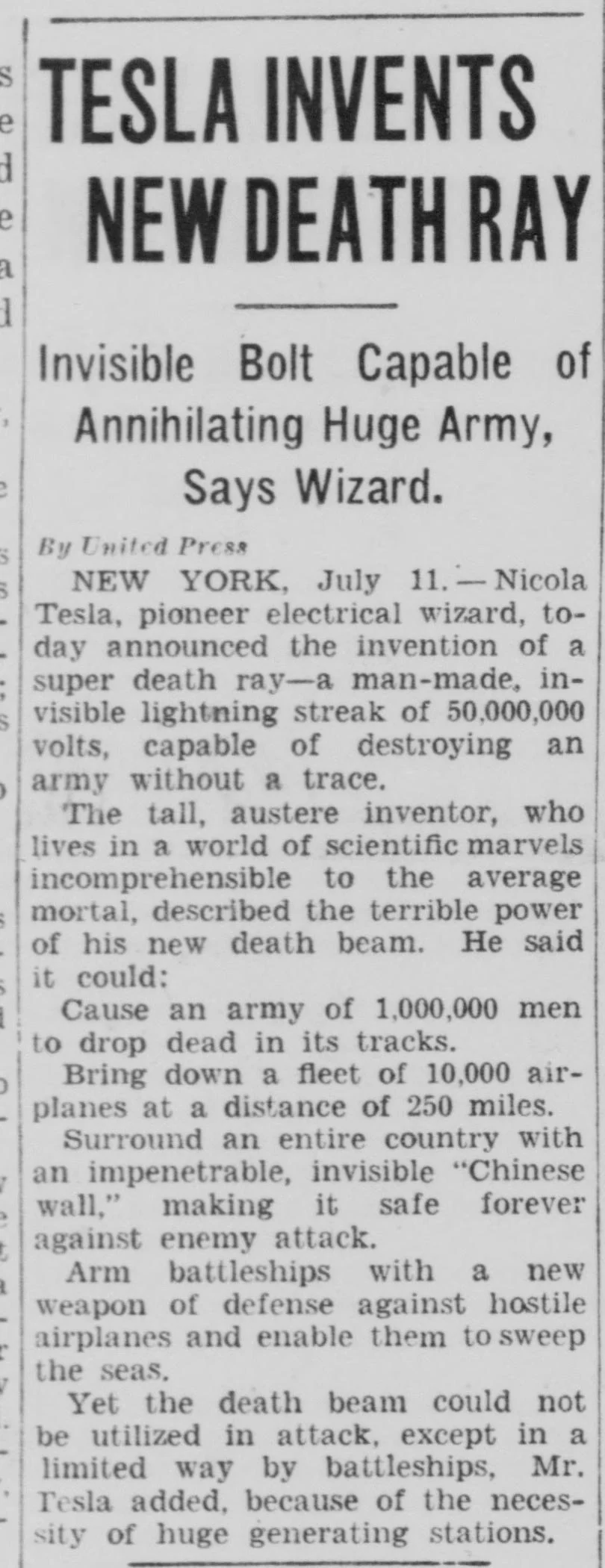
EARLIEST TRACE — “TESLA INVENTS NEW DEATH RAY”, United Press, on front pages of 11 July 1934. The phrase is the wire services'. The New York Times used his own word, “death-beam”.
RESTS ON — One press interview, repeated at intervals for six years. No patent, no demonstration, and no witness other than himself.
On Tuesday 10 July 1934 Nikola Tesla turned seventy-eight, and did what he had done every July for years: received reporters in a public room of the Hotel New Yorker, where he lived. Time, a fortnight later, described him “wearing an outmoded brown suit”. The New York Herald Tribune's man, Joseph Alsop, saw “a tall, thin, almost spiritual figure in the sort of brown cutaway suit that older men wore before the World War”.
What he announced that afternoon is now the most famous thing he ever said, and it has been mangled in almost every particular. He did not announce a ray. He announced a gun.
Four versions of one interview.
Start with the detail everyone gets wrong, because it is the easiest to check. The sentence repeated across hundreds of pages — that the headline ran on the front page of the New York Times — is not true. The Times's own archive records “Tesla, at 78, Bares New 'Death-Beam'” as 11 July 1934, page 18. The paper that put it on page one was the Herald Tribune, on pages 1 and 15.
Three wire services moved three different stories the same day, and they do not agree with one another. United Press called it a “super death ray”, a “man-made, invisible lightning streak of 50,000,000 volts”, reaching 250 miles. Associated Press called it a “force ray”, put the range at 100 miles, and described “vast curtains, miles high”. International News Service called it a “death beam” — and a fortnight later the Washington Times printed the voltage as “a lightning bolt of 1,000,000 volts”, off by a factor of fifty from the figure everybody now quotes.
Tesla gave one interview. The country got four machines. Every number still in circulation — 250 miles, fifty million volts, ten thousand aircraft — comes out of that single day's copy, and the papers could not keep them straight at the time.
What he actually described.
The technically useful account is Alsop's, in the Herald Tribune. The beam, he wrote, “is a concentrated current — it need be no thicker than a pencil — of microscopic particles moving at several hundred times the speed of artillery projectiles. The machine into which Dr. Tesla combines his four devices is, in reality, a sort of electrical gun.”
Four devices, as the Times listed them: a method of producing rays and other manifestations of energy in free air, dispensing with the sealed vacuum tube; a method of producing “very great electrical force”; a method of amplifying it; and “a new method for producing a tremendous electrical repelling force”. The first is the hard one and it is the interesting one. Everything of this kind before 1934 happened inside a sealed, evacuated glass tube. Tesla proposed to open the end of the tube and fire out of it.
He also set out, on the day, why the thing could only be defensive: the plants would be enormous, fixed and immovable, sited along a frontier “in the manner of old-time forts” every two hundred miles. You cannot invade with a building. The one exception he allowed was battleships, which could carry smaller units. And he said he would present the scheme at the disarmament conference at Geneva — a conference from which Germany had walked out nine months earlier and which adjourned permanently four months later. There is no record of him presenting anything there.
He said it was not a ray, and he said why.
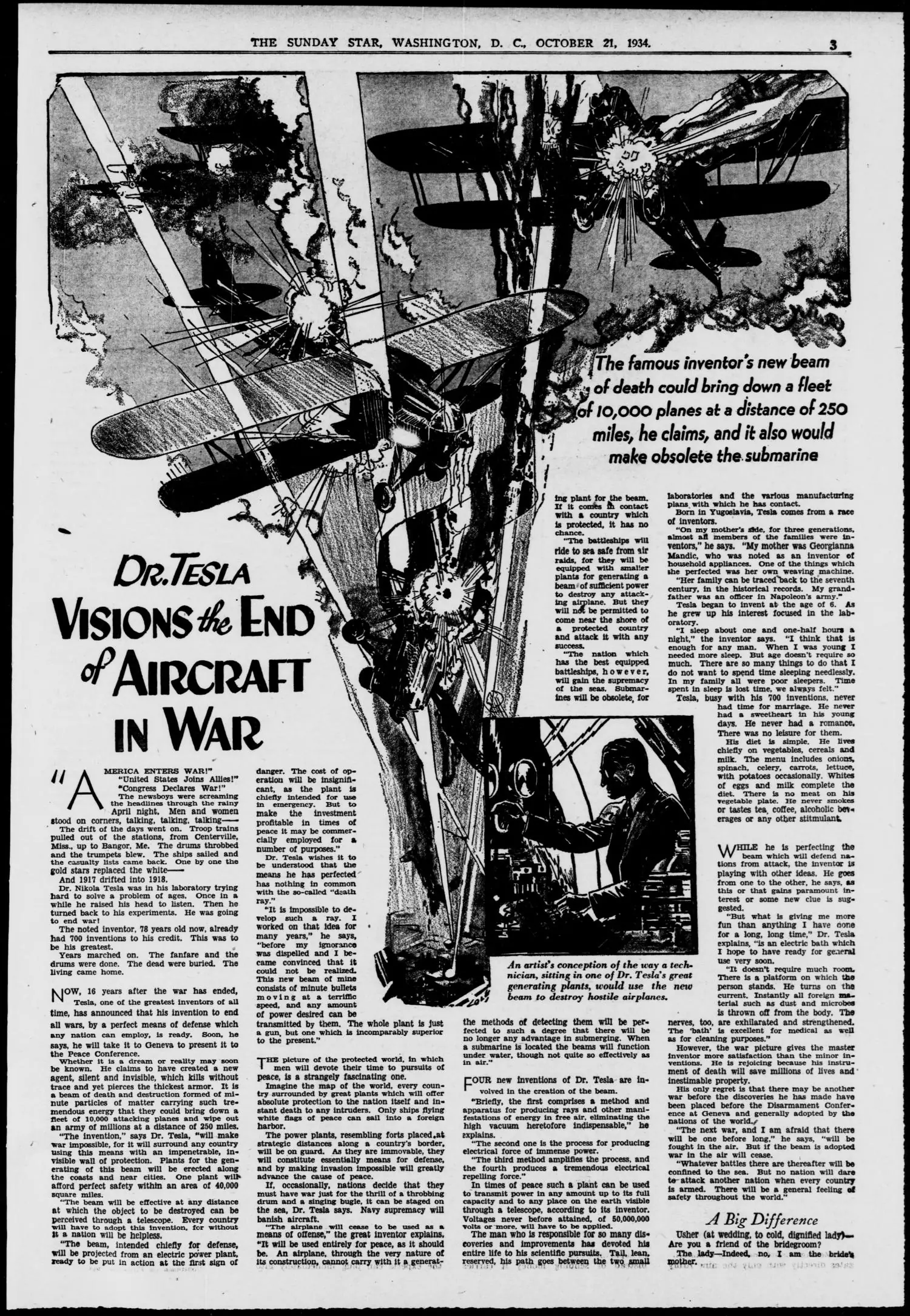
Three months after the announcement he put the correction in print himself, in a syndicated Sunday feature. It is the clearest sentence about Teleforce that exists anywhere, and it is sitting in a free public archive.
It is impossible to develop such a ray. I worked on that idea for many years, before my ignorance was dispelled and I became convinced that it could not be realized. This new beam of mine consists of minute bullets moving at a terrific speed, and any amount of power desired can be transmitted by them. The whole plant is just a gun, but one which is incomparably superior to the present.
“Dr. Tesla Visions the End of Aircraft in War”, by Helen Welshimer. The Sunday Star, Washington D.C., 21 October 1934, page 3.
He said it again, at greater length, in Liberty for 9 February 1935: “I want to state explicitly that this invention of mine does not contemplate the use of any so-called 'death rays.' Rays are not applicable because they cannot be produced in requisite quantities and diminish rapidly in intensity with distance. All the energy of New York City (approximately two million horsepower) transformed into rays and projected twenty miles, could not kill a human being.”
That article is worth two further notes. It is cited across the internet — including by a United States patent examiner in 1987 — as Liberty, February 1937. It is February 1935: the cover says so, and the editor's note introducing it calls him “now in his seventy-eighth year”, which fits 1935 and cannot fit 1937. And the phrase people quote from it, “invisible Chinese wall of defense”, is not in it. Liberty says “a wall of power”. The Chinese wall belongs to the New York Times, twice: the 1934 story, and William L. Laurence's piece of 22 September 1940.
One honest qualification, because the correction is usually overstated. What Tesla objected to was ray, not death. He used “death-beam” freely himself in 1934. He never disowned the lethality; he disowned the physics.
The paper, and the numbers in it.
There is a technical exposition. It is a typescript titled The New Art of Projecting Concentrated Non-dispersive Energy through the Natural Media, generally dated around 16 May 1935 — though the man who held the government's copy in 1943 called it, in writing, “this undated document”. It is the only place Tesla set out arithmetic for the thing, and the arithmetic is the most interesting part of the whole story, because he does it correctly and it does not come out where the headlines did.
The projectile is a sphere of tungsten one hundredth of a centimetre in radius, about seventy-five micrograms. It is charged in high vacuum, then accelerated by electrostatic repulsion from a terminal he proposes to hold at sixty million volts. The muzzle velocity he calculates is 16,130 metres per second. The kinetic energy he calculates for one particle is one kilogram-metre.
A kilogram-metre is 9.8 joules. That is roughly the muzzle energy of an air-rifle pellet.
His magazine is twenty cubic centimetres of tungsten wire, which he says would supply five million particles. Multiply it out, at his own figures, and the entire ammunition load of the machine carries about forty-nine megajoules — the chemical energy of something like a litre and a half of petrol, delivered one air-rifle pellet at a time, over however long it takes to fire five million of them. Against that, the claims of 10 July 1934 were an army of a million men dropping dead and a fleet of ten thousand aircraft brought down at two hundred and fifty miles.
The gap is not a rounding error. It is four orders of magnitude, and it is visible inside his own document, before anybody raises the question of whether the beam would hold together in air at all.
How was it supposed to get out of the tube?
This is the part that deserves respect, because it is a real idea and he was first to it. Particles cannot be accelerated in air — they lose their charge and their speed to collisions — so they must be accelerated in vacuum. But a sealed vacuum tube needs a window, and no window will survive a stream of tungsten at Mach forty-seven. Tesla's answer was to leave the end of the tube open and plug the hole with moving air.
The topology is right. A particle-beam weapon, if one were ever built, would have to do something of this kind: accelerate in vacuum, then get the beam out into air through an aperture. Differentially pumped apertures are routine in modern accelerators. They are small, and slow, and nothing like a gun muzzle — but the instinct was sound, and it is the strongest thing that can honestly be said for the paper.
The objection was made in 1934, in a newspaper.
The story usually told is that nobody listened. The 1934 papers do not support it. Within two days, physicists at the United States Bureau of Standards had gone on the record against the announcement: “Government Scientists Scout Chances of Tesla's 'Death Ray'” ran in the Washington Evening Star on 13 July 1934, quoting the head of the Bureau's atomic physics division.
Three days after that, a Science Service piece printed the sentence that has aged best of anything written about the affair: “The weakest part about all death ray schemes is that reputable scientists seldom see a demonstration.”
And on 17 July, Scripps-Howard's science editor made exactly the right objection, in a newspaper, six days after the announcement. The Van de Graaff generator at the Massachusetts Institute of Technology had reached seven million volts. Tesla was claiming fifty. Ninety years later that is still the objection, and it was not hindsight; it was contemporaneous.
Who he actually wrote to.
Here the record diverges sharply from the legend, and it does so in the government's favour in one direction and against it in another.
The legend says Tesla offered the weapon to the United States War Department and was turned away. What is documented is a public offer made through the press, repeatedly, from his eighty-fourth birthday onwards: a plant costing “no more than $2,000,000” and taking three months to build, with one condition — he would suffer “no interference from experts”. When a government reviewer inventoried the correspondence Tesla had kept by him at his death, he listed letters to Westinghouse, letters to the British Government, and letters to a Soviet trading company. He listed no correspondence with any agency of the United States. Tesla kept his approach letters; he kept the British ones for seven years. If he wrote to the War Department, that letter is not in the file.
What is documented is stranger and better. In April 1935 he signed an agreement with the Amtorg Trading Corporation — the Soviet trade mission in New York — undertaking to supply plans for producing fifty million volts, generating particles in a tube open to the air, and projecting them “to distances of a hundred miles or more”. He acknowledged a fee of $25,000. Five months earlier he had written to J. P. Morgan Jr. asking for exactly $25,000, and mentioning that “the Russians are very anxious to render their borders safe against Japanese invasion and I have made them a proposal”.
And from August 1936 to April 1938 he wrote four times to representatives of the British Government, offering the disclosure for a fee. Britain replied on 7 January 1938. The reviewer who read both sides of that correspondence summarised the reply in five words: a polite expression of disinterest.
Britain's reason is the best irony in the story, and it is a matter of record. In January 1935 the Air Ministry had asked whether radio waves could be used to destroy aircraft. Robert Watson-Watt and Arnold Wilkins worked out that they could not — and on 12 February 1935 sent back a memorandum proposing to use radio to detect aircraft instead. A fortnight later they picked up a bomber using a BBC transmitter. By the time Tesla's first letter arrived, eighteen months later, Britain had already run the death-ray question to ground and bet on radar. By the time the refusal was written, the Chain Home stations were going up.
January 1943, and what the review actually found.
Tesla died at the Hotel New Yorker on 7 January 1943. The Office of Alien Property Custodian seized his effects two days later — on an authority the Custodian itself recorded as doubtful, Tesla having been a United States citizen since 1891 — and on 26 and 27 January a party of six examined them in a Manhattan warehouse. The technical member was John G. Trump of MIT. His letter of 30 January is two pages long and it is the document the entire suppression story has to get past.
As a result of this examination, it is my considered opinion that there exist among Dr. Tesla's papers and possessions no scientific notes, descriptions of hitherto unrevealed methods or devices, or actual apparatus which could be of significant value to this country or which would constitute a hazard in unfriendly hands. I can therefore see no technical or military reason why further custody of the property should be retained.
John G. Trump to Walter Gorsuch, Alien Property Custodian, 30 January 1943. Federal Bureau of Investigation file, Nikola Tesla Part 01, page 178.
On the apparatus itself, Trump found “standard electrical measuring instruments in common use several decades ago”. On the teleforce paper specifically, he wrote that Tesla's disclosures “would not enable the construction of workable combinations of generator and tube even of limited power, though the general elements of such a combination are succinctly described”. That last clause is fair to Tesla and almost never quoted.
Two cautions, in opposite directions. The first: the man who concluded there was nothing worth keeping also recommended giving it all back, which is a peculiar way to suppress something. The second: the examination was explicitly partial. Trump says in the same letter that “no investigation was made of material in trunks which had remained untouched in the basement of the New Yorker Hotel for ten years”, and the Bureau's own memorandum of 11 January puts the total at “some 80 trunks in different places”. Anyone saying the government examined everything and found nothing is overstating the document. Anyone saying they found the weapon and buried it is contradicting it.
October 1945.
And then, two months after Hiroshima, the Army came looking. The letter is in the file, over a brigadier general's signature, asking the Bureau for access to Tesla's effects “in the interest of National Defense” for the Equipment Laboratory at Wright Field. A week later four officers called in person in New York. The agent who received them wrote up the visit, and his second paragraph is the single most striking sentence in the whole archive:
Private Fitzgerald and his associates stated that the Army believes Tesla's “Death Ray” to be the only possible defense against the atomic bomb, and they feel that possibly the secret of the “Death Ray” lies among Tesla's effects, which occupy several trunks at the Manhattan Storage Warehouse, New York City.
E. E. Conroy, Special Agent in Charge, New York, to the Director, 31 October 1945. Federal Bureau of Investigation file, Nikola Tesla Part 03, page 50.
The same memorandum ends: “This office is conducting no investigation on this matter.” Read it carefully and it is the best evidence the suppression literature has, and it does not say what that literature needs it to say. It is a report of what four junior officers believed, written by an agent who then declined to act, about papers a government reviewer had already read and found to contain no workable principles. The Army's belief is documented. The thing the Army believed in is not.
What is left.
There is no Teleforce patent. There is no Tesla patent of any kind after January 1928. There is no contemporary report, from 1934 or any year after, of anyone but Tesla seeing any part of the apparatus work. There is no record of a demonstration, no instrument reading, no third-party observation — the same shape of silence that sits behind the wireless-power claims of thirty years earlier.
What there is, is a correct instinct about how such a machine would have to be built, attached to an arithmetic that falls four orders of magnitude short of the press release, and a name he spent the rest of his life objecting to. The directed-energy weapons that actually exist today are lasers and high-power microwaves — which is to say, they are rays, the thing he said could not be made to work. He was right about his own era's rays and wrong about what coherence would later make possible, and he was wrong in the other direction about the dust.
The honest summary is the one he gave himself, in a Sunday newspaper in October 1934, and nobody printed it in a headline. The whole plant is just a gun.
The document
Nikola Tesla, The New Art of Projecting Concentrated Non-dispersive Energy through the Natural Media. Typescript, undated; generally dated circa 16 May 1935, which is the date of his proposal to the Amtorg Trading Corporation. The original is at the Nikola Tesla Museum in Belgrade; the text was printed by Leland I. Anderson in Nikola Tesla's Teleforce & Telegeodynamics Proposals (21st Century Books, 1998), from which the online transcriptions derive. Full text.
Checked against John G. Trump's letter to Walter Gorsuch of 30 January 1943 and its attachment of exhibit abstracts, in the Federal Bureau of Investigation's own release: Nikola Tesla Part 01, pages 178–185, and Part 03, pages 49–50.
The search log
Run 5 October 2026. Corpora: the Library of Congress Chronicling America collection, searched by phrase and read as page images and as optical character recognition; the Federal Bureau of Investigation's released Tesla file, read as page images rendered from the Bureau's own PDF; the New York Times archive; the published transcriptions at Tesla Universe, Open Tesla Research and tfcbooks.com; the Google Patents full-text index.
- “teleforce” in the patent record. Google Patents full text returns ten documents, none of them Tesla's and none about particle beams. His last United States grant of any kind is US 1,655,114, 3 January 1928. No teleforce patent exists.
- Any United States War Department, Navy or National Defense Research Committee document acknowledging, evaluating or declining the 1940 offer. Nothing located. The Bureau's file contains the newspaper clipping, not a War Department paper, and Trump's inventory of the letters Tesla kept lists Westinghouse, the British Government and Amtorg, and no United States agency. This is a strong negative and is reported as one.
- A primary basis for dating the typescript to 1937. Nothing located. Every full text found is headed circa May 1935, and the only contemporaneous description of the physical paper — Trump's, written while holding it — calls it undated. The 1937 date appears only in later summaries.
- The code name “Project Nick”. Nothing located in any primary document. The October 1945 letters are real and are plainly the episode being described, but they name no project.
- “teleforce” in Chronicling America, 1934–1943. One page, a Serbian-American weekly of 27 November 1940. A warning for anyone repeating the search: the scanning software renders the word as “rele-force” and “teleforee”, so a plain keyword search finds almost nothing. Search the surrounding phrases instead.
- Any contemporary report, by anyone other than Tesla, of the apparatus operating. Nothing located across the 1934–1943 article set or the Bureau's file.
- The text of the British letters of 1936–1938 and the reply of 7 January 1938. Not located. Their existence and content are established only by Trump's abstract of them; the letters themselves were removed by the Alien Property Custodian in 1943 and are not in the released file.
Caveat on the newspaper searches: Chronicling America's coverage of July 1934 is lopsided. Of the pages located carrying this story, forty-two per cent are Washington D.C. papers, and the only New York State title represented is the Daily Worker — in a story that broke in New York City. The archive is good enough to prove which wire texts ran, and verbatim. It is useless for estimating how far the story spread.
Unresolved: whether the typescript surfaced at the Belgrade museum in 1983 or 1984, which two standard accounts give differently; and the printed page numbers of the New York Sun pieces of 10 and 11 July 1934.
Primary documents
- “Tesla, at 78, Bares New 'Death-Beam'”, The New York Times, 11 July 1934, page 18. Archive page.
- “Tesla Invents New Death Ray — Invisible Bolt Capable of Annihilating Huge Army, Says Wizard”, United Press. The Indianapolis Times, 11 July 1934, page 1. Digitised page, Library of Congress.
- Joseph W. Alsop, Jr., “Beam to Kill Army at 200 Miles, Tesla's Claim on 78th Birthday”, New York Herald Tribune, 11 July 1934, pages 1 and 15.
- “Tesla Claims New Death Ray Can Make Nation Impregnable — Beam Capable of Destroying Army at 100 Miles”, Associated Press. Evening Star, Washington D.C., 11 July 1934, page 11. Digitised page.
- “Government Scientists Scout Chances of Tesla's 'Death Ray'”, Evening Star, Washington D.C., 13 July 1934, page 10. Digitised page.
- Helen Welshimer, “Dr. Tesla Visions the End of Aircraft in War”, The Sunday Star, Washington D.C., 21 October 1934, page 3, syndicated from Every Week Magazine. Digitised page.
- Nikola Tesla as told to George Sylvester Viereck, “A Machine to End War”, Liberty, 9 February 1935, pages 5–7. Transcription.
- Nikola Tesla, The New Art of Projecting Concentrated Non-dispersive Energy through the Natural Media, typescript, circa 16 May 1935. Full text.
- William L. Laurence, “'Death Ray' for Planes”, The New York Times, 22 September 1940, section 2, page 7.
- John G. Trump to Walter Gorsuch, 30 January 1943, with the attached abstracts of exhibits A to Q. Federal Bureau of Investigation, Nikola Tesla Part 01, pages 178–185.
- L. C. Craigie to the Federal Bureau of Investigation, 19 October 1945, and E. E. Conroy to the Director, 31 October 1945. Federal Bureau of Investigation, Nikola Tesla Part 03, pages 49–50.
Further reading
- “Tesla's Ray”, Time, 23 July 1934 — contemporary, and sceptical in a usefully specific way: “Two of these are complete in Dr. Tesla's mind. The other two await minor details.”
- R. J. Van de Graaff, K. T. Compton and L. C. Van Atta, “The Electrostatic Production of High Voltage for Nuclear Investigations”, Physical Review 43, no. 3 (1 February 1933), 149–157 — the machine Tesla's generator was competing with, and the reason the fifty-million-volt figure was challenged in 1934.
- Leland I. Anderson (ed.), Nikola Tesla's Teleforce & Telegeodynamics Proposals, 21st Century Books, 1998 — the printed edition the online transcriptions derive from. The transcriptions corrupt the exponents in the arithmetic; re-derive any number before quoting it.
- Watson-Watt proposes radar, Engineering and Technology History Wiki — the February 1935 memorandum that answered the death-ray question for Britain eighteen months before Tesla wrote to it.
- American Physical Society study group, “Report to The American Physical Society of the study group on science and technology of directed energy weapons”, Reviews of Modern Physics 59, no. 3 (July 1987), S1–S201 — the standard open assessment of whether charged-particle beams can be made to work, and under what conditions.
The record on this article
- False “The death ray was on the front page of the New York Times.” The Times's own archive gives page 18. The paper that ran it on page one was the New York Herald Tribune, pages 1 and 15.
- False “Tesla invented a death ray.” He described a particle gun and said in print, three months later, that a ray was impossible and that he knew because he had spent years trying. “Death ray” was the wire services' headline word.
- Unverifiable “He offered it to the United States War Department and was refused.” The offer is documented as a press statement, repeatedly. No War Department, Navy or research-committee paper acknowledging it has been located, and the 1943 inventory of Tesla's own correspondence lists no United States agency.
- False “The government seized his papers to suppress the weapon.” The reviewer who examined them concluded there was nothing of value or hazard in them and recommended that custody be released. He also recorded that he had not opened the trunks in the hotel basement.
- True “The Army believed the death ray was the only defence against the atomic bomb.” Four Wright Field officers said so at the Bureau's New York office on 26 October 1945, and the agent wrote it down. What the Army believed is documented; the device it believed in is not.