1943 onward · The record since
The Supreme Court did not rule that Tesla invented radio
It held the broad claims of Marconi's tuning patent invalid, and the prior art that killed them was mostly somebody else's.
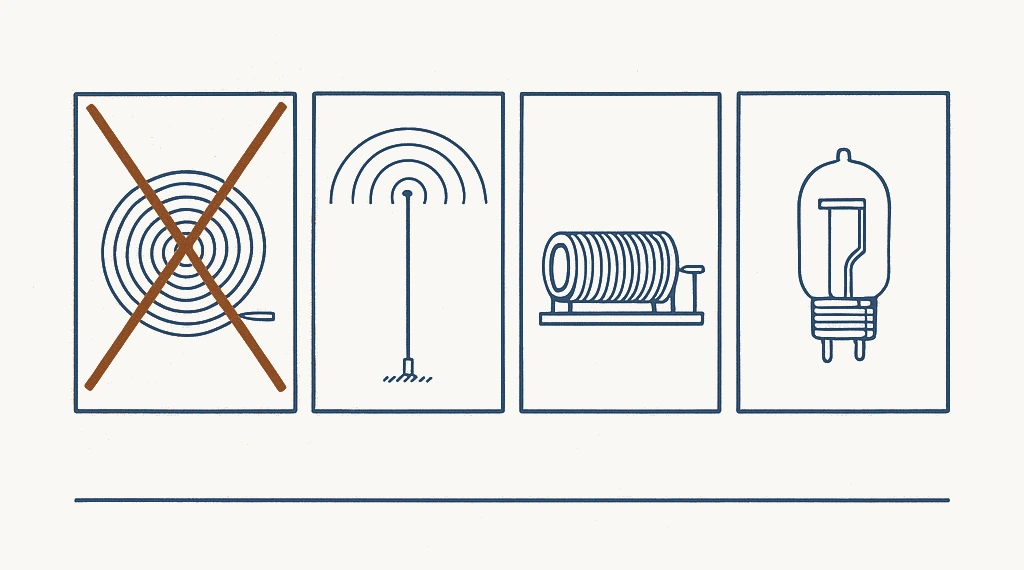
The claim
CLAIM — “In 1943 the Supreme Court ruled that Tesla, not Marconi, invented radio.”
STATUS — FALSE. The Court invalidated the broad claims of a Marconi tuning patent, on the priority of John Stone Stone, and said in terms that the patent behind Marconi's reputation was not before it.
EARLIEST TRACE — Not located. A dated instance of the claim in this form appears in the New York Times of 28 August 1984.
RESTS ON — Roughly two pages of a sixty-page opinion — 320 U.S. 1, 14–16 — in which Tesla's US 645,576 is discussed as prior art, and the date of the decision, five months after his death.
Nikola Tesla died in New York on 7 January 1943. Five months later, on 21 June, the Supreme Court decided Marconi Wireless Telegraph Company of America v. United States, 320 U.S. 1, and held invalid the broad claims of the tuning patent on which Guglielmo Marconi's company had built its position in wireless. Out of the proximity of those two dates a story has grown: that the Court, too late to tell him, gave Tesla the invention of radio.
It did not. The opinion is public, about sixty pages long before the dissents begin, and quotable to the page. What it says, in the first line of its own syllabus, is this:
The broad claims of the Marconi Patent No. 763,772, for improvements in apparatus for wireless telegraphy — briefly, for a structure and arrangement of four high-frequency circuits with means of independently adjusting each so that all four may be brought into electrical resonance with one another — held invalid because anticipated.
320 U.S. 1, syllabus ¶ 1, referring to page 38 of the opinion.
The paragraph under it names the men whose earlier work did the killing: “Marconi showed no invention over Stone (Patent No. 714,756) by making the tuning of his antenna circuit adjustable, or by using Lodge's (Patent No. 609,154) variable inductance for that purpose.” John Stone Stone and Oliver Lodge are the names the popular version deletes. Tesla is in the opinion too, in passages worth reading exactly — but no patent of his was in suit, no party was connected to him, and both patents of his that the Court discussed had expired twenty-six years earlier.
A suit about money, begun in 1916.
The case was not a referendum on who invented radio. It was a claim for damages. The Marconi Wireless Telegraph Company of America sued the United States in the Court of Claims under 35 U.S.C. § 68, which let a patent owner recover for an invention used or manufactured by or for the government without a licence, and it filed on 29 July 1916 (320 U.S. at 4 n.1). The apparatus at issue was radio gear the government used around the First World War. In November 1919 the company sold its assets to the Radio Corporation of America but kept these claims, which is why it was still in court in 1943.
The Court of Claims first held the broad claims of the tuning patent invalid in 1935, eight years before Tesla died. Justice Rutledge, dissenting, put it in one sentence: “Until 1935, when the Court of Claims held it invalid in this case, 81 Ct. Cl. 671, no court had found Marconi's patent wanting in invention” (at 67). Both sides then petitioned from the final judgment, so the case arrived as cross-petitions, Nos. 369 and 373, argued on 9 and 12 April 1943 and decided on 21 June. Chief Justice Harlan Fiske Stone wrote for the Court — no relation to the John Stone Stone whose priority decided it.
The sums were small. On the one Marconi claim the Court of Claims had upheld, it gave the company judgment for $42,984.93 with interest (at 3) — set at 65 per cent of what it would have cost the government to replace the infringing tuning condensers with induction coils, on the theory that a negotiated price would have come in under the cost of the alternative (at 49). Neither inventor was alive to hear any of it: Marconi had died in Rome on 20 July 1937.
Four patents, four different outcomes.
The company sued on four United States patents, and the story that survives collapses all four outcomes into one verdict. They were not the same.
| Patent | For | Outcome |
|---|---|---|
| US 763,772 | Marconi's four-circuit tuning apparatus, granted 28 June 1904 | Broad claims invalid as anticipated; affirmed. Claim 16, held valid and infringed below, vacated and remanded. |
| Reissue 11,913 | Marconi's original wireless patent, US 586,193 of 13 July 1897, reissued 4 June 1901 | Held not infringed in the Court of Claims. Validity never in question; neither side sought review. |
| US 609,154 | Lodge's adjustable inductance for tuning antenna circuits, granted 16 August 1898 | Held valid and infringed in the Court of Claims. Neither side sought review, so the holding stood. |
| US 803,684 | Fleming's diode valve, granted 7 November 1905 | Held not infringed below. The Supreme Court affirmed on the other ground: the patent was void for an improper disclaimer, filed in 1915, ten years late. |
The patent that made Marconi famous is the second row, and it was not on trial. The Court said so in the paragraph that ought to be the most quoted in the case and is almost never quoted at all:
Marconi's reputation as the man who first achieved successful radio transmission rests on his original patent, which became reissue No. 11,913, and which is not here in question. That reputation, however well-deserved, does not entitle him to a patent for every later improvement which he claims in the radio field. Patent cases, like others, must be decided not by weighing the reputations of the litigants, but by careful study of the merits of their respective contentions and proofs.
320 U.S. 1, 37–38.
What a four-circuit tuning claim is.
Strip the legal language and the invention in suit is an arrangement of circuits, drawn in Fig. 2 above. At the sending station there are two: a closed circuit containing a condenser, a coil and a spark gap, which generates the high-frequency oscillations, and an open antenna circuit running from an aerial down to earth, which radiates them. The two are not wired together; they are coupled through a transformer, so energy passes between them by induction. The receiving station mirrors it — an open antenna circuit picking up the wave, coupled through a transformer to a closed circuit containing the detector.
The claimed advance was that all four circuits be brought to the same electrical period. Marconi's specification puts the requirement arithmetically: the capacity and self-induction of the four circuits “are each and all to be so independently adjusted as to make the product of the self-induction multiplied by the capacity the same in each case or multiples of each other — that is to say, the electrical time periods of the four circuits are to be the same or octaves of each other” (at 7).
Two things follow, and they are the whole commercial value. The oscillations in the transmitter's antenna persist longer for the same input energy, so more of what goes in leaves the aerial as signal. And the receiver becomes selective: set two receiving stations to different periods and only the one you have matched will answer. The patent's stated object is to “provide new and simple means whereby oscillations of electrical waves from a transmitting station may be localized when desired at any one selected receiving station or stations out of a group of several receiving-stations” (at 6). The invention claimed was never sending signals without wires; by 1900 that was ordinary. It was sending them so that only the intended station heard.
The name the story deletes.
John Stone Stone filed his application on 8 February 1900, nine months before Marconi filed his on 10 November 1900, and it issued as US 714,756 on 2 December 1902, a year and a half before Marconi's. The Court's description is blunt: it “showed a four-circuit wireless telegraph apparatus substantially like that later specified and patented by Marconi” (at 17). The hard question was narrow and technical — Stone had amended his specification in 1902, after Marconi's filing date, to say explicitly that the two antenna circuits should also be resonant, and the company argued that the amendment added new matter rather than making the original application explicit.
The Court spent roughly twenty pages on that question, against two on Tesla, and resolved it against the company, partly on Stone's own letters of June and July 1899, in which he set out the four-circuit system and wrote that “the tuning of these circuits one to another and all to the same frequency will probably be best accomplished empirically” (at 32–33). Its conclusion, at page 38, is careful about what it is not deciding: “we are forced to conclude, without undertaking to determine whether Stone's patent involved invention, that the Court of Claims was right in deciding that Stone anticipated Marconi.”
A footnote makes the outcome look less like a modern reversal than like a return to the Patent Office's first instinct. Marconi's application “was at one time rejected by the Patent Office because anticipated by Stone, and was ultimately allowed… on the sole ground that Marconi showed the use of a variable inductance as a means of tuning the antenna circuits” (at 31 n.18). Rutledge's dissent walks through the sequence of rejections — on Lodge and an earlier Marconi patent, then on Lodge, that earlier patent, Braun and others, then on Tesla, and finally on Stone — before the patent issued on 28 June 1904 (at 67).
Lodge supplies the other missing name. His US 609,154, applied for on 1 February 1898 and allowed that August, put an adjustable induction coil in the antenna circuit so that transmitter and receiver could be tuned to each other — the mechanism Marconi later used. By the time of this suit that patent belonged to the Marconi company, which sued on it and won on it. The shape of the result is worth holding on to: the company left the Supreme Court having lost the broad claims of Marconi's tuning patent and keeping, unreviewed, the ruling that the government had infringed Lodge's.

Where Tesla actually appears.
His name turns up in a dozen places in the majority opinion; three passages carry the weight. The first is a sentence of background in the recital of prior art, at page 13: “A year later Tesla, who was then preoccupied with the wireless transmission of power for use in lighting or for the operation of dynamos, proposed, in a lecture before the Franklin Institute in Philadelphia, the use of adjustable high frequency oscillations for wireless transmission of signals.”
The second, at pages 14 to 16, is the substantial one, and it is the passage the myth is built on. It is also stronger than a debunking would like it to be, which is why it is quoted here in full rather than paraphrased:
The Tesla patent No. 645,576, applied for September 2, 1897 and allowed March 20, 1900, disclosed a four-circuit system, having two circuits each at transmitter and receiver, and recommended that all four circuits be tuned to the same frequency.
320 U.S. 1, 14.
Tesla thus anticipated the following features of the Marconi patent: A charging circuit in the transmitter for causing oscillations of the desired frequency, coupled, through a transformer, with the open antenna circuit, and the synchronization of the two circuits by the proper disposition of the inductance in either the closed or the antenna circuit or both. By this and the added disclosure of the two-circuit arrangement in the receiver with similar adjustment, he anticipated the four-circuit tuned combination of Marconi.
320 U.S. 1, 15–16.
That is a real finding and should not be softened: on the Court's reading, Tesla's 1897 application described the four tuned circuits before Marconi did. The very next sentence sets the limit. “A feature of the Marconi combination not shown by Tesla was the use of a variable inductance as a means of adjusting the tuning of the antenna circuit of transmitter and receiver. This was developed by Lodge after Tesla's patent but before the Marconi patent in suit” (at 16). Tesla had the arrangement; Lodge had the knob.
The third comes not in the recital of prior art but in the Court's own reasoning, one sentence at page 31: “Tesla, too, had shown the tuning of the antenna circuit at the transmitter to the frequency developed by the charging circuit, and the tuning of both circuits at the receiver to the frequency thus transmitted.”
Then comes the sentence that settles what the judgment rests on. Having decided the case on Stone, the Court declined to reach the alternative ground: “In view of our interpretation of the Stone application and patent we need not consider the correctness of the court's conclusion that even if Stone's disclosures should be read as failing to direct that the antenna circuits be made resonant to a particular frequency, Marconi's patent involved no invention over Lodge, Tesla, and Stone” (at 38). The Court of Claims had been willing to rest partly on Tesla. The Supreme Court was not.
The vote was not lopsided either. Justice Murphy took no part (at 60). Justice Frankfurter dissented in part, joined by Justice Roberts, writing that Marconi “hit upon something that had eluded the best brains of the time working on the problem of wireless communication — Clerk Maxwell and Sir Oliver Lodge and Nikola Tesla” (at 62). Justice Rutledge dissented separately and at length, and his picture of the field is the fairest sentence in the volume: “There, seeking, among others, were Tesla, Lodge and Stone, old hands and great ones” (at 65). Five to three, with one abstention.
What US 645,576 and US 649,621 do and do not cover.
Both patents are linked below, and their claims are the fastest way to see why “Tesla's radio patents” is a misdescription. US 645,576, System of Transmission of Electrical Energy, filed 2 September 1897 and granted 20 March 1900, ends in nine numbered claims, every one a method claim opening “The method hereinbefore described of transmitting electrical energy”, and eight of the nine going on “through the natural media”. The mechanism claimed is conduction: an electromotive force between earth and an elevated terminal high enough to make the rarefied upper air conduct, with the energy collected at a second elevated terminal far away. The specification proposes captive balloons as terminals, at thirty to thirty-five thousand feet, with impulses “not greatly exceeding fifteen or twenty million volts”. Not one claim mentions a message, a signal, a key or a detector.
Messages appear exactly once in the whole of US 645,576, in the sentence the Court quoted, and there they are an aside: “While the description here given contemplates chiefly a method and system of energy transmission to a distance through the natural media for industrial purposes… the apparatus which I have shown will obviously have many other valuable uses — as, for instance, when it is desired to transmit intelligible messages to great distances, or to illuminate upper strata of the air…”. Note which half of that sentence says what the patent is for. The Court quoted the concession, which was the part it needed, and the quotation has travelled ever since without the clause that governs it.
US 649,621 is the divisional apparatus patent from the same 1897 application, filed 19 February 1900 and granted 15 May 1900. Its claims are combinations of transmitting and receiving coils, each connected to ground and to an elevated terminal, with capacity and inductance proportioned “to secure synchronism”. Its specification contains the sentence that should end the argument about what these documents are:
It is to be noted that the phenomenon here involved in the transmission of electrical energy is one of true conduction and is not to be confounded with the phenomena of electrical radiation which have heretofore been observed and which from the very nature and mode of propagation would render practically impossible the transmission of any appreciable amount of energy to such distances as are of practical importance.
United States Patent 649,621, specification, granted 15 May 1900.
Rutledge noticed it: “Tesla in fact did not use Hertzian waves… As he did not use Hertzian waves, he had no such problem of selectivity as Marconi, Lodge, Stone and others were working on later” (at 68 n.11). The patents the myth calls Tesla's radio patents are, in their own words, wireless-power patents that expressly distinguish themselves from radiation — which is why the Court could treat US 645,576 as prior art for a tuning arrangement without deciding anything at all about who invented radio.
One more fact disposes of the idea that anything was restored to anyone. Under the law then in force a United States patent ran seventeen years from grant, so US 645,576 expired on 20 March 1917 and US 649,621 on 15 May 1917. By June 1943 both had been public property for twenty-six years.
Why the date looks like vindication.
Because it falls five months after a famous death, and because the losing name is the one everybody knows. Nothing in the record supports the reading. Tesla was not a party; no claim of his estate was before the Court; the invalidity holding had been made in 1935 while he was alive; and the only sum the opinion names, $42,984.93, was money owed to a corporation. The version in which the government invalidated the patent to escape paying fails too: the Lodge holding stood unreviewed, and the Court did not erase the award on Claim 16 — it vacated and remanded so the Court of Claims could reconsider (at 48).
The claim is easy to find in print. The New York Times of 28 August 1984 carried the sentence “It was Nikola Tesla, not Marconi, who invented radio. Indeed in 1943 the Justices of the Supreme Court of the United States overturned Marconi's patent because they found it had been preceded by Tesla's practical achievements in radio transmission.” That is quoted here at second hand, from A. David Wunsch's 1998 article in Antenna, which also records a National Park Service leaflet at the Cape Cod Marconi station saying much the same thing.
What the case is actually good for.
It is one of the better documents in the history of radio, though not for the reason it is usually cited. It is a court reading four inventors' applications side by side and finding that the arrangement everyone remembered as one man's leap was already in three other men's papers: Tesla's of 1897, Lodge's of 1898, Stone's of 1900 and his letters of 1899. Frankfurter thought that the wrong way to read invention, and said so in terms worth keeping — “seldom indeed has a great discoverer or inventor wandered lonely as a cloud” (at 62). He and the majority disagreed about the legal consequence, not about the picture.
The myth takes that picture, deletes Stone and Lodge, and hands the whole thing to a single name — the same operation it claims to be correcting, run in the other direction. The opinion is free, and it is linked below.
The document
Marconi Wireless Telegraph Company of America v. United States, 320 U.S. 1 (1943). Argued 9 and 12 April 1943, decided 21 June 1943, on certiorari to the Court of Claims. Opinion by Chief Justice Stone; Frankfurter, J., dissenting in part, joined by Roberts, J.; Rutledge, J., dissenting in part; Murphy, J., took no part.
Official text: United States Reports, volume 320, page 1 (PDF, Library of Congress). Every page cite in this article refers to that pagination, and the same opinion is searchable as text at Cornell's Legal Information Institute.
The two Tesla patents discussed in it are listed with their filing and grant dates in the patent table.
The record so far
- False “The 1943 decision awarded the invention of radio to Tesla.” It invalidated the broad claims of Marconi's tuning patent, US 763,772, on the priority of John Stone Stone, and expressly declined to decide the alternative ground that involved Tesla and Lodge.
- False “Wardenclyffe was going to give the world free energy.” The March 1901 agreement covered transatlantic wireless telegraphy, and the plant on the site burned coal. Read the contract and the patents
- False “Tesla invented alternating current.” Alternating current, transformers and AC lighting all predate him. What he patented in US 381,968 is narrower, and more interesting. Read the patent
Sources — primary documents
- Marconi Wireless Telegraph Company of America v. United States, 320 U.S. 1 (1943). Official US Reports text (PDF); searchable text at Cornell LII.
- Court of Claims below: 81 Ct. Cl. 671 (1935), the interlocutory decision holding the broad claims invalid; 99 Ct. Cl. 1, the final judgment affirmed in part on 21 June 1943.
- United States Patent 763,772, Marconi, Apparatus for Wireless Telegraphy, filed 10 November 1900, granted 28 June 1904 — the patent in suit.
- United States Patent 586,193, Marconi, granted 13 July 1897, reissued 4 June 1901 as Reissue 11,913 — the original wireless patent, not in question in the case.
- United States Patent 714,756, Stone, filed 8 February 1900, granted 2 December 1902 — the anticipation the judgment rests on.
- United States Patent 609,154, Lodge, filed 1 February 1898, granted 16 August 1898 — the variable inductance.
- United States Patent 803,684, Fleming, granted 7 November 1905 — the valve, voided by an improper disclaimer.
- United States Patent 645,576, Tesla, System of Transmission of Electrical Energy, filed 2 September 1897, granted 20 March 1900 — nine method claims, all for transmission through the natural media.
- United States Patent 649,621, Tesla, Apparatus for Transmission of Electrical Energy, filed 19 February 1900, granted 15 May 1900 — the divisional apparatus patent, containing the “true conduction” sentence.
Sources — further reading
- A. David Wunsch, “Misreading the Supreme Court: A Puzzling Chapter in the History of Radio”, Antenna (the Mercurians, Society for the History of Technology), November 1998. Full text. The article that first collected the misreadings, including the 1984 newspaper sentence quoted above.
- Wallace Edward Brand, “Rereading the Supreme Court: Tesla's Invention of Radio”, Antenna, 1999 — the reply to Wunsch, arguing the opposite reading of the same opinion. Full text.
- Thomas H. White, “Nikola Tesla: The Guy Who DIDN'T ‘Invent Radio’”, earlyradiohistory.us — a document-by-document survey of the same ground.