1893–1900 · Chicago, Niagara, Colorado Springs
The earthquake machine: 1901, 1912, 1935 and 1944
The oscillator is real, patented three times over and photographed in 1894. The earthquake exists in four tellings spread across forty-three years, and they disagree about the year, the place, the machine, and what the police were told.
The claim
CLAIM — “Tesla's pocket-sized oscillator shook a New York city block to the point of collapse. The police charged into the laboratory, and he destroyed the machine with a sledgehammer as they came through the door.”
STATUS — MIXED. The oscillator is real and well documented. The earthquake exists in four tellings across forty-three years, all of them Tesla's own or taken down from him, and no two agree. The year moves, the building moves, the machine changes size, and the police are told different things — or nothing.
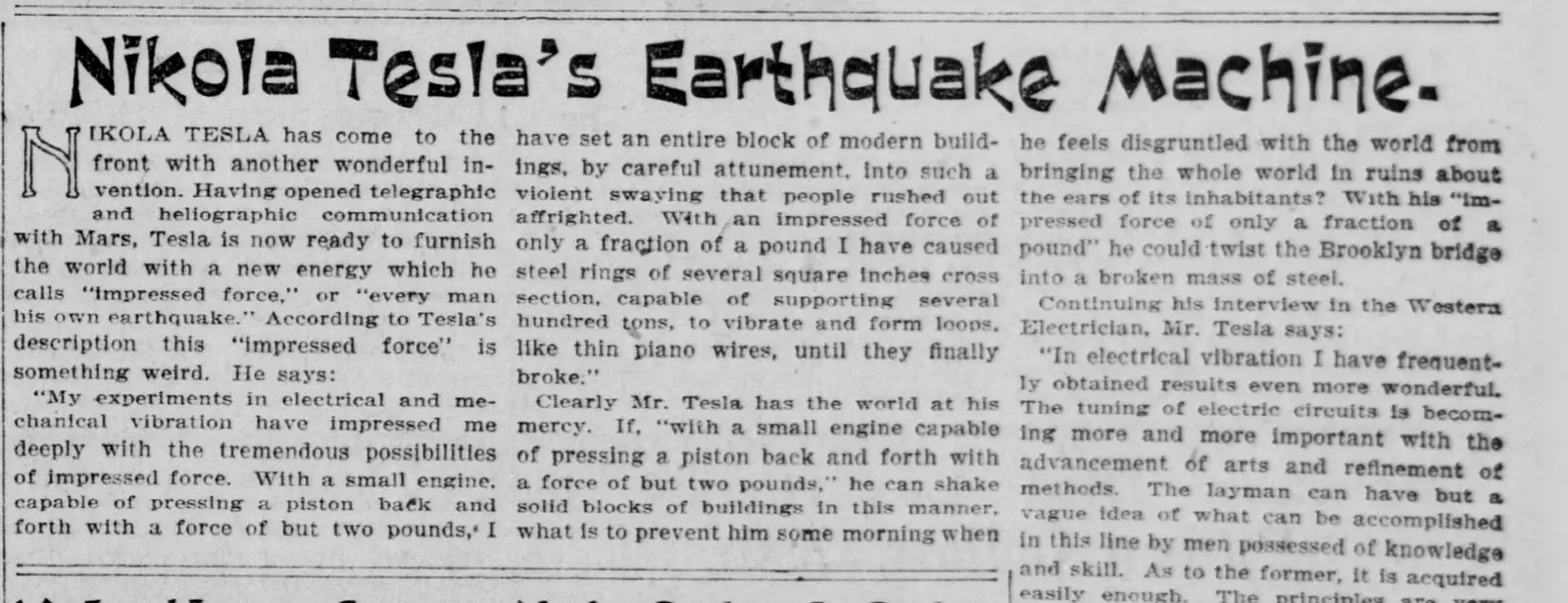
EARLIEST TRACE — Tesla himself, in an interview telegraphed from New York on the evening of 4 January 1901 and printed in the Western Electrician of 5 January. A month later the San Francisco Call reprinted it under the standing headline “Nikola Tesla's Earthquake Machine.” That is forty-three years before the biography usually blamed for the story.
RESTS ON — A real machine, a real physical principle, and an anecdote Tesla retold at intervals for the rest of his life, enlarging it each time. The version with the police bursting in comes from a biography published in 1944, whose author writes on the page that Tesla never told him the ending.
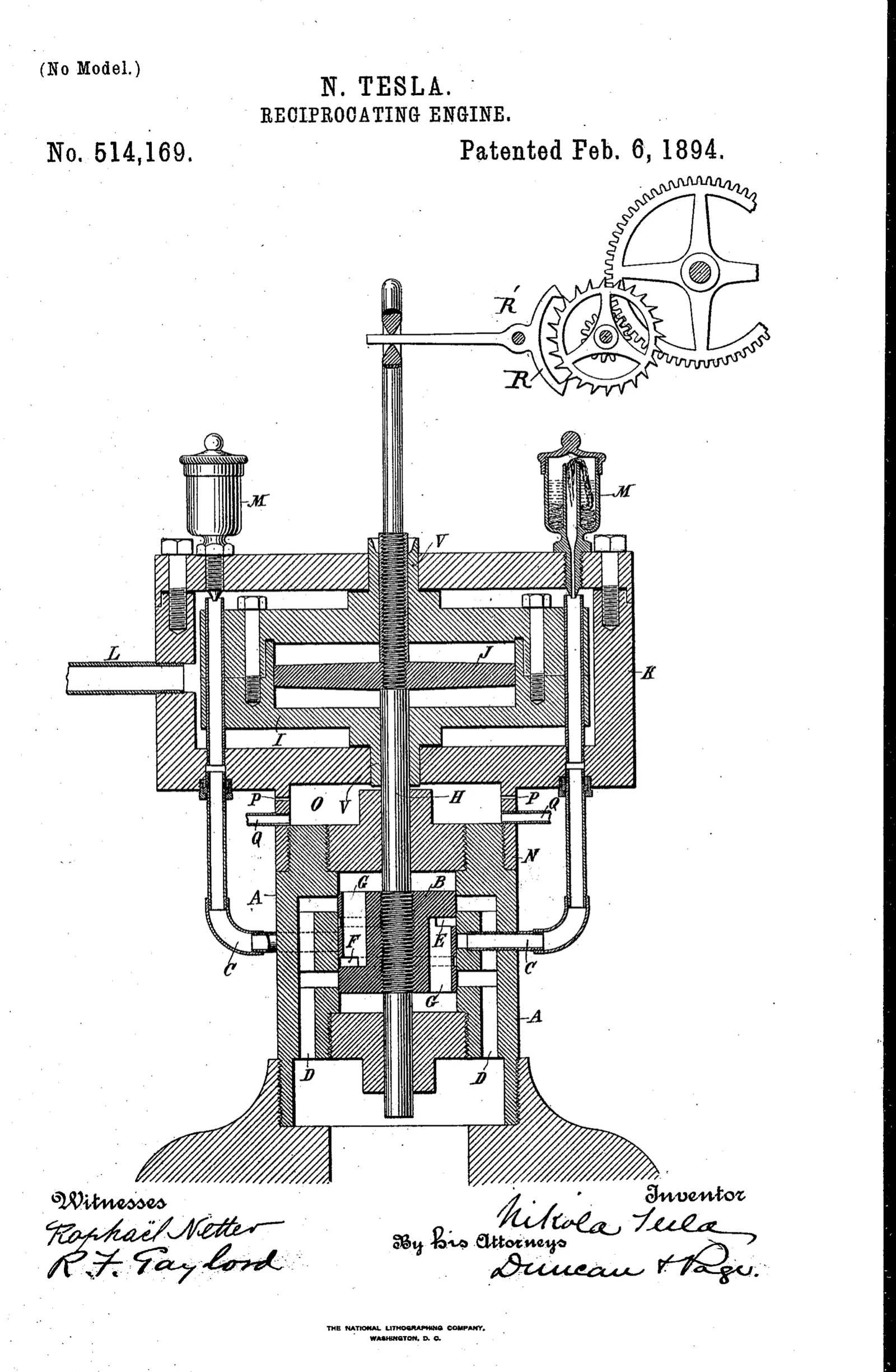
Begin with the part that is solid, because it is better than the legend. Between August and December 1893 Tesla filed three applications on a machine with no flywheel, no governor and no crank. US 514,169, Reciprocating Engine, was filed on 19 August 1893 under Serial No. 483,563 and granted on 6 February 1894. On the very same day he filed Serial No. 483,562, which became US 511,916, Electric Generator — its specification opens by pointing at “an application of even date herewith, Serial No. 483,563”, so the two documents are the engine and the dynamo built on it. A third, US 517,900, Steam-Engine, followed on 29 December 1893.
What the engine does is stated plainly in its own first paragraph: to yield “an oscillatory movement which, within very wide limits, will be of constant period, irrespective of variations of load, frictional losses and other factors which in all ordinary engines produce change in the rate of reciprocation.” The trick is an air spring working against the piston, “so that the alternate impulses of the power impelled piston, and the natural vibrations of the spring shall always correspond in direction and coincide in time.” Tesla had built a mechanical clock out of a steam engine.
The contemporary account, and the man who wrote it.
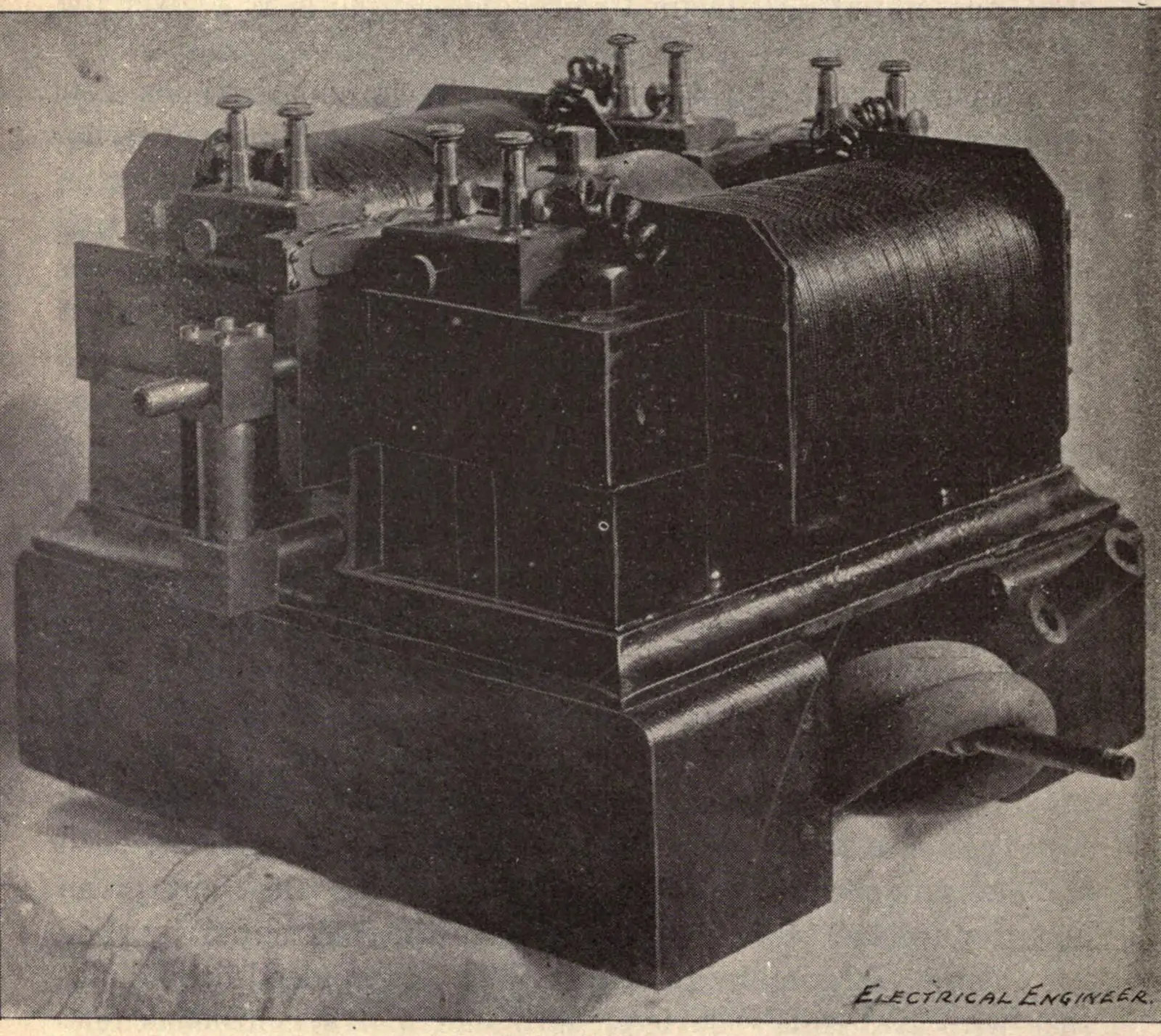
The machine was not a secret, and the best description of it is not Tesla's. In April 1895 The Century Magazine published “Tesla's Oscillator and Other Inventions” across pages 916 to 933, by T. Commerford Martin — an electrical engineer, editor of The Electrical Engineer, and the man who the year before had compiled Tesla's lectures and papers into the standard volume. The article is subtitled “An Authoritative Account of Some of His Recent Electrical Work”, and a footnote on its first page records that the photographs in it “were taken, under the special direction of the inventor, by Tonnelé & Co.” This is as close to Tesla's own voice as a third-party account gets.
Martin gives numbers the patents withhold. The steam form ran at 350 pounds of pressure, “although as low as 80 is also used in like oscillators”. For the same pressure and piston speed the engine weighed “about one thirtieth or one fortieth of the usual weight”. And the regularity was the point: “one could keep the time o' day with the machine about as well as with a clock.” His summary of what Tesla had thrown away is the best sentence anyone has written about it — “The steam-chest is the engine, bared to the skin like a prize-fighter, with every ounce counting.”
Martin's article runs to eighteen pages on this machine and its works. It does not contain the words earthquake, tremor or shook. Neither does his 1894 collection of everything Tesla had published to that date. Neither does My Inventions, the autobiography Tesla serialised in 1919.
What Tesla said about it when it was new.
There is one more contemporary document, and it is the most useful of all, because it is Tesla presenting this machine himself while it was six days old as a patent application. On the evening of Friday 25 August 1893 he lectured on his mechanical and electrical oscillators to the Electrical Congress at the World's Fair in Chicago, in the hall next to the Agricultural Building, introduced by Elisha Gray. He brought an air compressor driven by an electric motor, and Martin printed a long report of the evening.
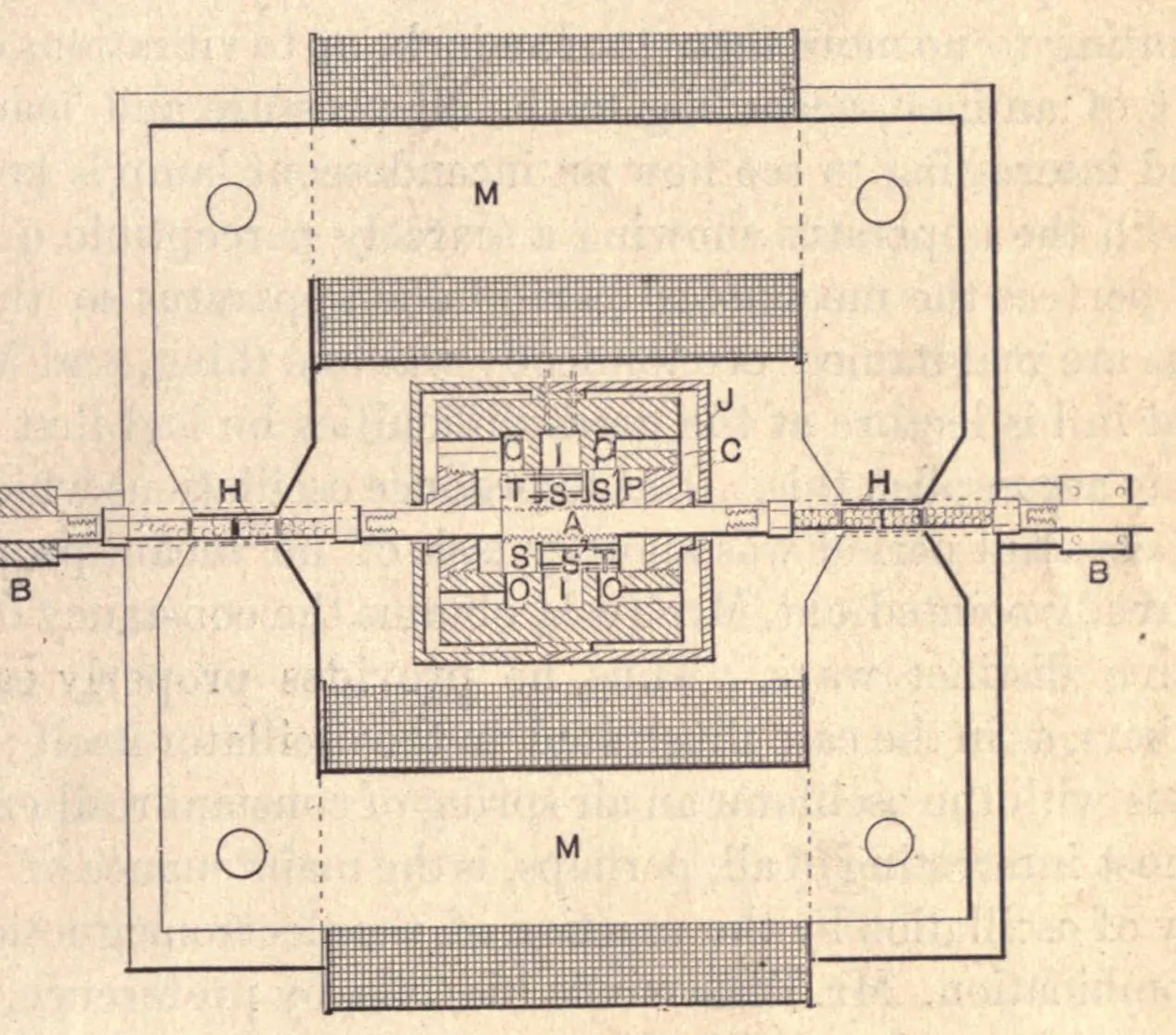
That report is where the numbers are. In one demonstration Tesla “vibrates a weight of approximately 20 pounds at the rate of about 80 per second and with a stroke of about ⅜ inch, but by shortening the stroke the weight could be vibrated many hundred times, and has been, in other experiments.” He showed a clock that could be hung on an oscillator and would keep correct time. He explained that the arrangement “acts exactly like a string tightly stretched between two points, and with fixed nodes”. And he passed round the pieces of a steel arbor which had been torn apart while vibrating against a minute air cushion — proof, in his hand, that the machine could destroy metal.
He also said, in 1893, exactly what he thought the thing was for. Martin's report closes: “He laid special stress on the facility now afforded for investigating the effect of mechanical vibration in all directions.” The interest in vibration as a subject is therefore documented from the beginning, in Tesla's own voice, in front of an audience. The earthquake is not.
The first telling: January 1901, and a headline
The story is very much older than the biography it is usually traced to. Late on the evening of Friday 4 January 1901 Tesla was seen at the Waldorf-Astoria by Frank L. Perry of the Western Electrician, who telegraphed the interview to Chicago in time for the paper's Twentieth Century number the following day. Asked what electrical science would achieve in the new century, Tesla answered mostly about resonance, and then said this:
My own experiments in electrical and mechanical vibration have impressed me deeply with the tremendous possibilities in this direction. With a small engine capable of pressing a piston back and forth with a force of but two pounds, I have set an entire block of modern buildings, by careful attunement, into such a violent swaying that people rushed out affrighted. With an impressed force of only a fraction of a pound, I have caused steel rings of several square inches cross-section, capable of supporting several hundred tons, to vibrate and form loops like thin piano wires, until they finally broke.
“Tesla's Twentieth-Century Views”, interview by Frank L. Perry, Western Electrician, vol. XXVIII, 5 January 1901, page 8b.
Note what is there in 1901 and what is not. An entire block of buildings, yes — and two pounds, not five. But there is no year, no laboratory, no Houston Street, no hammer and no police. The broken steel rings are the only part that matches the 1893 lecture, where the arbor was passed round the room.
A month later the San Francisco Call reprinted the interview, wrapped it in some cheerful alarm — Tesla is offering the world “a new energy which he calls ‘impressed force,’ or every man his own earthquake” — and gave it a headline.
The second telling: 1912, and the pocket.
Eleven years later the anecdote has grown a location, a cast and a piece of stage business that will outlive everything else in it. In a magazine profile of February 1912, Allan L. Benson sets it up with a different experiment first: Tesla orders a steel link two feet long and two inches thick, strong enough to carry hundreds of tons, clamps to it “an electric vibrator, no larger than an alarm-clock”, and tunes it until the link “dilated and contracted like a beating heart — and finally broke”. Benson's gloss is worth keeping, because of where the tool ends up thirty-two years later: “Sledge hammers could not have done it; crowbars could not have done it, but a fusillade of taps, no one of which would have harmed a baby, did it.”
Then Tesla puts “his little vibrator in his coat pocket” and goes out “to hunt a half-erected steel building”. He finds one in the Wall Street district, ten storeys of bare steel frame, clamps the vibrator to a beam, and waits. Tesla, quoted:
In a few minutes, I could feel the beam trembling. Gradually, the trembling increased in intensity and extended throughout the whole great mass of steel. Finally, the structure began to creak and weave, and the steelworkers came to the ground panic-stricken, believing that there had been an earthquake. Rumors spread that the building was about to fall, and the police reserve were called out. Before anything serious happened, I took off the vibrator, put it in my pocket and went away.
Allan L. Benson, “Nikola Tesla, Dreamer”, The World To-Day, vol. XXI no. 8, February 1912, pages 1763–1767. Quoted here from the syndicated reprint in the Oamaru Mail, Otago, New Zealand, 9 March 1912, page 3 of the supplement, which is free to read. Digitised page, National Library of New Zealand.
This is where the pocket enters, and it is worth being exact about what it is doing. In 1912 the vibrator goes into the pocket at the end, as the way Tesla leaves the scene. By 1935 the pocket has migrated into the description of the machine itself, and by 1944 it is the first thing anyone says about it. The same profile carries the two largest claims of the whole sequence: that the same vibrator could “drop Brooklyn Bridge into the East River in less than an hour”, and that Tesla could split the earth “as a boy would split an apple”.
And note the building. In 1912 it is an unfinished steel frame in the financial district, with steelworkers on it. It is not his laboratory, and he goes out looking for it.
The third and fourth tellings, on one afternoon in 1935
On 10 July 1935 Tesla held his annual birthday press reception at the Hotel New Yorker. It ran six hours. The report that appeared the next morning in the New York World-Telegram, under Earl Sparling's byline, is remarkably candid about the room:
Nikola Tesla is 79 years old, and he is one of the true geniuses of this time. Nevertheless, twenty-odd newspapermen came away from his Hotel New Yorker birthday party yesterday, which lasted six hours, feeling hesitantly that something was wrong either with the old man's mind or else with their own.
Earl Sparling, “Nikola Tesla, at 79, Uses Earth to Transmit Signals; Expects to have $100,000,000 Within Two Years”, The New York World-Telegram, 11 July 1935.
The same piece reports Tesla announcing that he had discovered the cosmic ray in 1896 and that some cosmic particles travel five hundred times faster than light. Under a sub-heading reading Tells of “Quake”, it goes on:
He said, among other things, that he expects to have $100,000,000 within two years, and he revealed that an earthquake which drew police and ambulances to the region of his laboratory at 48 E. Houston St. in 1887 or 1888 was the result of a little machine he was experimenting with at that time which “you could put in your overcoat pocket.”
Asked to tell it properly, Tesla did:
I was experimenting with vibrations. I had one of my machines going and I wanted to see if I could get it in tune with the vibration of the building. I put it up notch after notch. There was a peculiar cracking sound.
I asked my assistants where did the sound come from. They did not know. I put the machine up a few more notches. There was a louder cracking sound. I knew I was approaching the vibration of the steel building. I pushed the machine a little higher.
Suddenly all the heavy machinery in the place was flying around. I grabbed a hammer and broke the machine. The building would have been down about our ears in another few minutes. Outside in the street there was pandemonium. The police and ambulances arrived. I told my assistants to say nothing. We told the police it must have been an earthquake. That's all they ever knew about it.
Same article. The World-Telegram is not in any freely readable newspaper archive; this is quoted from transcription, and three independent transcriptions of it agree word for word. See the search log.
Note what is in that and what is not. There is a hammer, not a sledgehammer. There is no squad of policemen coming through the door. The police arrive in the street, are told it was an earthquake, and go away none the wiser — which is the exact opposite of the scene the story is now told for. The building is now his own laboratory, which it was not in 1912.
But the most useful thing about that afternoon is that a second reporter was in the same room and filed a different version of the same anecdote. The United Press account went out on the wire the same day and ran across the country. It is worth reading beside Sparling's:
The inventor, whose 700 basic patents include widely used methods of large-scale distribution of electricity, assumed on his 79th birthday the aspect of a sinister wizard, when he confessed that in his bony, wedge-shaped head started the Houston street earthquake of 37 years ago. One day violent temblors shook a neighborhood. They centered mysteriously, in one building. People were thrown into panic. Firemen and police responded to alarms. Suddenly the vibrations stopped. Tesla said the “quake” ceased when he snatched up a hammer and knocked a gadget from the wall of his laboratory. His workshop then was in the most affected building. Where it is now he refused to reveal.
United Press, “Noted Inventor Uses Birthday to Reveal ‘Earthquake Maker’”, Imperial Valley Press, El Centro, California, 11 July 1935, page 2. The same copy ran in the Washington Daily News, the Waterbury Democrat and the Indianapolis Times that day.
“Thirty-seven years ago” from 1935 is 1898. Sparling, in the same room, on the same afternoon, wrote down 1887 or 1888. The two accounts of a single press conference are a decade apart on the date, and they put the machine in different places — Sparling's on no stated mounting, the wire's knocked off a wall. Whatever else this shows, it shows that the date was already unstable before it left the hotel.
Line the tellings up, and the drift is the finding.
1901: no date at all, an entire block of buildings, two pounds, no laboratory and no police. 1912: no date, a half-built steel frame in the Wall Street district, steelworkers, and the police reserve called out. 1935, Sparling: 1887 or 1888, his own laboratory at 48 E. Houston Street, a hammer, and the police told it was an earthquake. 1935, United Press: thirty-seven years ago — so 1898 — Houston Street, the gadget knocked off a wall, firemen and police responding to alarms. 1944, O'Neill: 1896, Houston Street, the machine screwed to an iron pillar, a dozen square city blocks, and the police in the room.
Three years are on offer. One of them is impossible, and the other two are merely unsupported — a distinction worth keeping, because it is easy to wave all three away at once and that would be the wrong result.
1887 or 1888 cannot be right. The machine was not filed as a patent application until 19 August 1893, five to six years later; in 1887 and 1888 Tesla was doing something else entirely and it is very well dated, since US 381,968, the motor on which the whole polyphase system rests, was filed on 12 October 1887 and granted on 1 May 1888. The address fails on the same date. East Houston Street was not his until after the fire that destroyed the laboratory he had, which Scientific American reported ten days after it happened: “By a fire which occurred at 33 and 35 South Fifth Avenue, New York City, on the morning of March 13, Nikola Tesla, the inventor and scientist, sustained a severe loss in the total destruction of his laboratory.” In the period Sparling's copy names, Tesla was working on Grand Street, and he says so himself twice over in 1919: in My Inventions, recalling “the first tiny spark I observed in my Grand Street laboratory”, and in “The True Wireless” that he resumed research “in my laboratory on Grand Street, New York” once Hertz's work reached him. That account therefore puts a machine patented in 1893 inside a laboratory occupied from 1895, in the year 1887. (The street number is not one of the problems: Sparling writes 48 and O’Neill writes 46, and Tesla’s own letterhead of November 1898 reads “46 and 48 East Houston St.” The laboratory had both.)
1896 and 1898 both survive that test. By either year Tesla had the oscillators and had the Houston Street rooms — they are where he showed the radio-controlled boat in November 1898. What neither year has is any corroboration: no contemporary report of a tremor in that district has been located, and the two dates come from two reporters in the same room on the same afternoon. They cannot both be right, and nothing in the record chooses between them.
That the earliest dated version is impossible is measured, from the patent faces and the fire. Why the dates wander is not measured. A man of seventy-nine reaching back across four decades at the end of a six-hour reception will misremember, and that is the obvious explanation — but it is an inference, and it is offered as one.
The second telling, which is the one everybody repeats
A year after Tesla's death, the version with the police arrived. John J. O'Neill — science editor of the New York Herald Tribune, who had known Tesla — published Prodigal Genius in 1944. Its chapter ten is the earthquake chapter, and it is where the familiar details come from: the date moved to 1896, the oscillator screwed to an iron support pillar, “an area of a dozen square city blocks” shaking, pipes bursting, machinery shifting on its bolts, police headquarters in Mulberry Street emptying, and a squad running up the stairs to find Tesla lowering a sledgehammer and bowing from the waist — “Gentlemen, I am sorry, but you are just a trifle too late to witness my experiment.”
It is a wonderful scene. Note what has happened to the sledgehammer: in 1912 it was the thing that could not break the steel, the whole point being that a fusillade of gentle taps could. By 1944 it is in Tesla's hands. O'Neill is also the one who tells you not to trust the scene, three separate times, in his own text.
On what Tesla was doing that morning: “Just what experiment he had in mind on this particular morning will never be known.” On how the story ends:
George Scherff, Tesla's secretary, was standing nearby when Tesla so dramatically smashed his earthquake maker. Tesla never told the story beyond this point, and Mr. Scherff declares he does not recall what the response of the cops was. Imagination must finish the finale to the story.
John J. O'Neill, Prodigal Genius: The Life of Nikola Tesla, Ives Washburn, New York, 1944, chapter ten. Emphasis added.
And on where he got it at all: “Tesla related this experience to me when I asked the inventor's opinion of a plan that I had suggested some time previously to Elmer Sperry, Jr.” — a proposal to mount gyroscopes in earthquake country and bleed off seismic strain in small releases. The story was told, in other words, as an argument in favour of somebody else's idea, in conversation, in the late 1930s.
So the chain is: an event never dated when it was first told; recalled at intervals across four decades, growing at each retelling; and finished in 1944 by a journalist who says on the page that he is finishing it. George Scherff is the only named witness in either account, and the one thing recorded of his testimony is that he did not remember. O'Neill adds one more line that is rarely quoted: “we have no records available of any further major experiments with vibration in that laboratory.”
What the machine could and could not do.
The physics Tesla invoked is not in doubt, and he stated it correctly. Pushed at a structure's own natural frequency, small repeated impulses add rather than cancel, and the amplitude climbs. His own gloss at the 1935 party was the standard schoolroom one: “It would only be necessary to step up the vibrations of the machine to fit the natural vibration of the building and the building would come crashing down. That's why soldiers always break step crossing a bridge.” Asked what it would take to bring down the Empire State Building, he answered: “Five pounds of air pressure. If I attached the proper oscillating machine on a girder that is all the force I would need, five pounds. Vibration will do anything.” In 1901 the same feat had cost two pounds — and in the same breath “only a fraction of a pound” was breaking steel rings rated to hold several hundred tons. The force required moves with the telling, which is a sign of a figure doing rhetorical rather than arithmetical work.
What is missing is any number anyone measured. The three patents give no dimension, no weight and no rate of vibration whatever — the specifications are written entirely in terms of ratios and proportions. The only size statement in any located source is Benson's in 1912, and it is a comparison rather than a measurement: a vibrator “no larger than an alarm-clock”. The one place figures appear at all is Martin's report of the 1893 lecture, and they describe a demonstration rather than a device anyone weighed: a moving mass of about twenty pounds, about eighty oscillations a second, a stroke of three-eighths of an inch. The figures that circulate online — that the earthquake machine was about seven inches long and weighed a pound or two — are in none of it: not the patents, not Martin, not Benson, not the 1935 reports, not O'Neill, and not on the page most often cited for them. They have no located source at all. Real buildings also damp: energy fed in at resonance is bled away as heat in joints, cladding and soil, and the steady state is reached where input and loss balance. Whether a hand-portable air engine could outrun that in a loft building is not something the documents settle, and nothing here settles it either.
The one widely seen attempt to test it was a television experiment — the MythBusters episode “Earthquake Machine”, first broadcast on 30 August 2006 — in which a purpose-built oscillator was clamped to a steel truss bridge. It produced vibration detectable at a distance and no structural damage, and the programme called the myth busted. That is a demonstration rather than a published experiment, and the machine was the programme's own design rather than Tesla's, so it belongs here as what has actually been tried, not as a refutation of a patent.
What is left standing
Quite a lot, and none of it needs the earthquake. Tesla built an engine whose period was set by a spring rather than by a flywheel, got the same work from a thirtieth of the metal, and used it to generate current with nothing in the machine going round. He understood resonance well enough to make it the organising idea of his entire career, in the tuned circuits of the coil as much as in iron and air. And the ambition the story is usually taken to prove — sending mechanical impulses through the ground itself — was a real and separate proposal. At that same 1935 reception he called it his “Earth vibrating machine”, was cagey about how it worked, and said he believed it would be “the chief thing of my many inventions posterity will thank me for”.
The honest summary is narrower than the legend and more interesting than a debunking. A documented machine, a correctly stated principle, and an anecdote that grew for forty-three years: two pounds in 1901 and five by 1935, a block of buildings that becomes a half-built steel frame and then his own laboratory, a date that is absent at first and then wrong three different ways, and an ending that its last teller says he supplied himself.
The document
Three patents are the spine of this article, and all three were read from the patent faces rather than from any list: US 514,169, Reciprocating Engine, filed 19 August 1893 under Serial No. 483,563 and granted 6 February 1894; US 511,916, Electric Generator, filed the same day under Serial No. 483,562 and granted 2 January 1894; and US 517,900, Steam-Engine, filed 29 December 1893 under Serial No. 495,079 and granted 10 April 1894. The first two carry consecutive serial numbers and the generator issued five weeks before the engine it is built on. All three are on the patent list.
Two contemporary accounts describe the machine in use and contain nothing resembling the story. The earlier is chapter XLIII of T. Commerford Martin's The Inventions, Researches and Writings of Nikola Tesla, 1894, pages 486–493, reporting the lecture Tesla gave to the Electrical Congress at Chicago on the evening of Friday 25 August 1893 — six days after he filed the engine application — and carrying the photograph and the section reproduced above. The later is Martin's article in The Century Magazine for April 1895, pages 916–933.
Against them stand four narrative tellings across forty-three years: the Western Electrician interview of 5 January 1901, reprinted in the San Francisco Call of 3 February 1901; Allan L. Benson's profile in The World To-Day for February 1912; the two incompatible reports of the birthday reception of 10 July 1935, Earl Sparling's in the New York World-Telegram and the United Press wire story; and chapter ten of John J. O'Neill's Prodigal Genius, 1944.
The search log
Run 26 October 2026. Corpora, each downloaded whole and searched locally rather than through a site's own search box: the 1919 Electrical Experimenter run containing all six instalments of My Inventions; Martin's The Inventions, Researches and Writings of Nikola Tesla, 1894; the complete April 1895 issue of The Century Magazine; and O'Neill's Prodigal Genius. Patent text came from the patent documents themselves, converted locally. Every count below was re-run with whitespace normalised, because the optical character recognition on these scans doubles spaces and silently breaks multi-word searches — a point worth knowing before trusting any negative taken from them.
- The earthquake in My Inventions, 1919. Nothing. The word earthquake does not occur once in the whole 1919 run. Neither does mechanical oscillator nor reciprocating engine; every one of the thirty-two appearances of oscillator is an electrical one. Police occurs once, of a policeman twirling his stick, on an unrelated page. Controls: all six instalment months are present — February to June and October 1919 — along with the instalment titles, and content words behave as they should (Smiljan 1, Budapest 4, rotating magnetic 3). The corpus could have answered and did not.
- The earthquake in Martin's 1894 collection. Nothing. earthquake 0, tremor 0, shook 0, shake 0, in a volume gathering Tesla's lectures and papers to that date. Controls: high frequency 210, vibration 151, resonance 41, rotating magnetic field 7.
- The earthquake in the April 1895 Century. Nothing, in the article. The issue as a whole returns one earthquake and one sledge, and both were read in context: the first is in a travel piece about a storm off the Dalmatian coast, the second is a fictional newspaper called the Sledgeville Advertiser in a short story. Within Martin's eighteen pages there is no shaking of anything. This is the strongest of the negatives, because the article was written with Tesla's cooperation, its photographs were taken under his direction, and it is about this exact machine.
- Anything earlier than January 1901. Not located. The Western Electrician interview of 5 January 1901 is the earliest telling found, and the San Francisco Call of 3 February 1901 is the earliest located printing of the words earthquake machine beside Tesla's name. Searched without result, in a Tesla context: the complete 1898 runs of both American electrical weeklies; Tesla's own Century article of June 1900; and the Library of Congress newspaper collection for the pocket motif, the steel-frame building, the break-step line and the apple simile. This negative is the weakest thing on the page and is reported as such — the New York dailies of the 1890s are only partly digitised in the open collections.
- A caution about phrase searching that cost time here. The Library of Congress newspaper search is defeated by line-break hyphenation in the optical character recognition. The phrase “block of modern buildings” scores zero against the very San Francisco Call page that demonstrably contains it, because the scan reads modern build-/ings. Short phrases are reliable; long ones are not, and a long-phrase zero from that corpus must not be published as conclusive. The page above was found with affrighted, which survives the line break.
- The World-Telegram page image. Not obtained. The Sparling article is quoted here from transcription, not from a scan, and that paper is in no open archive. What reduces the risk is that three independent transcriptions — Wikisource, rexresearch.com and the Open Tesla Research collection — agree word for word, including the oddities (“48 E. Houston St.”, “1887 or 1888”). It remains a weaker citation than the rest of this article, and is marked as one — it is now the only one on the page in that condition. Everything else was read from the documents. The 1901 interview was read in a scan of the bound Western Electrician; the 1901 Call reprint and the 1935 wire story as page images at the Library of Congress; and the 1912 profile in the Oamaru Mail's syndicated reprint at the National Library of New Zealand, which is free and carries the passage in full, down to the alarm-clock and the police reserve.
- One press conference, two dates, same afternoon. A positive result worth recording as loudly as the negatives. Sparling and the United Press man were both at the Hotel New Yorker on 10 July 1935 and filed on 11 July; Sparling's copy says the quake was in 1887 or 1888, the wire copy says 37 years ago, which is 1898. The wire version also carries no pocket, no Empire State Building and no five pounds — those are Sparling's alone. Anyone citing “Tesla said” for this story should name which report they mean.
- The dimensions of the pocket oscillator. Not located, and the circulating figures have no source. Neither US 514,169 nor the other two patents gives a dimension, a weight or a rate of vibration; a local search of the patent text for inch, pound, diameter, horse and vibrations per returns only qualitative uses. Figures exist in exactly one contemporary place — Martin's report of the lecture of 25 August 1893, giving a moving mass of about twenty pounds at about eighty oscillations a second with a ⅜-inch stroke — and those are the terms of a demonstration, not a specification of the apparatus. The widely repeated “about seven inches, one or two pounds” is in none of the patents, Martin, the 1935 article or O'Neill, and is not on the page usually cited for it.
- O'Neill's pagination. Reported with a caveat. The chapter is cited here by chapter rather than by page, because editions disagree: the folios printed in the Internet Archive's full-text copy put the passages quoted above between pages 135 and 143, while other editions in circulation place the same material in the 160s. The Internet Archive's scan of the 1944 Ives Washburn first printing is lending-restricted, which is a block on any reader equally, so it was not worked around. A catalogue-wide phrase search of the other large full-text corpora returned nothing for “imagination must finish the finale”, which is weaker evidence than it looks — a volume can be held and full-view and still be missed by a cross-corpus phrase index.
- The date of the fire, and a worked example of why page images matter. The machine-read text of the Scientific American notice renders the sentence as “on the morning of March 18”. The page image, enlarged, reads March 13 — the figure is a 3, and the optical character recognition turned it into an 8, which is the commonest of all such slips. The date in this article is read off the scan, not off the text layer. Anyone quoting a date from a nineteenth-century newspaper or magazine database should assume the digits are the least reliable characters on the page.
- 46 or 48 East Houston Street — resolved, and it is neither mistake. Sparling's 1935 copy says 48, O'Neill says 46, and both are right: the laboratory occupied both numbers. Tesla's own letterhead settles it. A furious letter he sent to The Electrical Engineer, printed on 24 November 1898, is headed “New York, Nov. 18, 1898. 46 and 48 East Houston St.” — he was complaining that the paper had printed a lecture of his ahead of the society it was written for: “I confess, the wound is deep.”
- A note for anyone checking the patents. Two numbers that look like they belong to this family do not. US 511,915 is Electrical Transmission of Power, filed 3 December 1888, and US 514,168 is Means for Generating Electric Currents, filed 2 August 1893 and concerned with the oscillatory discharge of a condenser. Neither is a mechanical oscillator. Both were opened and read before being set aside.
Unresolved: whether any contemporary New York paper reported an unexplained tremor in that district in any of the candidate years; and what, if anything, became of the small air-driven oscillators after the fire of March 1895.
Primary documents
- Nikola Tesla, Reciprocating Engine, US 514,169, filed 19 August 1893, Serial No. 483,563; granted 6 February 1894. Full document.
- Nikola Tesla, Electric Generator, US 511,916, filed 19 August 1893, Serial No. 483,562; granted 2 January 1894. Full document.
- Nikola Tesla, Steam-Engine, US 517,900, filed 29 December 1893, Serial No. 495,079; granted 10 April 1894. Full document.
- T. Commerford Martin, “Tesla's Oscillator and Other Inventions: An Authoritative Account of Some of His Recent Electrical Work”, The Century Magazine, vol. XLIX no. 6, April 1895, pages 916–933 — the contemporary description of the machine, with photographs taken under Tesla's direction. Digitised issue, Internet Archive.
- “Tesla's Twentieth-Century Views”, interview by Frank L. Perry, Western Electrician (Chicago), vol. XXVIII, 5 January 1901, page 8b — the earliest located telling: two pounds, an entire block of buildings, and no date. The bound volume.
- “Nikola Tesla's Earthquake Machine”, The San Francisco Call, 3 February 1901, page 7 — the reprint, and the earliest located printing of that phrase beside his name. Digitised page, Library of Congress.
- Allan L. Benson, “Nikola Tesla, Dreamer”, The World To-Day, vol. XXI no. 8, February 1912, pages 1763–1767 — the broken steel link, the vibrator “no larger than an alarm-clock”, the half-built steel frame in the Wall Street district, the pocket, the Brooklyn Bridge and the apple. Read in the syndicated reprint: Oamaru Mail, vol. XXXVI no. 11487, 9 March 1912, page 3 of the supplement. Digitised page, National Library of New Zealand.
- United Press, “Noted Inventor Uses Birthday to Reveal ‘Earthquake Maker’”, Imperial Valley Press, El Centro, California, 11 July 1935, page 2 — the other account of the same press reception, dating the event to “37 years ago”. Digitised page, Library of Congress.
- Earl Sparling, “Nikola Tesla, at 79, Uses Earth to Transmit Signals; Expects to have $100,000,000 Within Two Years”, The New York World-Telegram, 11 July 1935 — the only source for the pocket, the Empire State Building and the five pounds. Quoted from transcription; no page image located. Transcription.
- “Inventor Tesla's Loss”, Scientific American, vol. LXXII no. 12, 23 March 1895, page 185 — the contemporary report of the fire of 13 March 1895 at 33 and 35 South Fifth Avenue, read from the page image. Digitised issue, Internet Archive.
- “Mr. Tesla to His Friends”, The Electrical Engineer (New York), vol. XXVI no. 551, 24 November 1898, page 514 — a letter on Tesla's own letterhead, “46 and 48 East Houston St.”, which fixes the laboratory's address in print in his lifetime. The bound volume.
- Nikola Tesla, My Inventions, The Electrical Experimenter, six instalments, February to June and October 1919 — searched in full; it contains no earthquake. The 1919 run.
- T. Commerford Martin, The Inventions, Researches and Writings of Nikola Tesla, The Electrical Engineer, New York, 1894, chapter XLIII, “The Tesla Mechanical and Electrical Oscillators”, pages 486–492 — the report of Tesla's lecture to the Electrical Congress at Chicago on 25 August 1893, with the twenty pounds at eighty a second, the clock, the broken steel arbor, and the photograph and section of the air-driven machine at pages 490 and 491. Searched in full; it contains no earthquake. The chapter.
- John J. O'Neill, Prodigal Genius: The Life of Nikola Tesla, Ives Washburn, New York, 1944, chapter ten — the origin of the version with the police and the sledgehammer, and candid about its own method. Full text.
Further reading
- The patent list — where the three oscillator patents sit among the roughly 112 United States grants, and why published counts run to “over 700”.
- “Earthquake Machine”, MythBusters, first broadcast 30 August 2006 — the one widely seen attempt to build and test such a device. Episode record.
The record on this article
- True “Tesla patented a mechanical oscillator.” Three of them, filed between August and December 1893 and granted in 1894: US 514,169, US 511,916 and US 517,900. The engine's period is set by an air spring and the mass of the moving parts rather than by the driving pressure, which is what the specification claims and explains.
- Unsupported “The oscillator caused an earthquake in lower Manhattan.” The event appears in no contemporary document. It is absent from Martin's authoritative 1895 account of the machine, from his 1894 collection of Tesla's writings, and from My Inventions. The earliest located telling is Tesla's own, in an interview of 4 January 1901, and it names no year, no laboratory and no police.
- False “It happened in 1887 or 1888.” Three different years are on offer. “1887 or 1888” is impossible: the machine was not filed as a patent application until 19 August 1893, and the East Houston Street laboratory was not his until after fire destroyed the South Fifth Avenue laboratory on 13 March 1895. 1896 (O'Neill) and 1898 (the United Press report) are both chronologically possible and neither is corroborated — and the two 1935 figures were taken down in the same room on the same afternoon. The earliest tellings, of 1901 and 1912, give no year at all.
- Unsupported “The police stormed the laboratory and he smashed the machine as they came in.” That scene is from O'Neill's biography of 1944 and contradicts every earlier telling. In 1912 the alarmed parties are steelworkers on a half-built frame in the Wall Street district and the police reserve is merely “called out”; in Sparling's 1935 report the police arrive in the street, are told it was an earthquake and — in Tesla's words — “that's all they ever knew about it”; in the United Press report of the same afternoon they simply “responded to alarms”. O'Neill writes that Tesla never told him the ending, that the only named witness did not recall it, and that “imagination must finish the finale to the story.”
- Unverifiable “The device was about seven inches long and weighed a pound or two.” The three patents give no dimension, weight or rate of vibration at all. The only contemporary figures are from the lecture of 25 August 1893 — a moving mass of about twenty pounds at about eighty oscillations a second — and they describe a demonstration rather than the apparatus. The circulating “seven inches, one or two pounds” is in no source located for this article.