Colorado Springs, 1899: the year Tesla wrote down
For 221 days he kept a dated laboratory diary. It survives, it is published, it is free to read — and the things the legend remembers about that year are not in it.

The claim
CLAIM — “At Colorado Springs Tesla transmitted power without wires twenty-six miles and lit two hundred lamps, and the records were lost.”
STATUS — FALSE on both halves. The records were not lost: he kept a dated laboratory diary, it survives, and it has been in print since 1978. The twenty-six miles and the two hundred lamps are not in it.
EARLIEST TRACE — John J. O'Neill, Prodigal Genius, 1944, pages 170–171, where it is introduced with the words “by piecing together the fragmentary material”.
RESTS ON — A biographer's reconstruction, published forty-five years after the event, which states its own arithmetic as a conditional.
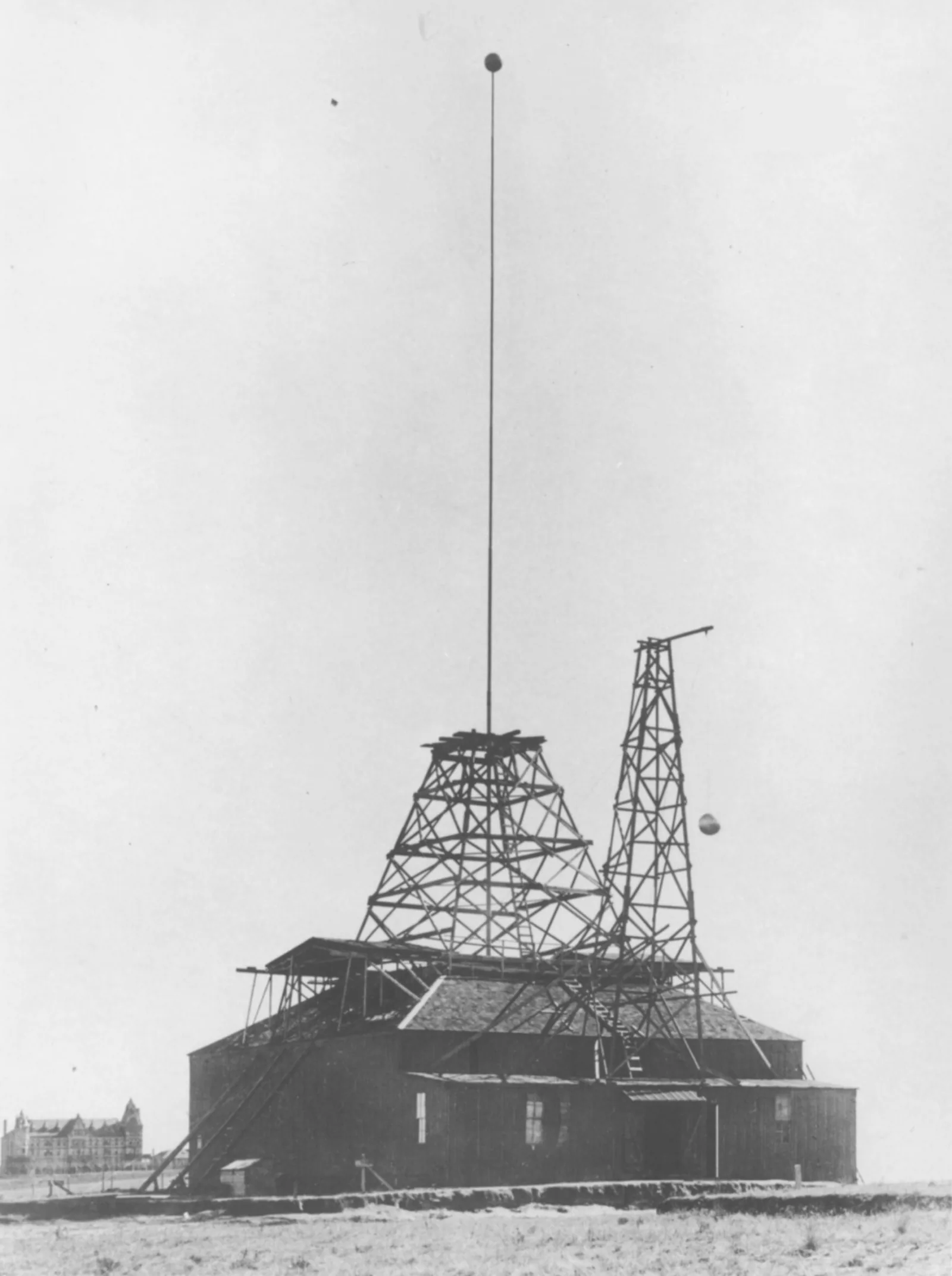
Almost everything known about Nikola Tesla's working life has to be assembled sideways — from patents, from lectures as printed, from letters that survive because somebody else kept them, and from his own recollections written down decades later. One stretch is different. Between the summer of 1899 and the first week of 1900, in a wooden shed on the prairie east of Colorado Springs, he wrote down what he did, on the day he did it, with the date at the top of the page.
That document exists. It is Colorado Springs Notes 1899—1900, published in Belgrade in 1978, and the whole of it can be read free online. It is the best-documented year of his life by a wide margin, and the reason it is not better known is that it is a laboratory notebook: it is full of capacitance measurements and coil windings, and the famous things are missing from it.
What the document is, and what it is not.
Tesla reached Colorado Springs on 17 May 1899. The date comes from the Colorado Springs Evening Telegraph, which interviewed him the same day, reported that he had been met by “his old time friend, Mr. Leonard Curtis”, and quoted him saying “while here I shall make my headquarters at the Alta Vista hotel, where I have my suite”. The widely printed date of 18 May comes from a Philadelphia trade journal reporting at a distance, by way of the 1978 edition's own introduction. Where a local daily and an eastern weekly disagree about an arrival in the local daily's own town, the local daily is the better witness — though it is only fair to add that the Telegraph cannot keep its own story straight either: its headline says he arrived at noon and its second paragraph says one o'clock.
The diary proper opens two weeks later, on 1 June 1899, with a plan for building small high-voltage batteries. The station was not finished then and the apparatus was not running: the first entry recording work in the building is 15 June — “First experiments in the station were made today. The e.m.f. of the supply transformer was 200 volts only.” The last entry is dated 7 January 1900.
The manuscript travelled with Tesla's estate to Belgrade and was transcribed and published by the Nikola Tesla Museum through the Yugoslav house Nolit in 1978, with scientific commentaries by a Belgrade professor of electrical engineering. Two things about that edition are worth knowing before anyone cites it.
It is a typeset transcription, not a facsimile. Tesla's diagrams are redrawn as clean line art and his own per-entry figure numbering is kept, but there are no pages of his handwriting in it beyond a single reproduced slide. Anyone picturing a photographic facsimile of the notebook is picturing a book that has not been published.
And the edition is routinely described wrongly. The Wikipedia article on the book welds together two different editions: it gives the 1978 Nolit imprint, then attaches the ISBN, the page count and the editors of a later 1999 Belgrade edition. The 1978 volume is 436 pages, has no ISBN, and credits one scholar with the commentaries; the second editor named in most online citations belongs to the 1999 book. The error is small and it propagates, which is a reasonable warning about the rest of the secondary literature on this year.
How complete is it, actually?
“Daily diary” is the usual description and it is close enough to be useful and wrong enough to be worth measuring. The span from 1 June 1899 to 7 January 1900 is 221 days. The published volume carries 196 dated entries. Twenty-five days have none.
The gaps are not ragged. They fall in six runs, and five of them are accounted for inside the book itself, because Tesla opened most month-sections with a short list of work he had not written up. The heading for November is typical: “Want of time compelled omission of following items partly worked out: Nov. 27, 28 Corrected and completed results of experiments of Nov. 3 … Nov. 29, 30 a) Extra coils in series exciting one another, b) Methods of tuning by telephone, c) Exciting receiving circuit through small sensitive arc.” Those four dates are exactly November's four blank days.
The same is true of 4 August, of 9, 10 and 30 September, and of 11 to 13 December. For those days the omission note is the only trace of the work, and it is a line long. The notes also name items for days that do carry entries — 6 and 31 August, 5 October — so they are a list of unwritten write-ups rather than a list of days off.
One run is not explained that way, and it is the longest: 17 to 30 December. Something is known about that fortnight from the entry that follows it. The entry for 31 December begins: “Of the photographs taken here from Dec. 17 to Dec. 31, 1899 by Mr. Alley the following were forwarded through him to my friends of the Century”, and then runs to dozens of numbered plate descriptions that fill the remaining pages of the book.
So the diary's longest silence and the photographic session occupy the same fourteen days. That coincidence is measured. The explanation that suggests itself — that he stopped writing because he was busy being photographed — is a guess, and it is worth labelling as one, because the entries resume in a different mode rather than simply resuming: from 31 December onward the book is no longer a record of experiments but a catalogue of pictures of them.
The photograph, and what he said about it on the day.
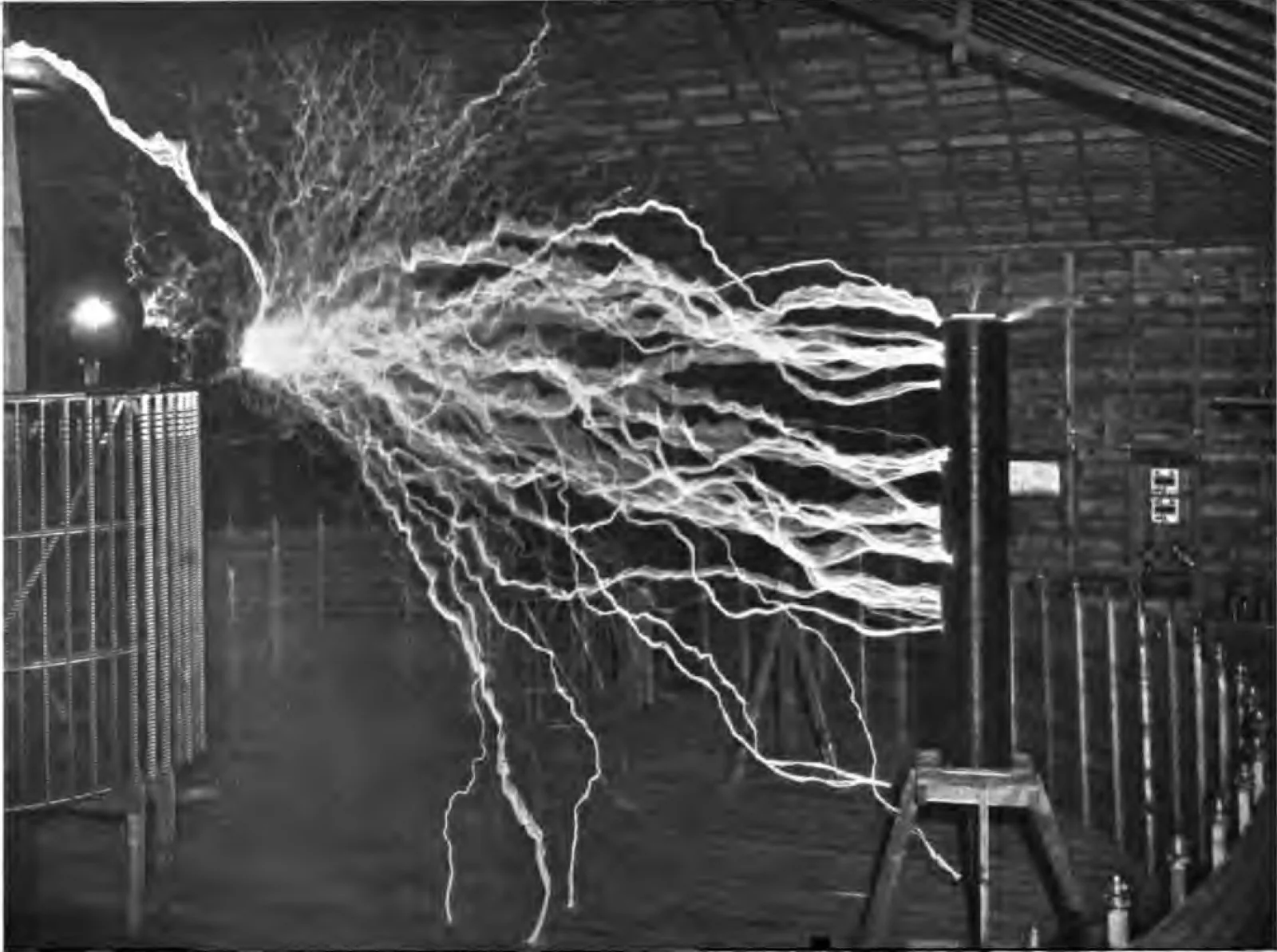
The best-known image of Tesla, and one of the best-known photographs of any scientist, shows him sitting in a plain chair reading calmly while a storm of branching discharge fills the room behind him. It is a composite, it was always a composite, and the person who said so first was Tesla, in writing, within days of its being made.
His description of plate XL in the diary is not a confession extracted later. It is a working note:
To give an idea of the magnitude of the discharge the experimenter is sitting slightly behind the “extra coil”. I did not like this idea but some people find such photographs interesting. Of course, the discharge was not playing when the experimenter was photographed, as might be imagined! The streamers were first impressed upon [the plate] … and an exposure to arc light was made and, finally, to bring out the features and other detail, a small flash powder was set off. It was found necessary to sit in the chair during the exposure to arc light as, otherwise, the structure of the chair would show through the body of the person.
Nikola Tesla, Colorado Springs Notes 1899—1900, entry of 31 December 1899, photograph XL, page 367.
Three details in that passage are routinely lost. It is a triple exposure, not a double: streamers in the dark, then the sitter under arc light, then flash powder for the face. The arc-light stage was necessary because without it the chair showed through the man. And Tesla did not think much of the idea — “I did not like this idea but some people find such photographs interesting” is the sentence of someone being talked into a publicity picture, which is a different thing from someone faking a result.
The second protagonist here has a name that almost never appears: Alley, the photographer sent out by the Century. The diary never gives him a first name — the surname appears sixteen times, fifteen of them as “Mr. Alley” — and he is the only member of the Colorado Springs crew Tesla names at all in the body of the notebook. He also sat in the chair himself: the note on an earlier plate reads “an experimenter (Mr. Alley) sitting in the chair”, and the book prints the Alley version and the Tesla version as a matched pair. The staging was a two-man job and they took turns.

What is not in the notebook
This is where a complete dated record earns its keep, because it allows a particular kind of negative to be stated with confidence. The full text of the published volume was searched for this article. The following return nothing at all.
Twenty-six miles. No entry mentions a distance of twenty-six miles, or twenty-five, or any transmission at the scale of miles. Two hundred lamps. No entry mentions two hundred lamps, or one hundred. Mars. The word does not occur in the book. Nor does “135 feet”, the discharge length attached to Colorado Springs in a thousand retellings; the four occurrences of the digits 1-3-5 are all capacitance values in microfarads.
The twenty-six miles and the two hundred lamps have a single traceable origin, and it is honest about itself. John J. O'Neill, who had been science editor of the New York Herald Tribune and knew Tesla, published Prodigal Genius in 1944. The passage reads:
As a result of this most unfortunate design, technical details are lacking concerning the principal discoveries made at Colorado Springs. By piecing together the fragmentary material published in a number of publications, however, it appears evident that Tesla … tested his power transmission system at a distance of twenty-six miles from his laboratory and was able to light two hundred incandescent lamps, of the Edison type … These lamps consumed about fifty watts each; and if two hundred were used in the test bank, the energy consumed would be 10,000 watts, or approximately thirteen horsepower.
John J. O'Neill, Prodigal Genius: The Life of Nikola Tesla, Ives Washburn, New York, 1944, pages 170–171. Emphasis added.
O'Neill says he is piecing it together, says technical details are lacking, and then makes the lamp count a condition of his own arithmetic — if two hundred were used. The figure that the next eighty years treated as a measurement was offered as an assumption inside a reconstruction. Nothing dishonest happened; a hedge simply wore off in transmission, the way hedges do.
What is in the notebook instead.
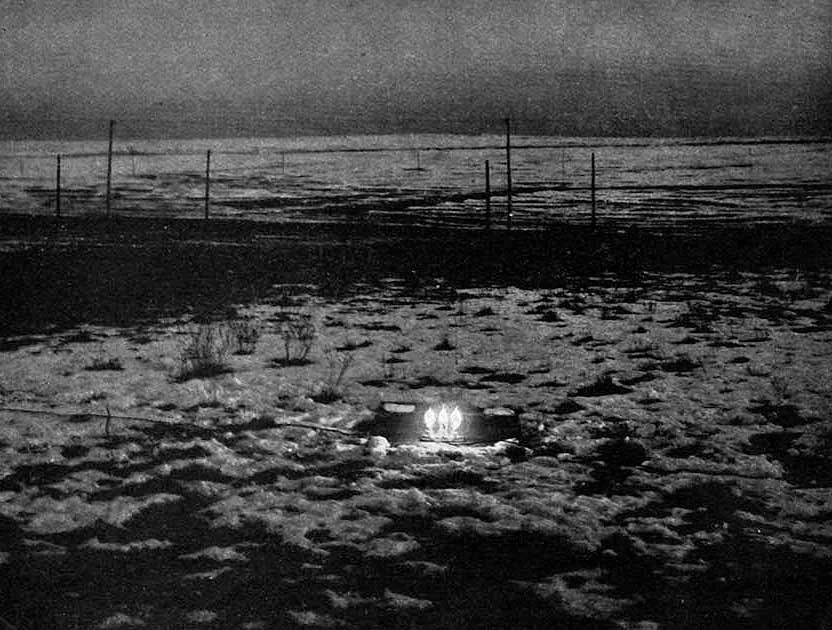
The real experiments of that kind are recorded, and they are small. On 1 January 1900 a cord of the same section as No. 10 wire was laid out on the field in a square of 62 feet 5 inches a side, its centre “a little over 60 feet” from the primary loop inside the building, and three incandescent lamps in it lit. On 2 January five lamps in series stood on a table in front of the coil, one end of the series earthed and the other joined to the base of the coil — which is conduction through a ground connection, indoors, not power beamed through the air.
Tesla then does the extrapolation himself, in the same entry, and his own ceiling is the number worth remembering. The exciting apparatus had been run at about a third of capacity with three of eight tanks in circuit, so, he reasons, a system designed for full output could have lit “3 × 8/3 = 8 times as many lamps, or about 40 lamps”.
Forty, as a projection, against two hundred as a reported fact.

The same pattern holds for the discharges. The largest figure anywhere in the diary is from the plate descriptions of 31 December: “From end to end of the longest streamers about 50—55 feet in a straight line.” In the Century six months later his own captions give a flame-like discharge that “measures sixty-five feet across” and another whose “greatest width across is nearly seventy feet”; by Collier's in February 1901 he is writing of sparks “more than one hundred feet in length, and this without difficulty”. Each step is Tesla, and each step is larger than the one he wrote down at the bench. The 135 feet that appears in the modern literature is larger again and is in none of them.
The thing he did observe, and the inference he drew from it.
One night's work from that summer deserves to be better known than the lamps, because it is the intellectual event of the year. During a thunderstorm on the night of 3 July 1899, writing it up the next morning, Tesla recorded that his receiver responded to a storm, fell silent, then began responding again as the storm receded past two hundred miles, and went on alternating at intervals of about half an hour with most of the sky clear.
It showed clearly the existence of stationary waves, for how could the observations be otherwise explained? How can these waves be stationary unless reflected and where can they be reflected from unless from the point where they started? … It is now certain that they can be produced with an oscillator (This is of immense importance)
Nikola Tesla, Colorado Springs Notes 1899—1900, entry of 4 July 1899, describing the previous night.
The observation is a measurement and the conclusion is an inference, and the diary keeps them visibly apart in a way the later retellings do not. Note also what he thought at the bench: he considered reflection from the far side of the earth “may be possible” but thought reflection from the storm itself more likely. The grand version — “this planet, despite its vast extent, behaved like a conductor of limited dimensions” — is from his article of 5 March 1904, nearly five years afterwards, and it is a much more confident sentence than the one he wrote at the time. What that conclusion was eventually built into, and why the scheme does not work, is a separate story.
The 3 July work also has a witness, which almost nothing else from Colorado Springs does. In 1904 Tesla wrote that “similar observations were also made by my assistant, Mr. Fritz Lowenstein” — and the diary's unnamed “Mr. L.” of 4 July is presumably him. Lowenstein was taken on in New York in April 1899 and sent out at the end of May; he left at the end of September and was replaced by Kolman Czito, who was wired for on 19 September and reached Colorado Springs about the 24th. That date disposes of a favourite anecdote on its own: any story that puts Czito at the switch during a summer blackout is describing a month in which he was still in New York.
Who paid, and who was never paid
The power came from the local utility, whose name is given four different ways by four reliable sources — “The El Paso Electric Company” on a surviving 1899 receipt billed to Tesla, “City Electric company” in the local paper of 29 July 1899, and “the Colorado Springs Electric Company” in Tesla's own article of 1904, which credits “the help proffered by my friend Leonard E. Curtis” for the choice of site. Curtis, a patent lawyer who had known Tesla for about fifteen years, is said to have arranged the current free because he held an interest in the plant; the quotation everyone reproduces to that effect has no locatable original and should be treated as unverified.
Two contemporaneous facts cut against the free-and-unlimited version anyway. The Evening Telegraph of 29 July 1899 reports that “he is generally unable to get the power in the daytime, and is required to use it at night”. And the 1899 receipt exists, which means he was being billed for something.
What happened afterwards is documented in the Colorado Springs papers and is bleaker and more ordinary than the legend. He left for New York on about 11 January 1900 intending to come back; the Evening Telegraph of 5 January reported that “a number of assistants will be kept at the station during his absence” and that he was taking some of his instruments east himself, thinking it better to hand them to their makers for readjustment. He never returned. In April 1904 the electric company sued for $180 — and the bill was for current furnished from 1 June 1903 to 31 March 1904, years after the experiments ended, to a station standing empty. He did not answer the summons, and the property was advertised for sale. He then sent the sheriff enough money to cancel the bill and the station became his again; and then, the Gazette reports, “supposedly on his order”, it was sold off anyway — the building to a man who wanted the lumber for a house he was building in Ivywild, the piping separately.
The second judgement is the one worth sitting with. In November 1905 a man named Duffner won about $928 against him by default. Duffner's claim, as the press reported it, was that he had been employed as caretaker of the station for two years after Tesla went back to New York. On 22 March 1906 the sheriff auctioned twenty-seven cases of goods and ten coils of copper wire to satisfy it.
So the material remains of the best-documented year of Tesla's life were sold at a courthouse door to pay the wages of a man who had been looking after an empty shed. The notebook was in New York, in a trunk, and it outlasted all of it.
The document
Nikola Tesla, Colorado Springs Notes 1899—1900. The manuscript prepared for publication by the Nikola Tesla Museum, Beograd, with scientific commentaries by Aleksandar Marinčić; Nolit, Beograd, 1978, 436 pages. A complete typeset transcription of the dated laboratory diary, with Tesla's diagrams redrawn and the Alley photographs printed as plates I–LXIII. Full scan, free and unrestricted; also readable page by page.
Read alongside Tesla's own article of the following June, which is the only thing he published about the work at the time: “The Problem of Increasing Human Energy, with Special Reference to the Harnessing of the Sun's Energy”, The Century Illustrated Monthly Magazine, vol. LX, no. 2, June 1900, pages 175–211. The whole issue.
No page of the manuscript is reproduced here, and there is a reason beyond preference. Under 17 U.S.C. §303(a), a work created before 1978 that was still unpublished and uncopyrighted on 1 January 1978, and then first published between 1978 and 2002, keeps its United States copyright until at least 31 December 2047 — whatever the author's dates. The diary sat unpublished until 1978, so it lands squarely in that window. The photographs are a different matter: Tesla published those in The Century in 1900, so their United States copyright expired long ago, which is why the figures above are plates and not pages.
The search log
Run 12 October 2026. The principal corpus is the full text of the 1978 edition as scanned and machine-read by the Internet Archive, downloaded whole and searched locally; the optical character recognition is poor in places and every negative below was confirmed by reading the surrounding pages rather than trusting a keyword miss. Also searched: Tesla's Century article of June 1900 as printed; the transcriptions at Tesla Universe and tfcbooks.com; the Internet Archive's copy of Prodigal Genius.
- The count of dated entries. Every entry heading in the published volume was extracted and the damaged ones resolved by position against their neighbours. 196 dated entries across 221 days, with 25 blank days. Per month: June 30/30, July 31/31, August 30/31, September 27/30, October 31/31, November 26/30, December 14/31, January 7/7.
- “26 miles”, “twenty-six miles”, “200 lamps”, “200 incandescent”. Nothing in the diary. Zero occurrences of any of them. The largest lamp figure Tesla records is five, and the largest he projects is forty.
- “Mars”. Nothing. The word does not appear in the book. “Planet” appears once, in the dispatch of 8 December 1899 to Julian Hawthorne for the Philadelphia North American, where he writes of changes “now being wrought by intelligent beings on a neighbouring planet” — a speculation about canals, not a claim to have received anything. The claim to have received signals is from Collier's Weekly of 9 February 1901, thirteen months later and after he had left.
- “135 feet”. Nothing, in the diary or in Tesla's own published statements. The digits occur four times in the book, all as capacitance values. The figure appears to enter through the twentieth-century local press and secondary literature; its first appearance has not been located.
- A contemporaneous report of the generator burnout or a town blackout. Not located. No 1899 or 1900 newspaper report of either was found. What exists is a receipt from the utility to Tesla for line work on 31 October and 1 November 1899, and Tesla's own recollection eighteen years later, in The Electrical Experimenter of August 1917, that “the dynamos in a power house six miles away were repeatedly burned out” — note repeatedly, which is not one catastrophic night. The 1978 edition's own commentary attributes the story to a 1927 popular history and hedges it with “probably on some other occasion”. The Colorado Springs Pioneers Museum states plainly that there is no evidence for the blackout.
- The dollar figure of John Jacob Astor's 1899 investment. Not settled. The Nikola Tesla Museum's archive inventory confirms a statement concerning the sale of 500 shares to Astor dated 10 January 1899, but names no sum. Modern biographies say $100,000; O'Neill in 1944 says $30,000. No primary document fixing the amount was located, and the two figures are reported here unreconciled.
- Colorado newspapers of 1899–1900, searched directly. Blocked, and the gap is real. The Colorado Historic Newspapers Collection refused automated requests, and the Library of Congress's Chronicling America search was unavailable throughout. The Colorado items cited here were therefore read as transcriptions at Tesla Universe rather than as page scans. Anyone redoing this work with a browser should start there; the Colorado Springs Telegraph for 1904–1905, the lawsuit period, is digitised and has not been examined for this article.
Unresolved: the printed page numbers of several of the Colorado Springs items, which the transcriptions do not carry; whether Duffner's initials were C. J. or J. C., which two papers give differently; and the precise date the Philadelphia North American printed the Hawthorne dispatch.
Primary documents
- Nikola Tesla, Colorado Springs Notes 1899—1900, Nolit, Beograd, 1978. Full scan, Internet Archive.
- Nikola Tesla, “The Problem of Increasing Human Energy”, The Century Illustrated Monthly Magazine, vol. LX, no. 2, June 1900, pages 175–211. Scanned issue.
- “Nikola Tesla Will ‘Wire’ to France”, Colorado Springs Evening Telegraph, 17 May 1899, page 6. Transcription.
- “Tesla Talks to the Telegraph”, Colorado Springs Evening Telegraph, 29 July 1899. Transcription.
- “Tesla”, Colorado Springs Evening Telegraph, 5 January 1900 — the departure reported as temporary. Transcription.
- Nikola Tesla, “The Transmission of Electrical Energy Without Wires”, Electrical World and Engineer, 5 March 1904. Full text.
- “Tesla Is Sued”, Colorado Springs Gazette, 6 April 1904. Transcription.
- “Tesla's Electrical Station Is Sold For Value Of Lumber”, Colorado Springs Gazette, 2 July 1904. Transcription.
- “Tesla's Fixtures in Sheriff's Sale”, Colorado Springs Gazette, 10 March 1906, and “Tesla Plant at Auction”, Evening Statesman, Walla Walla, 22 March 1906, page 2. Transcription of the first.
- H. Winfield Secor, “Tesla's Views on Electricity and the War”, The Electrical Experimenter, vol. V no. 4, August 1917 — the source of the burned-out dynamos. Scanned issue.
Further reading
- John J. O'Neill, Prodigal Genius: The Life of Nikola Tesla, Ives Washburn, 1944 — the origin of a great many Colorado Springs stories, and more candid about its own method than the works that quote it. Full text.
- Nikola Tesla, Colorado Springs Pioneers Museum — the local institution's own account, which declines to repeat the blackout story and says why.
- B. F. Burke and K. L. Franklin, “Observations of a variable radio source associated with the planet Jupiter”, Journal of Geophysical Research 60, no. 2 (June 1955), 213–217 — the decametric Jovian source, discovered fifty-five years after the Colorado Springs summer, and the usual modern candidate for whatever he was receiving.
The record on this article
- False “The records of the Colorado Springs work were lost.” He kept a dated laboratory diary. 196 entries across the 221 days from 1 June 1899 to 7 January 1900 survive, published in full in 1978 and free to read online.
- Unverifiable “He lit two hundred lamps twenty-six miles away.” Neither figure appears anywhere in the diary. Both come from a 1944 biography that introduces them as a reconstruction and makes the lamp count a condition of its own arithmetic. Tesla's own recorded maximum is five lamps; his own projection for full power is forty.
- True “The famous photograph of Tesla reading beside the discharge is staged.” It is, and he wrote so himself in the diary on 31 December 1899. It is a triple exposure — streamers, then the sitter under arc light, then flash powder — and the photographer sat for an earlier plate in the same chair.
- False “Discharges 135 feet long were produced at Colorado Springs.” The figure is in neither the diary nor any statement of Tesla's. His own notebook maximum is 50 to 55 feet; his largest published claim, in 1901, is “more than one hundred feet”.
- Unverifiable “Tesla blacked out Colorado Springs.” No contemporaneous report of a blackout has been located, and the city's own museum says there is no evidence for one. What is documented is a utility bill for line work in late 1899, and Tesla's recollection in 1917 that dynamos six miles away were “repeatedly burned out”.