1893–1900 · Chicago, Niagara, Colorado Springs
Niagara, 1895: what Tesla actually contributed
The people who built the plant called the arrangement “the Tesla Polyphase Alternating-Current System” in print, while they were building it. The same volume names the men who designed the turbines, proposed the form of the generator and supervised the installation — and Tesla, standing in the power house in 1896, called his own share in it insignificant.
The claim
CLAIM — “Tesla designed and built the Niagara Falls power plant.”
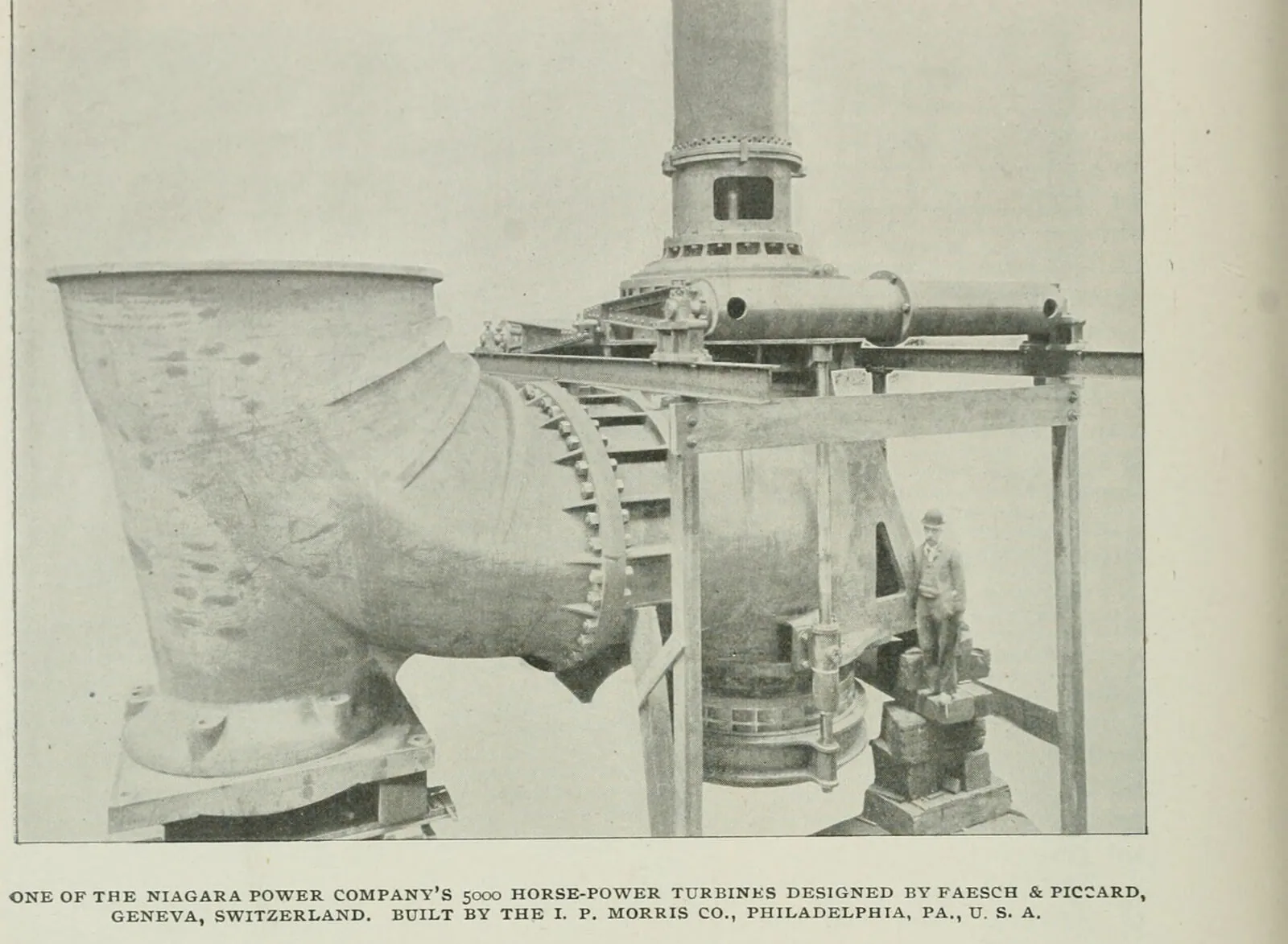
STATUS — MIXED, and the mixture is the article. The electrical system adopted at Niagara was his, and the men who built the plant said so in print while they were building it. The plant was not. Its turbines were designed in Geneva and built in Philadelphia, the mechanical form of its generator was proposed by a Scottish professor, and its installation was supervised by a Westinghouse staff of nineteen named men. The most specific version of the claim in circulation — that he devised the Niagara turbines — is flatly false.
EARLIEST TRACE — Of the overclaim, a journalist's sentence rather than Tesla's. A New York Times birthday interview of July 1932 added, in the reporter's own voice, that Tesla “designed the great power system at Niagara”. On 8 January 1943 the Washington Evening Star set “Devised Transmitters And Niagara Turbines” over an Associated Press obituary whose own text said something much more careful — and a paper in Juneau ran the identical wire copy the next day under a headline that does not mention Niagara at all.
RESTS ON — A real and decisive contribution; a boyhood daydream about a water wheel that Tesla retold for fifty years; and the compression that happens when a system is named after one man and a building after another. Tesla's own accounts, across thirty-six years, are consistently narrower than the legend: at the Niagara celebration of 1897 he named ten other men and not himself.
Begin where the people who did the work began. In July 1895, a month before the station opened, Cassier's Magazine gave its whole number to Niagara. The electrical article in it is signed Lewis Buckley Stillwell, who in 1895 was Westinghouse's own electrical engineer and assistant manager, and who “had under supervision the entire installation of the electrical apparatus”. Nobody was better placed to say whose plant it was. He sets out what the company asked for — four vertical shafts turning at 250 revolutions a minute, each delivering 5,000 to 5,500 horse-power — and names the answer:
The system or organization of electric apparatus which was adopted is known as the Tesla Polyphase Alternating-Current System. Each generator delivers alternating current to each of two circuits, the currents in these circuits differing from each other in their time relation, or phase, by 90 degrees; that is to say, the current delivered to each circuit attains its maximum value at the instant when the current delivered to the other circuit is zero. The frequency is 25 cycles per second.
Lewis Buckley Stillwell, “Electric Power Generation at Niagara”, Cassier's Magazine, vol. VIII no. 3, July 1895, page 255.
That is the correction, and it points the opposite way from a debunking. The system was credited to Tesla by name, in print, by the firm spending the money, before a single customer had been served. Anyone told that Tesla was written out of Niagara should start with the fact that he was written into it, correctly, at the time.
What follows is the rest of the sentence. The same volume names every other party to the work with equal plainness, and that is where the modern story goes wrong: it has quietly swallowed the lot.
What had to be decided, and who decided it
The Niagara project did not begin with a motor. It began with a hole in the ground and an argument about how to get power out of it. The Cataract Construction Company was assembled on the proposition that the site was worth having as a hydraulic installation alone and would be worth more as a source of power for transmission; its investors are a roll-call of the period — Morgan, Mills, Vanderbilt, Astor — and the man who ran it was Edward Dean Adams.
In the winter of 1890 Adams did something unusual. Finding that “even the latest books upon this subject had become inadequate to our demand for information”, he established in London, in June 1890, an International Niagara Commission, with power to award $22,000 in prizes:
Sir William Thomson (now Lord Kelvin) as chairman, with Dr. Coleman Sellers of Philadelphia, Lieut.-Col. Theodore Turrettini of Geneva, Switzerland, originator and engineer of the great water-power installation on the Rhone, and Prof. E. Mascart of the College of France, as members, and Prof. William Cawthorne Unwin, Dean of the Central Institute of the Guilds of the City of London, as secretary.
Francis Lynde Stetson, first vice-president of the Cataract Construction Company, “The Use of the Niagara Water Power”, same number, page 185.
Plans came in from twenty-eight invited parties in Britain, on the Continent and in America, all of them in the commission's hands by 1 January 1891. Fourteen entries were formally judged, prizes went to eight, and not one scheme was adopted. Unwin's own report says why, and the sentence is worth having exactly:
No first prize was awarded for a Combined Project for Hydraulic Development and Distribution of the Power. There was no project which, in the opinion of the Commission, could be recommended for adoption without considerable modification. … Projects for Distribution. No prize awarded.
W. C. Unwin, Secretary to the Commission, report dated London, 13 April 1891, printed as Appendix E in Adams, Niagara Power, vol. I, pages 443–444. The award list was corroborated independently in Engineering News of 14 March 1891, page 250, which reprints it from Industries of London.
Read that twice. The commission convened to choose how to distribute Niagara's power awarded no prize at all for distributing it. What it settled was the water: its “first important result”, Stetson writes, “was the selection of Messrs. Faesch & Piccard of Geneva, as designers of the turbines.”
Three facts follow from the same report, each cutting against a different piece of the legend. George Forbes entered the competition and lost. His scheme is Project XIII in Unwin's abstracts; it took a £100 premium, the lowest award on offer, and the commission “were not convinced that the reasons given by Professor Forbes for an alternating-current system, in preference to a continuous-current system, were sufficient to establish his case.” Westinghouse did not enter at all — “These people are trying to secure $100,000 worth of information by offering prizes, the largest of which is $3000,” its founder said. And the commission's own verdict went against alternating current: its members “were not convinced of the advisability of departing from the older and better understood methods of continuous currents”.
Lord Kelvin fought alternating current to the last, and then changed his mind in the building.
The commission's chairman was the most eminent physicist alive, and he was wrong about this, at length and in writing. In January 1892, with the first machines nearly ready, he wrote:
I do not believe that alternating currents will be found to be the right solution of the electric transmission to a distance. I have no doubt in my own mind but that the high-pressure direct-current system is greatly to be preferred to alternating currents. The fascinating character of the mathematical problems and experimental illustrations presented by the alternating current system … have, I think, tended to lead astray even engineers, who ought to be insensible to everything except estimates of economy and utility.
Lord Kelvin, letter of 6 January 1892, quoted in Silvanus P. Thompson, The Life of William Thomson, Baron Kelvin of Largs, 1910, vol. II, page 896. Stillwell also records that Kelvin moved a resolution at the commission itself “which aimed to exclude from further consideration all systems of electrical power transmission other than direct-current systems”, and that Coleman Sellers talked it down.
The company adopted alternating current by resolution of its directors on 6 May 1893. Five days before that vote, Kelvin cabled Adams from Glasgow with a complete alternative — a geared bank of twenty continuous-current dynamos around the turbine shaft — and one last sentence:
Buffalo project realizable immediately; have designed special easy gearing twenty or similar number continuous current dynamos, vertical shafts above ground around main turbine shaft; its design unchanged from present plan; delay till autumn unnecessary; trust you avoid gigantic mistake of adoption alternate current.
Lord Kelvin to Edward Dean Adams, cable of 1 May 1893, printed in Adams, Niagara Power, vol. II, page 256.
So the arrangement Niagara was built on did not arrive with authority behind it. It won over the stated advice of the commission convened to judge it, and over the explicit objection of that commission's president. That is the strongest thing that can be said for Tesla's side of this story.
The turbines, which were not his.
Of all the things attributed to Tesla at Niagara, the turbines are the easiest to settle, because the photograph settles itself. The three wheels first set in the wheel-pit were “designed by Faesch & Piccard, of Geneva, Switzerland, and were built under contract with the I. P. Morris Company of Philadelphia” — paired Fourneyron turbines about five feet across, mounted 140 feet down, fed by a steel penstock whose column of water carried the whole weight of the revolving parts.
Tesla had nothing to do with any of it, and never claimed otherwise. A turbine is a hydraulic machine; his patents are electrical. The confusion survives only because the word turbine appears in both halves of the story — in the water wheel at the bottom of the shaft, and in a boy's daydream, which we will come to.
The dynamo, whose outside was Forbes's idea.
The generators were Westinghouse machines; the contract for three of 5,000 horse-power each was placed with Westinghouse in October 1893. But the shape of them was not Westinghouse's, and it was not Tesla's either. Stillwell is exact about this:
The Niagara generators were constructed by the Westinghouse Company, following, as regards mechanical form, the type of machine proposed by the engineers of the Cataract Construction Company. This was fully described by Prof. George Forbes in a paper read in November, 1893, before the British Institution of Electrical Engineers.
Stillwell, same article, page 256.
Stetson says what the idea bought: the special advantage “result[ed] from Prof. Forbes' happy idea of a dynamo in which the field magnets should revolve instead of the armature.” Set the poles in a ring turning outside a stationary armature, and the heavy current never passes through a sliding contact, while the revolving mass doubles as the flywheel the turbines needed. Stillwell hands the credit abroad outright: “Great Britain is represented directly in the excellent general form of construction adopted, which was proposed by Prof. Geo. Forbes.”
That is narrower than it sounds, and the narrowness is the whole of the matter. Both company men confine the credit to form — “as regards mechanical form”, “the excellent general form of construction” — and within two months the firm that actually built the machines said in public exactly where that boundary ran. Forbes had by then claimed the plant for himself in Blackwood's Magazine, and George Westinghouse answered him in The Times:
There is about the same difference between the machine designed by Prof. Forbes and that designed by us as there is between the picture of a man and the man himself — the appearance externally being very similar, but internally there is no resemblance whatever.
Westinghouse Electric and Manufacturing Company, signed Geo. Westinghouse, jun., president, dated Pittsburg 29 August 1895; printed in The Times (London) 10 September 1895, reprinted in The Electrical Review (London), vol. 37 no. 929, 13 September 1895, pages 317–318. The same letter says the generators “were built by us according to plans and specifications prepared by our own engineers”. Forbes's secretary wrote the next day that his employer was travelling in South Africa and would need “some weeks” to reply. MEASURED: no reply from Forbes appears in The Times, the Review or The Electrical World at any date afterwards.
Read as a quarrel, that is Westinghouse calling Forbes a fraud. Read as evidence, it is better than that: a hostile witness conceding the outside and claiming the inside, which is the line Stillwell had already drawn in July without the hostility. The two agreed about where the boundary fell and disagreed only about what it was worth.
George Forbes was the Cataract Construction Company's consulting electrical engineer, and he is the person this story has most thoroughly deleted. He appears in the popular account of Niagara not at all. He appears in the company's own account six times.
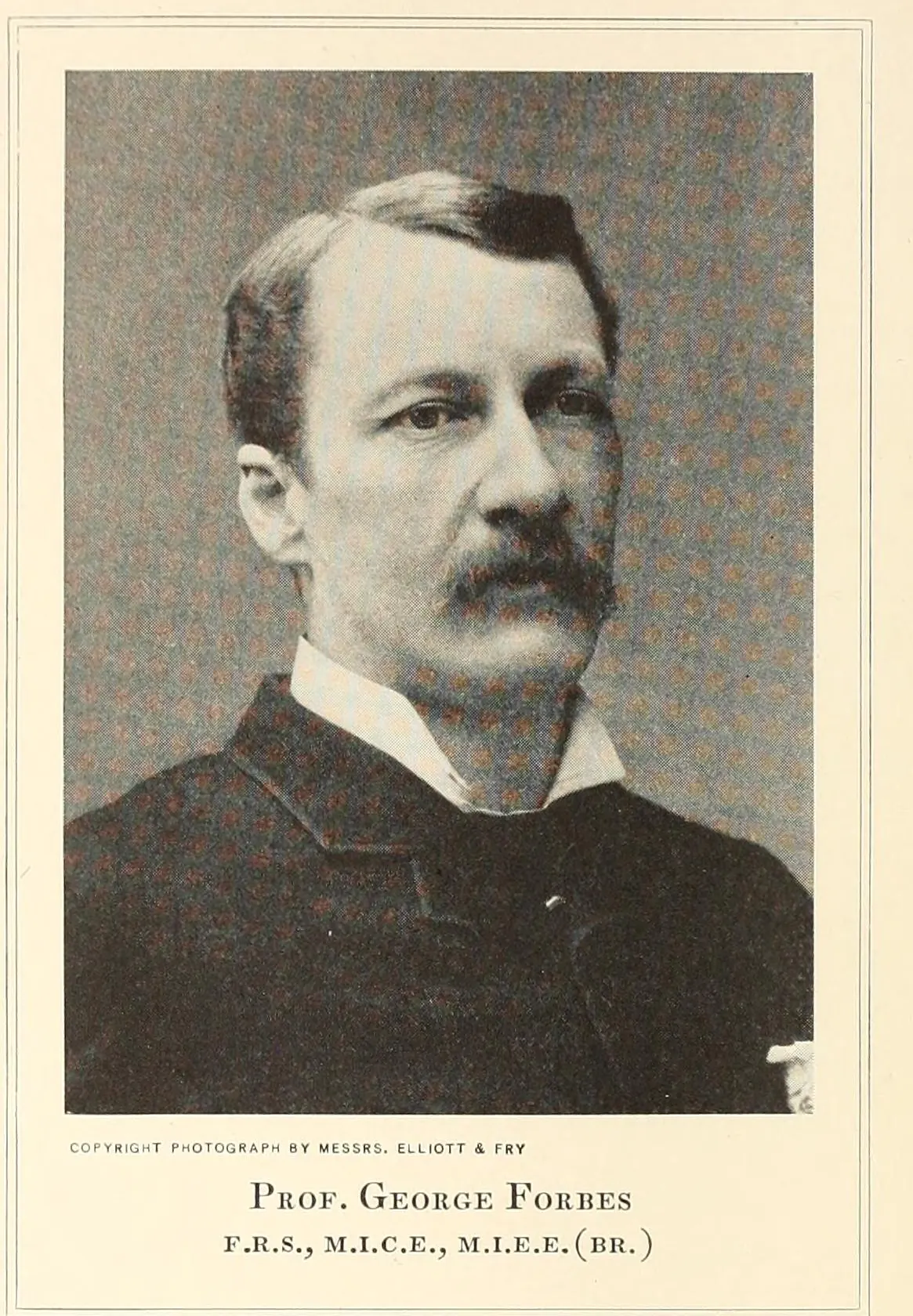
Forbes was asked, thirty years later, what he had contributed, and the answer is printed in Adams's own history: foresight in backing alternating current “even at a date when no single alternating current motor was in commercial use”; insistence on low frequency; and persistence in overcoming “the prejudices of American manufacturers”. He closes:
These three points, all received with violent opposition from outside, were the secret of your success in the electrical development, and have led all engineers of hydro-electrical developments all over the world to copy your pioneer, and therefore, experimental, scheme of construction. … Your reward was not equal to your deserts, but it was, I am glad to note, substantial.
George Forbes, letter dated London, 1924, printed in Adams, Niagara Power, vol. II, pages 356–357.
Treat that sceptically: an interested party claiming credit three decades on, in a volume edited by the man he is congratulating. It need not carry the weight — the 1895 number credits him with the revolving field twice, in two voices, while the machines were going in, and even Westinghouse conceded the outside of it.
It is also, on his second point, not what happened — and the truth is better, because it gives the number everybody quotes an author nobody expects. Forbes did not specify 25 cycles. He wanted far fewer: first 8⅓ a second, then by mid-1893 no more than 16⅔, and he held that current could safely be generated at 20,000 volts in the machine itself, with no step-up transformers at all. Westinghouse's engineers thought that unbuildable and would guarantee nothing below 30. The deadlock broke over dinner:
Before the diners separated, President Adams … sought a personal conference with Mr. Stillwell … at which a question substantially as follows was asked: Can the Westinghouse Company build a satisfactory alternator which would deliver current at 25 cycles, the efficiency of which would be guaranteed by that company? … It was finally agreed that there should be 12 poles and the result was 3000 alternations or 25 cycles, this being the lowest frequency for which the Westinghouse Company would guarantee sound mechanical design. This Niagara frequency was soon adopted by many other power plants.
Adams, Niagara Power, vol. II, pages 237–238, on a conference at the Union League Club of New York in October 1893. Twelve poles turning at the turbines' fixed 250 revolutions a minute give 3,000 alternations a minute, which is 25 cycles a second.
Forbes confirmed it himself three weeks later, in public and without pretending he had won: “Consequently we have made a compromise, and are going to build our first three dynamos for a frequency of 25 periods per second.” So 25 cycles at Niagara was nobody's preference. Not Forbes's, not Westinghouse's, and not Tesla's, who was still complaining in 1919 that “the Westinghouse experts had adopted 133 cycles” while his own system “was based on the use of low frequency currents”.
The nineteen men who installed it
Stillwell ends his article by thanking the people who did the work. The list is worth reading at length, because it is the thing a sentence like “Tesla built Niagara” costs:
Among those who have been particularly prominent in the work are: Mr. Albert Schmid, general superintendent; Mr. C. F. Scott, electrician; Mr. Philip Lange, superintendent; Mr. O. B. Shallenberger, consulting electrician; Mr. B. C. Lamme, Mr. E. C. Means, Mr. H. P. Davis, Mr. Henry Noel Potter, and Messrs. Sigfried, Wright, Boegel, W. F. Lamme, Beinitz, Alberger, Mirault, Friedlander, Strauss, Mould and Parks.
Stillwell, same article, page 306. He then thanks “Dr. Coleman Sellers, president and chief engineer of the Niagara Falls Power Company”, “Mr. De Courcy May, late superintendent and engineer of the Cataract Construction Company”, and “Mr. W. A. Brachenridge, resident engineer of the Cataract Company, in charge of the plant”.
Two of those names repay a pause. Albert Schmid is the Westinghouse man Tesla's own 1919 memoir singles out for building the rotating-field ring and the copper egg that drew the crowds at Chicago; O. B. Shallenberger had invented the induction wattmeter in 1888, without which none of this power could have been sold by the unit at all.
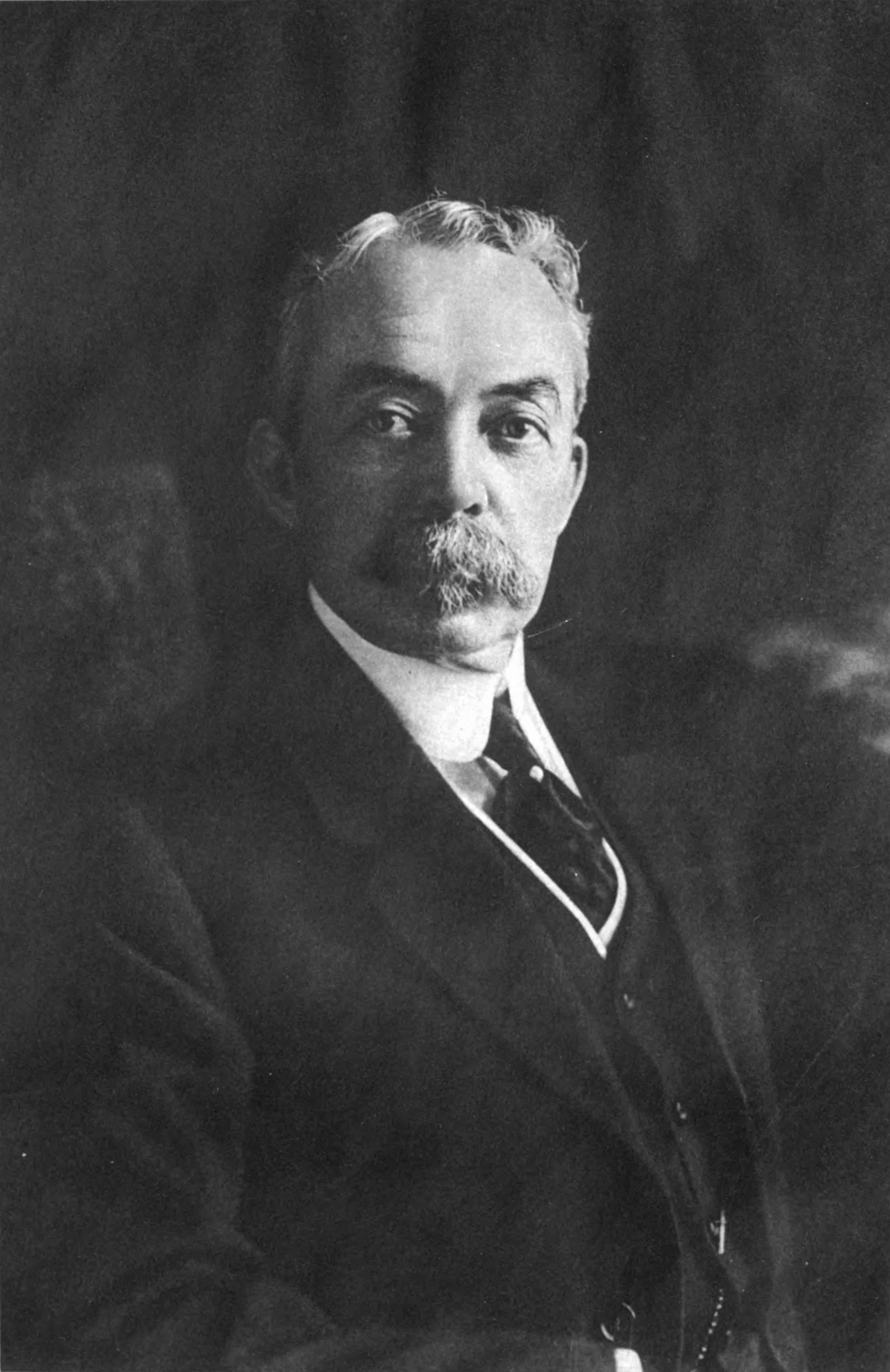

What was his, and it is not small.
Strip away the turbines, the penstocks, the wheel-pit, the tunnel and the switchboard, and what is left is the thing that made the rest worth building: a way of sending power down a wire as two currents a quarter-cycle apart, so a motor at the far end turns without a commutator and transformers at each end let the voltage be raised for the journey and dropped on arrival. That is the polyphase system; its foundation patent, US 381,968, was filed on 12 October 1887 and granted on 1 May 1888, and Westinghouse had bought the rights in 1888.
The cleanest contemporary statement of that ledger is not a company document. On 3 January 1896, five months after the station opened, T. Commerford Martin lectured on Niagara at the Franklin Institute. Martin edited The Electrical Engineer in New York, had been president of the American Institute of Electrical Engineers, and two years earlier had edited Tesla's own collected papers — he is close to the last man in America who would undersell Tesla. Coming to the 5,000 horse-power alternator, he said:
Here then we have broadly a Tesla two-phase generator, but of course it embodies the novel suggestions and useful ideas of many able men, among whom should be specially mentioned Mr. L. B. Stillwell, the gifted young engineer of the Westinghouse Company, upon whom vast responsibility has been thrown, and Prof. George Forbes, of England.
T. Commerford Martin, “Niagara on Tap”, a lecture delivered before the Franklin Institute on 3 January 1896, printed in the Journal of the Franklin Institute, vol. CXLII no. 4, October 1896, page 300. Read from the page image. On the page before it he is just as explicit the other way: the generators “are of the Tesla two-phase type … one of the many striking innovations and improvements that electricity owes to Mr. Nikola Tesla”, and “Mr. Tesla's idea as to the superiority of a two-phase current was adopted, and the apparatus was built on that plan by the Westinghouse Company”.
Both halves of that were uncontroversial in January 1896. The popular version has only ever carried the first.
He was also in contact with the company's leadership. Stetson — the first vice-president, in the same July 1895 number — reports a conversation: “Mr. Nikola Tesla having quite recently stated to me that if the company would put 100,000 horse-power upon a wire, he would deliver it at commercial profit in the city of New York.”
Adams's own history is exact about rank. On two phases against three, “the counsel of other than the company's regular expert advisers gave a weight of authority in favor of the two-phase system. Confirming the advice of Professor Forbes and Dr. Sellers in this regard were Nikola Tesla … Colonel Turrettini … and Dr. J. A. Fleming.” Tesla sits in the second rank of that sentence — an outside authority cabled for an opinion alongside a Geneva engineer and a London professor. In the thousand pages of Adams's two volumes he has six index references.
Midnight, 15 November 1896
Adams Station delivered its first commercial power on 26 August 1895, to the Pittsburgh Reduction Company's aluminium works 2,500 feet away — a load reached by an underground conduit, not a transmission line. The transmission that mattered came fifteen months later.
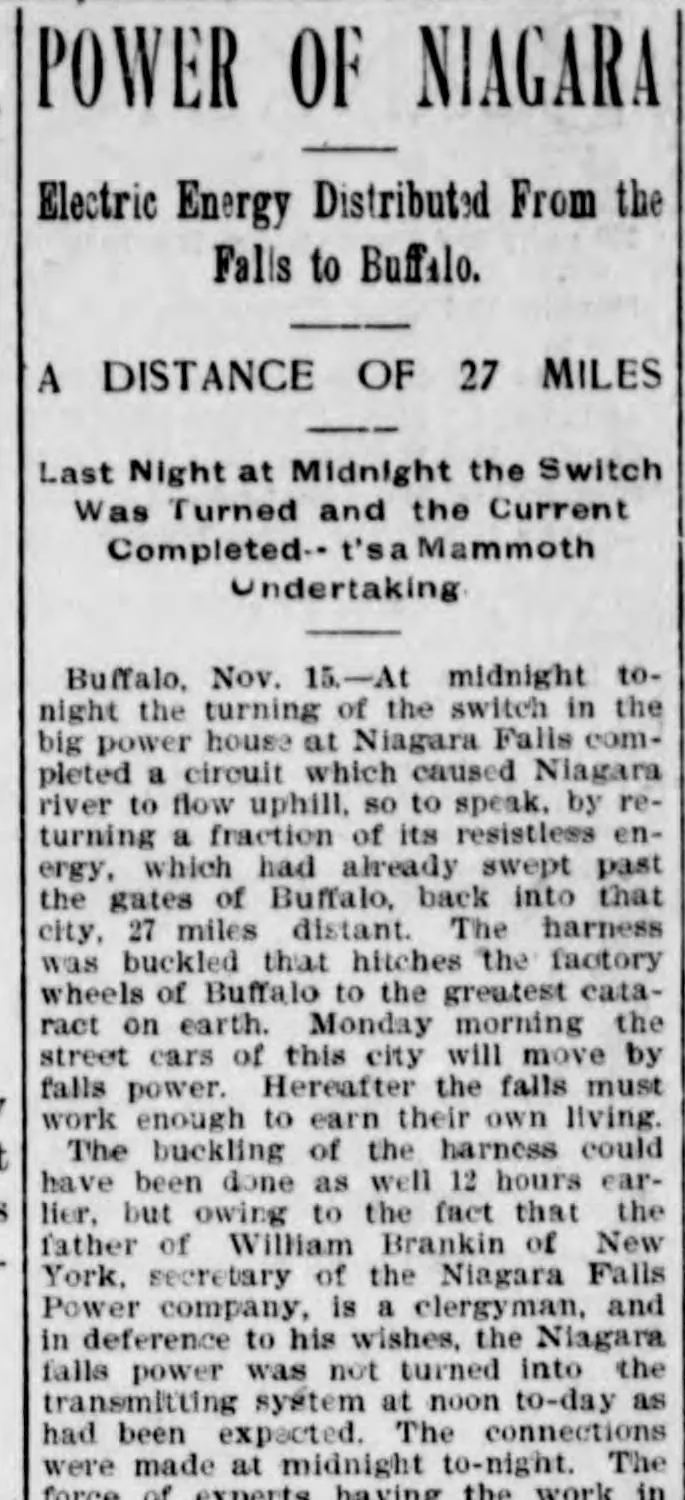
Further down the same column the paper does something invaluable. It names everybody who was standing in the building:
Those present in the power house proper were: Messrs. W. B. Rankin, secretary of the company; W. K. Breckinridge, resident engineer; Paul H. Lincoln, electrical superintendent; E. R. Edmunds of the General Electric company and Hon. W. H. Ely. Mr. Edmonds had charge of the transformer house.
At 11:45 o'clock p. m. Messrs. Rankin, Breckinridge and Lincoln took positions on the raised platform in front of the switch board on the main floor of the power house and arranged the switches. … Mr. Rankin then stepped to the platform, threw the switch over and Niagara's power was in Buffalo. A salute of 21 guns was fired by a battery stationed at the power house.
Same page and column, read from the page image. A preliminary test had been run at 8.57 that Sunday evening, and the Buffalo Evening News of the following morning is careful to say that the current “came in here last night, but as a matter of fact it is yet inactive” — Stetson later dated the steady supply of the 1,000 horse-power to 1 December 1896. The initials below are reproduced as printed, and the printing is not careful: the paper spells the General Electric man “Edmunds” and “Edmonds” in consecutive sentences, and gives the resident engineer as “W. K. Breckinridge” where the 1895 Cassier's volume has “W. A. Brachenridge”. The first Buffalo customer was the Buffalo Street Railway company, taking 1,000 horse-power at $36 per horse-power a year.
Tesla is not in that room. He is, however, in the same column eight paragraphs higher, in a sentence that shows the legend already forming in his lifetime: the company “has frequently called upon Messrs. Edison and Tesla for advice, and these famous masters of electricity have been frequently visitors to the Niagara falls power house to solve the technical problems.”
Both halves of that are from one page of one newspaper, and the second half is not true — which can be shown from another contemporary document rather than argued. Three months earlier a trade journal had printed an interview at the plant in which Tesla was asked, in terms, whether this was his first visit. It was.
What Tesla said when he was standing in the building
On Sunday 19 July 1896, eleven months after the station opened, Tesla went to see it, in a party that included George Westinghouse, Edward Dean Adams and William B. Rankine. The report was filed by Orrin E. Dunlap for the Western Electrician and reprinted in London:
Quite naturally, the event of Tesla's visit was one of importance, for never before had his eyes rested on this greatest of power plants. For four years he had refused to leave his work and visit the Falls, preferring to work out his theories and await the proper time to see them put into practical use and operation. Tesla was delighted with the manner in which his discoveries had been adapted to practical use by the engineers, and he unhesitatingly declared that there was no doubt of the success of the gigantic undertaking.
“Nikola Tesla at Niagara Falls”, The Electrical Review, vol. 39 no. 978, 21 August 1896, pages 225–226.
Asked directly what he thought of the plant, Tesla gave the answer that ought to end the argument:
Yes… it is all and more than I anticipated it would be. It is fully all that was promised. It is one of the wonders of this century. The power-producing plant of the Cataract Construction Company is a marvel in its completeness and in its superiority of construction. … In its entirety, in connection with the possibilities of the future, the plant, and the prospect of future development in electrical science, and the more ordinary uses of electricity, are my ideals. They are what I have long anticipated, and have laboured, in an insignificant way, to contribute toward bringing about.
“The power-producing plant of the Cataract Construction Company.” Not his plant: theirs. And his own labour toward it described, in the power house, as insignificant. He was being modest, and modesty is not a measurement — but a man who thought he had built the building does not say that while standing inside it.
Two other things. Rankine, the company secretary, made the attribution himself on the spot — “It is Mr. Tesla's two-phase system which is used” — the third independent contemporary crediting of the system to him. And Tesla explained why he would not linger: “The jar of the machinery curiously affects my spine.”
What he said at the celebration
On Tuesday 12 January 1897 the Cataract Power and Conduit Company gave a banquet at the Ellicott Club in Buffalo for four hundred guests, the menu cards bound in aluminium smelted with Niagara current. Tesla was the guest of honour and answered the toast “Electricity”. He did not finish — “the departure of his train compelled him to leave before the completion of his address” — but the manuscript was printed in full a fortnight later. Partway through he stops to name the men the age belonged to:
Bell, who, by his admirable invention enabling us to transmit speech to great distances, has profoundly affected our commercial and social relations…; Edison, who, had he not done anything else beyond his early work in incandescent lighting, would have proved himself one of the greatest benefactors of the age; Westinghouse, the founder of the commercial alternating system; Brush, the great pioneer of arc lighting; Thomson, who gave us the first practical welding machine…; Weston, who once led the world in dynamo design…; Sprague, who, with rare energy, mastered the problem and insured the success of practical electrical railroading; Acheson, Hall, Willson and others, who are creating new and revolutionizing industries here under our very eyes at Niagara.
“Tesla on Electricity: His Address in Full on the Occasion of the Commemoration of the Introduction of Niagara Falls Power in Buffalo at the Ellicott Club, January 12, 1897”, Electrical Review (New York), vol. 30 no. 4, 27 January 1897, pages 46–47.
He names ten men and omits himself. He calls the plant “that monument at Niagara”, “a monument worthy of our scientific age”, and closes by asking the room to “congratulate the intrepid pioneers who have joined their efforts and means to bring it about” — pioneers in the third person, at his own celebration. What he claims is all future tense: that he has “devised means” for much higher transmission voltages, and hopes still for “the transmission of power from station to station without the employment of any connecting wire.”
He was no less exact twenty years later. Accepting the Edison Medal in May 1917, he turned aside to say where the credit for Niagara belonged:
We have a man here to-night to whom belongs really the credit for the early steps and for the first financiering of the project, which was difficult at that time. I refer to Mr. E. D. Adams. … I went to see Mr. Adams. I remember the interview perfectly. … whether it was in consequence of my enlightening him on the situation, or owing to some other influence, my system was adopted. Since that time, of course, new men, new interests have come in, and what has been done I do not know.
Minutes of the annual meeting of the American Institute of Electrical Engineers, 18 May 1917. Quoted from transcription — the one contemporary printing located, Electrical Review and Western Electrician of 26 May 1917, page 880, states that “lack of space unfortunately prevents giving in full” and stops before this passage. This is the weakest citation on the page and is marked as one.
“My system was adopted” — and even that hedged with “or owing to some other influence”. A man building a legend does not insert that clause.
How “my ideas carried out” became “my turbines”.
The one Niagara story Tesla did tell about himself, over and over, is a boyhood one, and watching it change is the clearest view of the whole process. In My Inventions, serialised in 1919, it reads:
In the schoolroom there were a few mechanical models which interested me and turned my attention to water turbines. I constructed many of these and found great pleasure in operating them. … I was fascinated by a description of Niagara Falls I had perused, and pictured in my imagination a big wheel run by the Falls. I told my uncle that I would go to America and carry out this scheme. Thirty years later I saw my ideas carried out at Niagara and marveled at the unfathomable mystery of the mind.
Nikola Tesla, My Inventions, The Electrical Experimenter, February 1919. Those are the only two appearances of the word “Niagara” in the entire 1919 run — see the search log.
“My ideas carried out.” Carried out, that is, by somebody else: the passive is doing the same work the 1896 interview does. Now the same anecdote as Associated Press copy printed it within forty-eight hours of his death:
When I was about 9 years old I used to construct little water turbines in the streams that rushed down the mountains near my home. On one occasion I told my uncle, a metropolitan of the Greek church, that some day I would put a water wheel in Niagara Falls, about which I had read. So, in 1895, when I saw my turbines in action at Niagara Falls, I realized my boyhood dream.
Associated Press, in the Evening Star, Washington, 8 January 1943, page 14. The Amerikanski Srbobran of 13 January printed the same passage with “a metropolitan of the Orthodox Church”, which is the correction a Serbian-American paper would make.
Between 1919 and 1943 “my ideas carried out” has become “my turbines in action”, and the year has acquired a precision — 1895 — that does not fit the visit of July 1896 which is the only one on record. One word of drift, and the Swiss designers and the Philadelphia foundry are gone.
The headline, and the body text underneath it
Which brings us back to Figure 1. The same Evening Star page carried, above that obituary, a stack of headlines ending in a deck reading “Devised Transmitters And Niagara Turbines; Worked With Edison.”
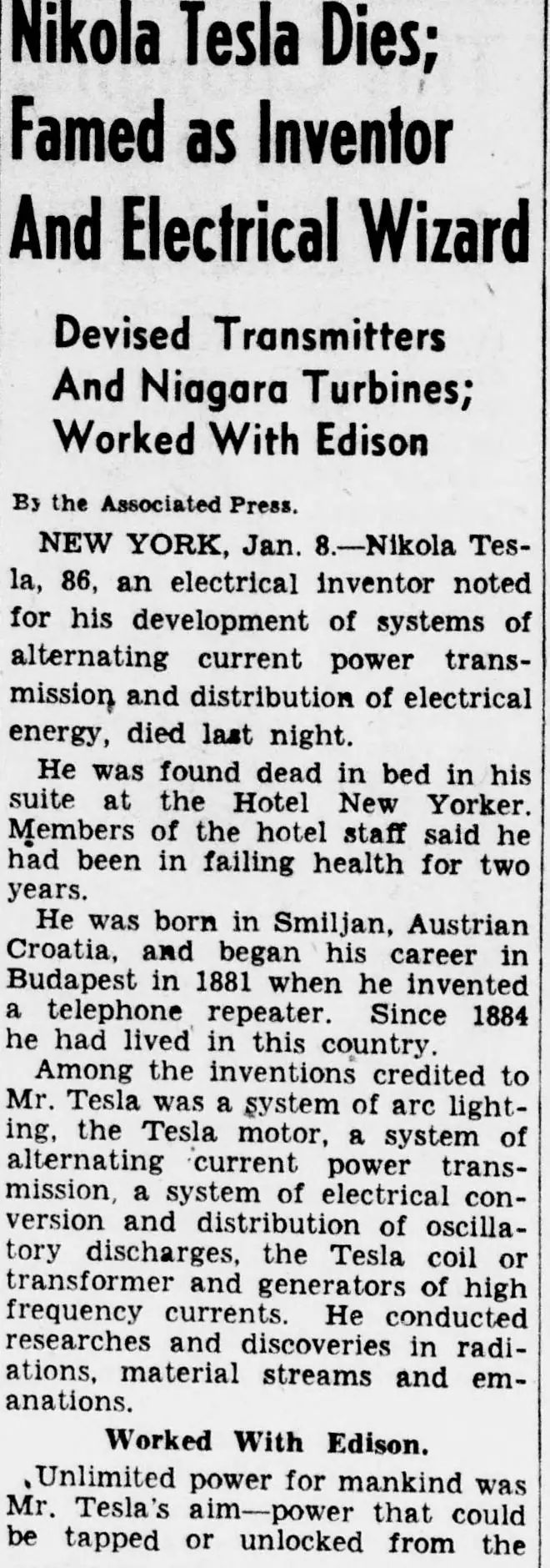
The headline and the story disagree, and the story is right. “The principle of the rotary magnetic field embodied in the apparatus used to transmit power from Niagara Falls was his invention” attributes a principle, embodied in apparatus, used to transmit power. Every qualifier is load-bearing, and every one is missing from the three words above.
That the deck belongs to the Evening Star's own copy desk rather than to the Associated Press can be shown, which is the difference between a finding and a guess. The Daily Alaska Empire of Juneau ran the identical wire copy the following day — the two match word for word across the paragraphs on the induction motor and the rotary field — under a headline of its own: “ELECTRICAL WIZARD HAS PASSED AWAY / Nikola Tesla, Who Played with Thor's Thunderbolts, Died in N. Y.” Niagara is not in it.
It had happened once already, in the same shape. In July 1932 a New York Times birthday interview quoted Tesla on the boyhood wheel — “I did put a big wheel in Niagara Falls” — and then added, in the reporter's own voice and not Tesla's, that he “designed the great power system at Niagara”. Twice now the expansive sentence is the journalist's and the careful one is the subject's.
That the misattribution was in print by 8 January 1943 is measured. That newspaper work is where this kind of error enters is not. It is a reasonable reading of three pages and is offered as one: a deck has four words and no room for a qualifier, while the body of the same story had room and used it. Whether that is the general mechanism is not something three pages can settle.
What is left standing
A great deal, and none of it needs the turbines. The arrangement that made long-distance power transmission a business rather than an experiment was Tesla's, and the firm that built the first great installation of it said so in its own souvenir volume three times over — in the voices of the engineer who installed it, its first vice-president and its secretary. Niagara is the commercial proof of the polyphase patents, and the reason the argument about copper ended as it did.
What is not left standing is the plant. It was conceived by Edward Dean Adams; judged by a commission that awarded no prize for distributing the power at all; turned by water wheels designed in Geneva and cast in Philadelphia; generated by machines whose form a professor in London proposed and whose frequency a financier split over dinner; assembled by nineteen Westinghouse men listed by name on page 306 of a magazine anyone can read; and switched into Buffalo at midnight on a Sunday while a battery fired a salute outside. When Kelvin finally came to look, in August 1897, he conceded from Toronto that the results “thoroughly justified Dr. Coleman Sellers in his adoption of the alternate-current system.” Even in surrender he credited a different man.
The last word belongs to one of the nineteen. Benjamin Lamme, who designed the generator that was actually built, was asked by Adams in 1920 who deserved the credit for it, and declined to answer the question as put:
It is impossible to give individual credit to all who were interested in the early design of the first Niagara generators … Consequently, it would not be right to refer to any individual engineer as responsible for these machines. There were no older engineers on this work, with younger assistants, as is now common; for there were no “older” engineers then, all of us being in the younger class … So, in reality, it must be considered that this equipment was the production of many men and not of any one individual.
B. G. Lamme, written at Adams's request and signed 20 October 1920, printed as Appendix M in Niagara Power, vol. II, page 420. Schmid was thirty-six at the time of the work and Lamme twenty-nine.
Tesla said his own part had been insignificant, which was too modest. Lamme said no one man was responsible, which was exactly right.
The document
The spine of this article is one volume: the Niagara Number of Cassier's Magazine, vol. VIII no. 3, July 1895, reissued in hard covers by the Cassier Magazine Co. of London in 1899 as The Harnessing of Niagara because, as its own preface says, the paper-covered number would not survive library use. It is a company souvenir, and that matters in both directions. Its authors are the project's own people — Francis Lynde Stetson was the Cataract Construction Company's first vice-president, Lewis Buckley Stillwell Westinghouse's electrical engineer and assistant manager, Coleman Sellers the Niagara Falls Power Company's president and chief engineer, Colonel Turrettini a member of the commission writing about his own Geneva installation. Nothing in it is disinterested. What makes it the right source anyway is the direction of its bias: a house organ with every incentive to claim American and in-house credit nevertheless names the system for Tesla, hands the generator's form to a professor in London, hands the turbines to a firm in Geneva, and prints nineteen subcontractors' engineers by surname. A partisan document that concedes against interest is worth more than a neutral one that concedes nothing.
Against it stand three contemporary newspaper and trade pages, each read as an image: the Electrical Review interview of 21 August 1896, in which Tesla is asked whether this is his first visit; the Anaconda Standard of 16 November 1896, which names the five men in the power house at midnight; and the Evening Star of 8 January 1943, whose headline and body text contradict each other. Tesla's own account appears only in My Inventions, 1919, where Niagara occupies two words of a childhood anecdote and nothing else at all.
The search log
Run 2 November 2026. Two corpora were downloaded whole and searched locally rather than through any site's search box: the 1899 bound reissue of the Niagara Number, and the 1919 Electrical Experimenter run containing all six instalments of My Inventions. Counts were re-run with whitespace normalised, because the optical character recognition on these scans doubles spaces and silently breaks multi-word searches.
- Niagara in My Inventions, 1919. Twice, and only in a boyhood paragraph. The word occurs exactly two times in the whole 1919 run — “a description of Niagara Falls I had perused” and “I saw my ideas carried out at Niagara” — in consecutive sentences about a schoolroom model. There is no account of the plant, no visit and no claim. Cataract 0, Forbes 0; both hits for Buffalo are advertisements for the Buffalo Sled Co. of North Tonawanda, so the city does not appear in the run at all. Controls, to show the corpus could have answered: all six instalment months present (February to June and October 1919), Smiljan 1, Budapest 4, rotating magnetic 3, Westinghouse 4, Kelvin 3. Tesla's 1900 Century manifesto, “The Problem of Increasing Human Energy”, does not use the word once either.
- Who is in the 1895 volume, counted. Cataract 30, Westinghouse 20, Faesch 9, Piccard 9, Sellers 7, Forbes 6, Morris 5, Unwin 4, Adams 4, Turrettini 3, Kelvin 2, Mascart 1 — and Tesla 3. The system carries his name on page 255; Stetson quotes a conversation with him on page 185; and page 254 calls Smiljan “that sturdy little province on the Adriatic, which has honoured itself by producing Mr. Nicola Telsa”, misspelling him in the act of praising him. Three mentions, in a volume that names the men who did the work dozens of times, is the correct proportion rather than a slight.
- A public-domain portrait of George Forbes. Found — and the first sweep of this article wrongly concluded there was none. That wrong conclusion is recorded because it was instructive. Searching the obvious place, Wikimedia Commons, returns two candidates and both are traps: a “George Forbes, 1914” which is the wrong man — George William Forbes, later Prime Minister of New Zealand — and a second file carrying a CC BY-SA 4.0 tag over the description “Found under search for ‘George Forbes, Scottish scientist’” and an unknown source. Having rejected both it is very easy to write “no portrait exists”. One does, at full-page plate size, in Adams's own 1927 history of the company — exactly where a portrait of the company's consulting engineer would be. A negative taken from one aggregator is not a negative.
- Who designed the generator was a public fight in 1895, and this page's two company sources are on one side of it. Stetson and Stillwell both credit Forbes with the general form, and both were paid by the company that hired him. The firm that built the machines said otherwise in The Times, quoted above. So did a competitor: C. E. L. Brown of Brown, Boveri published in the London Electrical Review of 15 March 1895, pages 319–320, the design he says he submitted to the Niagara company on 20 September 1892, claiming priority for the vertical shaft and for “the ‘umbrella shape' form of the field magnet system”, and noting that an external revolving field had already been illustrated by Patin in L'Industrie Électrique for 25 May 1892. Forbes had written to the same journal on 20 February 1895 asking where an earlier priority claim came from, because “if any prior publication of the principle exists, it would, of course, invalidate my American patent, No. 518,944”, and on 8 March allowed that “I have had no desire to introduce novelties at Niagara”. Against all of which, Coleman Sellers testified for the defence in the Rowland suit in January 1894 that the apparatus “was designed entirely by Prof. Forbes and himself, and was entirely different from that in Prof. Rowland's report”. Two of these are read from page images — the Westinghouse letter at Electrical Review page 317 and the Sellers testimony at The Electrical World of 27 January 1894, page 121, where it is a reporter's summary of what was said in court and not a transcript; no transcript of the trial has been located. The Brown and Forbes letters of February and March 1895 are read from the text layer only and are not independently confirmed here. MEASURED: company documents and testimony credit Forbes with the form; the builder and a rival contested it within months, and no reply from Forbes to the builder has been found. This page asserts only what survives all of those accounts at once — that the form was not Tesla's, and was never claimed for him by anybody.
- The best witness for the division this article draws is a Tesla partisan, and he was found last. T. Commerford Martin's Franklin Institute lecture of 3 January 1896, quoted above, puts both halves in one sentence; he had edited Tesla's collected papers two years before. He was not found by searching for Tesla or Niagara, which return thousands of hits in the 1890s trade press, but by enumerating all 1,417 Journal of the Franklin Institute identifiers on the Internet Archive and grepping each text layer in turn — because the Archive's own full-text search now fails at every public endpoint, ia-pub-fts-api and the sin=TXT parameter alike. A dead search API is not an empty shelf. Note also that the halftone of the alternator on page 299 of that number has reproduced as a solid black rectangle on the microfilm, so the lecture survives as text and not as a picture.
- The distance to Buffalo: 27 miles, 22, or 21? The contemporary sources disagree with each other, and that is the finding. The wire report of 16 November 1896 gives 27 miles twice. The Electrical World of 21 November 1896 says “about 22 miles”, and on 2 January 1897 “21 miles”. The engineer who built the line, J. G. White, told the National Electric Light Association in June 1897 that once the route was fixed “its length was found to exceed twenty-seven miles instead of being twenty-five miles, as previously assumed”, and that the line as operating was “over twenty-five miles long”. Scientific American gives 78 miles of conductor, which is 26 miles of three-wire route. Electrical Review of 18 November 1896 says 26, and Electrical World's itemisation adds to the same: eighteen miles across private land, five along the Erie Canal bank, about three inside the city, then 4,200 feet of underground conduit. INFERRED: about 26 miles overhead is the engineering figure and 22 and 27 are press roundings. No figure on the copper page has been changed on the strength of this.
- The 1943 headline, and the control that makes it mean something. Thirty-two newspaper pages from the week of Tesla's death, pulled in full text from the Library of Congress for an earlier article, were re-searched for Niagara. Four pages carry it. The Evening Star of 8 January is the only one whose headline does, and the only occurrence anywhere in the set of the claim that Tesla devised the turbines. The Daily Alaska Empire of 9 January carries the identical Associated Press body text under a headline with no Niagara in it; the Srbobran of 13 January and the Slovenian-language Enakopravnost of Cleveland of 14 January both describe the rotating magnetic field as the thing used in the transmission, which is correct. Three of the four got it right.
- The names in the power house — and a warning about taking them from a newspaper. The Anaconda Standard's column is quoted above exactly as printed, and the printing is poor: it spells the General Electric man “Edmunds” and “Edmonds” in consecutive sentences. Checked against the trade press, four of its five names are wrong in some particular. The Electrical World of 21 November 1896, page 618, has W. Caryl Ely (not W. H.), W. A. Brackenridge (not W. K. Breckinridge), Paul M. Lincoln (not Paul H.) and I. B. Edmonds (not E. R. Edmunds), and adds that the Buffalo end was switched by W. L. R. Emmet of General Electric with Mayor Jewett holding the watch. For personal names, prefer the trade weekly to the wire.
- The 1895 issue and the 1899 reissue do not say the same thing about Stillwell, and the difference matters. The copy read for this article is the 1899 bound reissue, whose biographical note calls him “the electrical director of the Niagara Falls Power Company”. The 1895 printing of the same pages calls him “the electrical engineer and assistant manager of the Westinghouse Electric and Manufacturing Company”. Both are true in their year: he was Westinghouse's man when he wrote the article and moved to the power company — from the contractor to the client — in 1897, and the reissue quietly updated his title four years after the fact. This page uses the 1895 title, because it is the one that was true when the sentences were written, and because it makes his testimony heavier rather than lighter: the contractor's own engineer is the man who put Tesla's name on the system and handed the generator's form to a professor in London. Anyone citing the biographical note should say which printing they have.
- Which Electrical Review, and a cataloguing trap. This page cites two different journals of that name. The 1896 interview at the plant is in the London Electrical Review, formerly The Telegraphic Journal and Electrical Review, whose volume 39 runs July to December 1896 with issues numbered 973 on 17 July to 994 on 11 December — so issue 978 falls on 21 August 1896, which is what the running head says. The 1897 Ellicott Club address is in the New York Electrical Review, volume 30. On the Internet Archive the New York journal is filed under identifiers beginning sim_factory_, because the microfilm reel follows the title into its successor Factory; sim_electrical-review_ is the London one. Two independent searches hit that trap.
- Grep the text layer, publish from the page image — again. The archive's own optical character recognition of the August 1896 issue renders the key sentence as “They are what I have long anticipated, and have la a, in an insignificant way” and replaces the words “are my ideals” with a dash. The page image reads both plainly. The quotation above was transcribed from the image and then confirmed against the text layer, not the other way round.
- The exact day of the 1896 visit. 19 July, on two independent sources, but the wire copy will not support it alone. The Electrical Review reprint states “his first visit … on Sunday, July 19th”, and the Evening Times of Washington, printing the dispatch on Monday 20 July, says the visitors were in the city “yesterday”. But the same dispatch was re-dated by each paper that ran it: the Scranton Tribune of 22 July heads it “July 21 … today”, and the Topeka State Journal of 24 July heads it “July 24 … today”. Anyone dating this from a single syndicated printing will get it wrong.
- The 1917 Edison Medal passage is transcription-only, and is the weakest citation here. No contemporary printing of it has been located. Electrical Review and Western Electrician of 26 May 1917, page 880, printed the acceptance but states that “lack of space unfortunately prevents giving in full”, and its text stops before Niagara; Electrical World went to press before the ceremony; the AIEE Transactions for 1917 carry no Edison Medal minutes. Two independent transcriptions of the meeting minutes agree word for word, and the same transcriptions' rendering of E. W. Behrend's presentation address matches the 1917 printed text almost to the comma — which raises confidence without supplying a page image.
- The prize fund: $22,000 or £4,500? Both, and the arithmetic reconciles them. Stetson's 1895 text, quoted above, says “$22,000 in prizes”. Unwin's own 1891 report says “a sum of about £4,500 was placed in the hands of the Commission”, and the letter of invitation fixes the company's own conversion at “five dollars per pound sterling” — so £4,500 is $22,500, and Stetson is rounding his own secretary's sterling figure. The largest single prize was £600, which is the $3,000 Westinghouse sneered at. The “$20,000” that circulates has no document behind it.
- Was Unwin a member of the commission or only its secretary? The sources genuinely disagree and the page does not pretend otherwise. Stetson, quoted above, lists four members and Unwin “as secretary”; Kelvin's private letter of 21 June 1890 describes “a consulting Commission of four”; Unwin's own report sets himself apart as “Secretary”. Against that, Adams writes that “the members of the commission were five in number, two from England”, counting Unwin; the 1926 memorial tablet in London names all five; and Cassier's own biographical note calls him “a member”, contradicting Stetson in the same issue.
- Kelvin's recantation: the famous wording is apocryphal. The sentence widely quoted as Kelvin's surrender — that he had “entirely abandoned” his view of 1893 — is in no document located. It is absent from both volumes of Adams and from Silvanus P. Thompson's authorised Life. What exists is quoted above: the visitors'-book entry of 16 August 1897, reproduced by Adams in facsimile, and the letter from Toronto of 23 August. A third, later letter is paraphrased by Adams and not quoted, and is not treated here as a quotation. And the conflict is not resolved: Thompson wrote in 1910 that Kelvin “was throughout and to the last entirely opposed to the use of alternating currents in any shape”. Adams is the better authority — he was the addressee and prints a facsimile — but Thompson signed the same visitors' book five days after Kelvin did.
- Two interfaces that manufacture false negatives. The documented Chronicling America JSON interface at chroniclingamerica.loc.gov/search/pages/results/ now answers HTTP 308 and then 404 rather than returning results, and the human-readable text view at www.loc.gov/resource/…?st=text answers 403 to anything that is not a browser. Neither means the page is unavailable: the page's own JSON carries a full-text URL on the Library's unauthenticated tile service, which returns the whole page as data. A careless harness reads both refusals as “no such page”.
Unresolved: the surveyed length of the Buffalo line; whether any 1917 printing of Tesla's Edison Medal remarks on Niagara exists; the eight Tesla-to-Adams letters of 1893, which are in corporate custody at National Grid in Syracuse, undigitised and without a public finding aid; and when, between 1896 and 1943, a newspaper first printed the claim that Tesla designed the Niagara turbines.
Primary documents
- Lewis Buckley Stillwell, “Electric Power Generation at Niagara”, Cassier's Magazine, vol. VIII no. 3, July 1895, pages 253–306 — by the man who had the entire electrical installation under his supervision. The source for “the Tesla Polyphase Alternating-Current System”, for the Forbes attribution, and for the roster of nineteen. The bound volume.
- Francis Lynde Stetson, “The Use of the Niagara Water Power”, same number, pages 173–194 — by the Cataract Construction Company's first vice-president. The International Niagara Commission, the $22,000 in prizes, “Prof. Forbes' happy idea”, and the conversation with Tesla about 100,000 horse-power on a wire. Digitised pages.
- Clemens Herschel, “Niagara Mill Sites, Water Connections and Turbines”, same number, pages 227–252 — the Faesch & Piccard wheels, and the page carrying the photograph reproduced as Fig. 1. Page 242.
- W. C. Unwin, report of the International Niagara Commission, London, 13 April 1891 — “There was no project which, in the opinion of the Commission, could be recommended for adoption without considerable modification”, the award list, and the refusal of any prize for distribution. Printed as Appendix E in Adams, Niagara Power, vol. I, pages 393–445; the award list is independently reprinted in Engineering News, 14 March 1891, page 250, from Industries of London. The awards.
- Edward Dean Adams, Niagara Power: History of the Niagara Falls Power Company 1886–1918, 2 vols., Niagara Falls, N.Y., 1927 — the company's own history, by its president. Kelvin's cable of 1 May 1893 (II, 256); the Union League Club dinner and the 25-cycle compromise (II, 237–238); Tesla as a confirming adviser on two phases (II, 235); Forbes's letter of 1924 and his portrait (II, 356–357); Lamme's Appendix M (II, 409–421). Volume I · Volume II.
- George Forbes, “The Electrical Transmission of Power from Niagara Falls”, Journal of the Institution of Electrical Engineers, vol. XXII no. 108, 1893, pages 484–531, read on 9 November 1893 — his own specification, including “Consequently we have made a compromise, and are going to build our first three dynamos for a frequency of 25 periods per second” at page 503. The discussion that follows is worth reading for its own sake: Ferranti accused Forbes to his face of taking the design from C. E. L. Brown of Baden. The volume.
- George Forbes, Dynamo-Electric Machine, US 518,944, and two companion patents, US 518,945 and US 518,946, all filed August 1893 and granted 1 May 1894 — the bell-shaped revolving field, the armature winding, and the oil-cooled coil that Westinghouse refused to build. Recorded contemporaneously in The Electrical World, 19 May 1894, page 694.
- Westinghouse Electric and Manufacturing Company, signed Geo. Westinghouse, jun., president, letter to The Times (London) dated Pittsburg, Pa., 29 August 1895 and printed 10 September 1895; reprinted with the surrounding correspondence under the heading “Niagara” in The Electrical Review (London), vol. 37 no. 929, 13 September 1895, pages 317–318. The manufacturer's public answer to Forbes's claim on the plant — “the picture of a man and the man himself” — together with two letters of 1891 between Forbes and Westinghouse printed in full, and, on the following day, the Cataract Construction Company's letters on the other side. Read from the page image. The issue.
- “Prof. H. A. Rowland vs. the Cataract Construction Company”, The Electrical World, vol. 23 no. 4, 27 January 1894, pages 119–121 — the trade weekly's report of the trial, in which Coleman Sellers testified that the generator “was designed entirely by Prof. Forbes and himself”, Rankin gave the commission's fees under cross-examination, and the jury awarded Rowland $5,500. A reporter's summary, not a transcript. The issue.
- T. Commerford Martin, “Niagara on Tap”, a lecture delivered before the Franklin Institute on 3 January 1896, printed in the Journal of the Franklin Institute, vol. CXLII no. 4, October 1896, pages 287–302, ending “To be concluded” — the sentence that states both halves of the division at once, at page 300, by the editor of Tesla's own collected papers. Read from the page image. The issue.
- “Nikola Tesla at Niagara Falls”, The Electrical Review (London), vol. 39 no. 978, 21 August 1896, pages 225–226, reprinted from Orrin E. Dunlap in the Western Electrician — the interview at the plant. “Never before had his eyes rested on this greatest of power plants”, and “have laboured, in an insignificant way”. The bound issue.
- “Power of Niagara: Electric Energy Distributed From the Falls to Buffalo”, The Anaconda Standard, Anaconda, Montana, 16 November 1896, page 1 — the midnight switching, the 27 miles, the men in the power house, the 21-gun salute, and the claim that the company had “frequently called upon Messrs. Edison and Tesla for advice”. The same wire copy ran on the front page of the Omaha Daily Bee the same morning. Digitised page, Library of Congress.
- “Power from Niagara … The Men Who Have Done It”, New-York Daily Tribune, 15 November 1896, page 8 — the sharpest contemporary statement of the division of labour: “Tesla's ‘polyphase’ system of operating motors with alternating currents was then chosen. The dynamos, which were designed by George Forbes, of London, and made by Westinghouse after the plans had been modified considerably…” Its roll-call of the company's advisers names Kelvin, Turrettini, Mascart, Unwin, Bogart and Rowland — and not Tesla. Digitised page, Library of Congress.
- “Niagara Power in Buffalo”, The Electrical World, vol. XXVIII no. 21, 21 November 1896, page 618 — the trade weekly's account of the same midnight, with the names spelled correctly. The following week's issue, pages 653–655, gives the minute (“one minute after 12 o'clock Monday morning, Nov. 16”) and the price of $36 per horse-power a year. The issue.
- “Tesla on Electricity: His Address in Full … at the Ellicott Club, January 12, 1897”, Electrical Review (New York), vol. 30 no. 4, 27 January 1897, pages 46–47 — the speech in which he names ten other men and not himself. The report of the banquet, and the note that his train took him away before he finished, are in the previous week's issue, vol. 30 no. 3, 20 January 1897, pages 26 and 30. Page 46.
- Nikola Tesla, My Inventions, The Electrical Experimenter, six instalments, February to June and October 1919 — searched in full. Niagara appears twice, both in one boyhood paragraph, in the instalment of March 1919 at page 843. The page.
- Minutes of the annual meeting of the American Institute of Electrical Engineers, 18 May 1917 — Tesla's acceptance of the Edison Medal, in which he gives “the credit for the early steps and for the first financiering of the project” to Edward Dean Adams. Quoted from transcription; no page image located. See the search log.
- Associated Press, “Nikola Tesla Dies; Famed as Inventor and Electrical Wizard”, Evening star, Washington, D.C., 8 January 1943, page 14 — the “Devised Transmitters And Niagara Turbines” deck, the careful sentence about the rotary magnetic field underneath it, and the “my turbines” version of the boyhood anecdote. Digitised page, Library of Congress.
- Associated Press, “Electrical Wizard Has Passed Away”, The Daily Alaska Empire, Juneau, 9 January 1943, page 3 — the control: the same wire copy, a different headline, no Niagara. Digitised page, Library of Congress.
- Nikola Tesla, Electro-Magnetic Motor, US 381,968, filed 12 October 1887, granted 1 May 1888 — the foundation patent of the system Niagara was built around. Full document.
- IEEE Milestone, Adams Hydroelectric Generating Plant, 1895 — for 26 August 1895, and for the ten 5,000-horse-power generators in place by May 1900.
Further reading
- George Forbes, “Harnessing Niagara”, Blackwood's Magazine, vol. 158 no. 959, September 1895, pages 430–444, and the replies it drew: Ernest A. Le Sueur in The Popular Science Monthly, vol. XLVIII, December 1895, pages 198–204, and the notices collected as “Prof. Forbes Castigated” in The Electrical World of 5 October 1895, page 378. A credit fight worth reading in full. The article.
- Silvanus P. Thompson, The Life of William Thomson, Baron Kelvin of Largs, 1910, vol. II, pages 894–896 — Kelvin's letter of 6 January 1892, and his biographer's insistence that he never came round. The pages.
- Did Tesla invent alternating current? — the patents the Niagara system was licensed from, and the other people in that room.
- The war of the currents was an argument about copper — why a distance like Niagara to Buffalo decided the question, with the arithmetic.
- The patent list — where US 381,968 sits among the roughly 112 United States grants.
The record on this article
- True “The Niagara plant used Tesla's polyphase system.” And it was called that in print at the time, by the people building it. The man who supervised the whole electrical installation wrote in July 1895 that “the system or organization of electric apparatus which was adopted is known as the Tesla Polyphase Alternating-Current System” — two-phase, 90 degrees apart, 25 cycles per second. The company's first vice-president and its secretary made the same attribution independently.
- False “Tesla designed the Niagara turbines.” They were designed by Faesch & Piccard of Geneva and built by the I. P. Morris Company of Philadelphia, and the 1895 photograph says so in its own printed caption. Faesch & Piccard were selected in 1891, as the first result of a commission convened in London the year before. A turbine is a hydraulic machine; Tesla's patents are electrical. The claim appears to enter the record through a newspaper headline of 8 January 1943.
- False “Tesla designed the Niagara generators.” They were built by Westinghouse “following, as regards mechanical form, the type of machine proposed by the engineers of the Cataract Construction Company” — specifically, by Professor George Forbes, whose “happy idea of a dynamo in which the field magnets should revolve instead of the armature” is credited to him by name in the same volume, twice, by two different authors. Westinghouse then disputed in The Times even that much, claiming the internals for its own engineers and conceding Forbes only the outside. Nobody on any side of that argument mentioned Tesla.
- False “Tesla was a frequent visitor to the Niagara power house.” A wire report of 16 November 1896 says exactly this of both Edison and Tesla. It is contradicted by a trade-journal interview conducted at the plant three months earlier, in which Tesla is asked “This is your first visit to the plant?” and answers “Yes; I came purposely to see it.” The report adds that “for four years he had refused to leave his work and visit the Falls”. The visit was on Sunday 19 July 1896, eleven months after the station opened.
- False “Tesla claimed Niagara as his own achievement.” He did the opposite, consistently, for thirty-six years. At the plant in July 1896 he called it “the power-producing plant of the Cataract Construction Company” and said he had “laboured, in an insignificant way, to contribute toward bringing about”. As guest of honour at the Buffalo celebration in January 1897 he named Bell, Edison, Westinghouse, Brush, Thomson, Weston, Sprague, Acheson, Hall and Willson, and not himself, and asked the room to “congratulate the intrepid pioneers”. Accepting the Edison Medal in 1917 he said the credit “for the early steps and for the first financiering of the project” belonged to Edward Dean Adams, and that his own system was adopted “whether it was in consequence of my enlightening him on the situation, or owing to some other influence”. In 1919 he wrote that he “saw my ideas carried out at Niagara” — passive, and by other people.
- Source is Tesla alone “Tesla dreamed as a boy of putting a wheel in Niagara Falls, and lived to see it.” The anecdote is his own and has no corroboration, which does not make it false. What is measurable is that it changed. In 1919 he wrote “Thirty years later I saw my ideas carried out at Niagara.” In the wire copy of January 1943 the same story ends “when I saw my turbines in action at Niagara Falls”. The passive became a possessive, and the year moved to 1895, which is a year before the only visit on record.