My Inventions: six magazine articles, and a seventh that never came
Tesla's autobiography was commissioned by a popular monthly, prepared month by month with its editors, and abandoned mid-promise. The seventh instalment was announced, apologised for, and never printed.
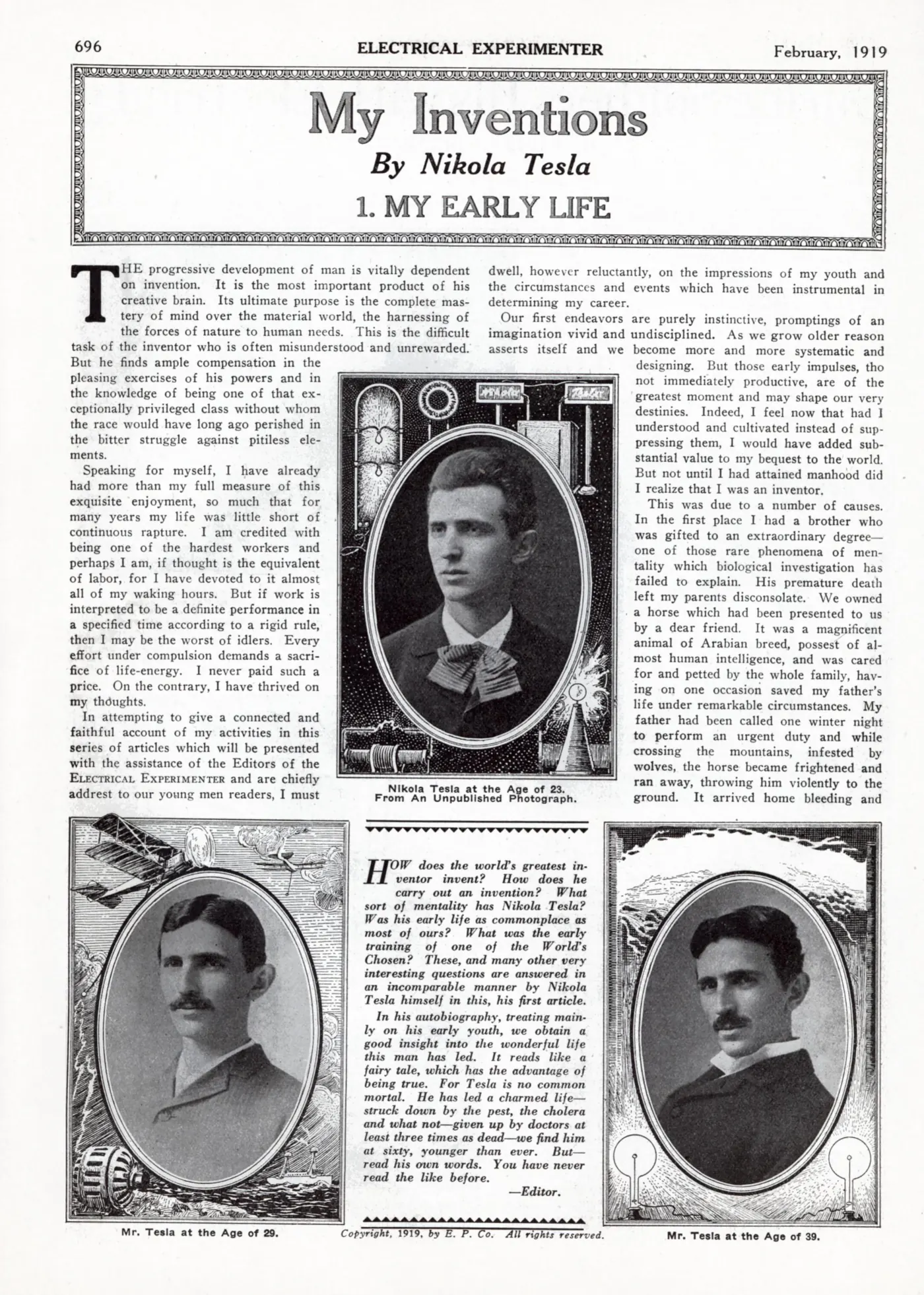
Accounts of Tesla's life quote My Inventions constantly. In a sample of eleven careful citations collected for this article — scholarly books, a museum catalogue, a journal article, an encyclopedia — what they mostly quote is not the magazine at all but a book: a paperback of 111 pages, edited by Ben Johnston, published by Hart Brothers of Williston, Vermont, in 1982. That book is a reprint. What Tesla produced, sixty-three years earlier, was six articles in a monthly magazine, written to a commission, prepared with its editors, and broken off in the middle.
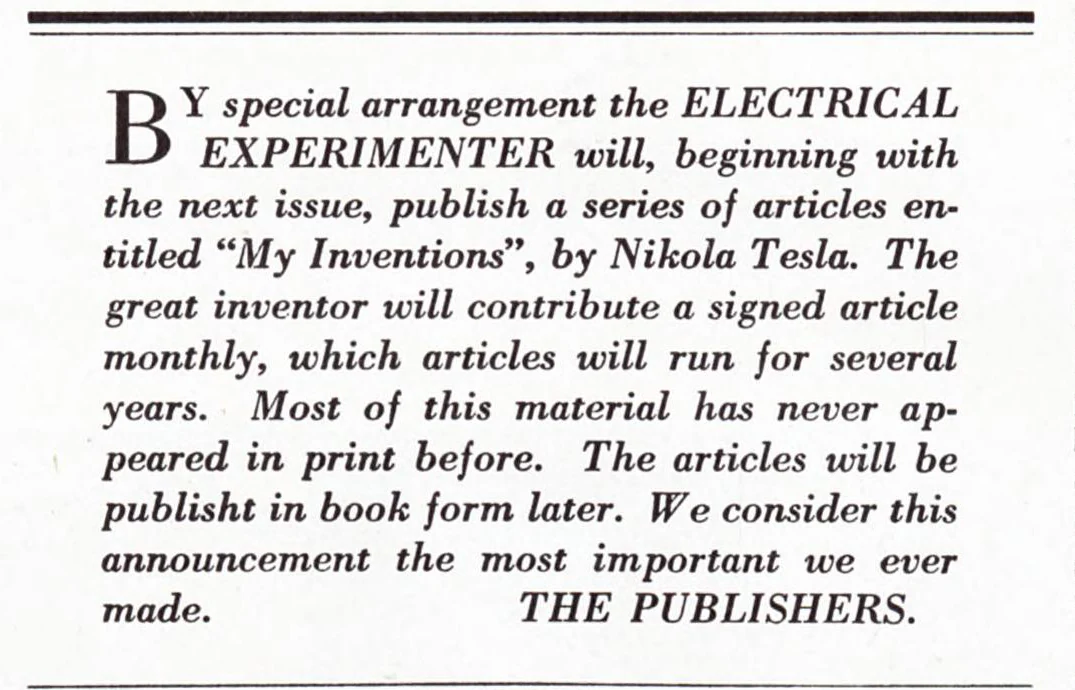
They ran in The Electrical Experimenter of New York in February, March, April, May, June and October 1919. A seventh was announced in print, apologised for in print, and never appeared. The series nobody finished is the single most quoted source on Tesla's childhood, his health, his visions, and the moment he says the rotating magnetic field occurred to him.
None of that makes it worthless. It makes it a particular kind of document, and the terms are legible on the pages.
The man who commissioned it.
Hugo Gernsback commissioned it, and his name is almost never in the citation. The contents page names him as the publisher — "Publisht by Experimenter Publishing Company, Inc. (H. Gernsback, President; S. Gernsback, Treasurer;)" — and three pages further in, on an engraved banner the machine-read text turns to gibberish, the magazine names him again: "H. GERNSBACK — EDITOR / H. W. SECOR — ASSOCIATE EDITOR." He owned it and he edited it, and he wrote the signed editorial every month. He had met Tesla years before, as he tells it in the January issue: "Some years ago as Editor of Modern Electrics, I met him in a New York shop where his famous turbine models were first built." The announcement of the series is a signed article of his own: "Nikola Tesla and His Inventions, By H. Gernsback, AN ANNOUNCEMENT," pages 614 to 615, continued on page 657. (The issue's own contents page sends a reader to page 622, which is an article called "An All-Electric Hot Air Balloon." The citation problem this piece is about starts inside the magazine.)
In it he quotes the pitch he made in person, and it describes exactly what the resulting document is:
Why not let the EXPERIMENTER be your brother? Why not let us translate your work into a language that the man in the street can readily understand? … The public does not want patent drawings or patent language. It wants pictures and plain English. … My plan is to run one of your inventions every month, in plain English fully illustrated. That means that it will probably take over two years to deal with all of your more important inventions. At the end of this period the articles can be published in book form, a thing that does not exist at present.
H. Gernsback, "Nikola Tesla and His Inventions: An Announcement," The Electrical Experimenter, January 1919, continued on page 657.
And the sentence that governs how the whole thing should be read: "Great was my surprise therefore, that he not only gave his consent, but he actually agreed to prepare each article personally with the Editors' collaboration."
What the two of them actually signed.
The agreement survives: a single typed sheet on Experimenter Publishing letterhead — "100,000 Copies Monthly, Guaranteed, A.B.C. Audit" across the top — dated 27 November 1918, addressed to Tesla at 8 West 40th Street, signed by Gernsback, held by the Nikola Tesla Museum in Belgrade. Its terms are not what a reader of the magazine would guess.
In accordance with our verbal understanding, I wish to state, on behalf of the ELECTRICAL EXPERIMENTER Magazine and myself, that we will undertake to publish a series of monthly articles dealing with your inventions, to run consecutively for a period not to exceed two years and to be thereafter printed in book-form. … You are to cooperate with us in the composition of the articles, make corrections, supply sketches, photographs and other data you may have available, all free of charge. … In consideration of this we agree to pay you ten percent author's remuneration on all books sold.
Hugo Gernsback to Nikola Tesla, 27 November 1918, Experimenter Publishing Co., Inc., 233 Fulton Street, New York. Nikola Tesla Museum, Belgrade; its stamp is on the face of the sheet.
So Tesla was paid nothing for the articles. His entire consideration was a royalty on a book, and the contract gives the publisher a year after the series ends to produce one, after which "our privilege will cease and you will be free to dispose of them." The carve-out is pointed, because the magazine's own colophon in every 1919 issue reads: "ALL accepted contributions are paid for on publication." The most famous thing Tesla ever wrote is the exception to his publisher's standing policy.
What the document physically is
Six instalments, each opening under the same ornamental display head. The headings below are as printed on the page:
| # | Heading as printed | Issue | Page |
|---|---|---|---|
| 1 | 1. MY EARLY LIFE | February 1919 | 696 |
| 2 | 2. MY FIRST EFFORTS IN INVENTION | March 1919 | 776 |
| 3 | III. MY LATER ENDEAVORS — The Discovery of the Rotating Magnetic Field | April 1919 | 864 |
| 4 | IV. The Discovery of the Tesla Coil and Transformer | May 1919 | 16 |
| 5 | V. The Magnifying Transmitter | June 1919 | 112 |
| 6 | VI. THE ART OF TELAUTOMATICS | October 1919 | 506 |
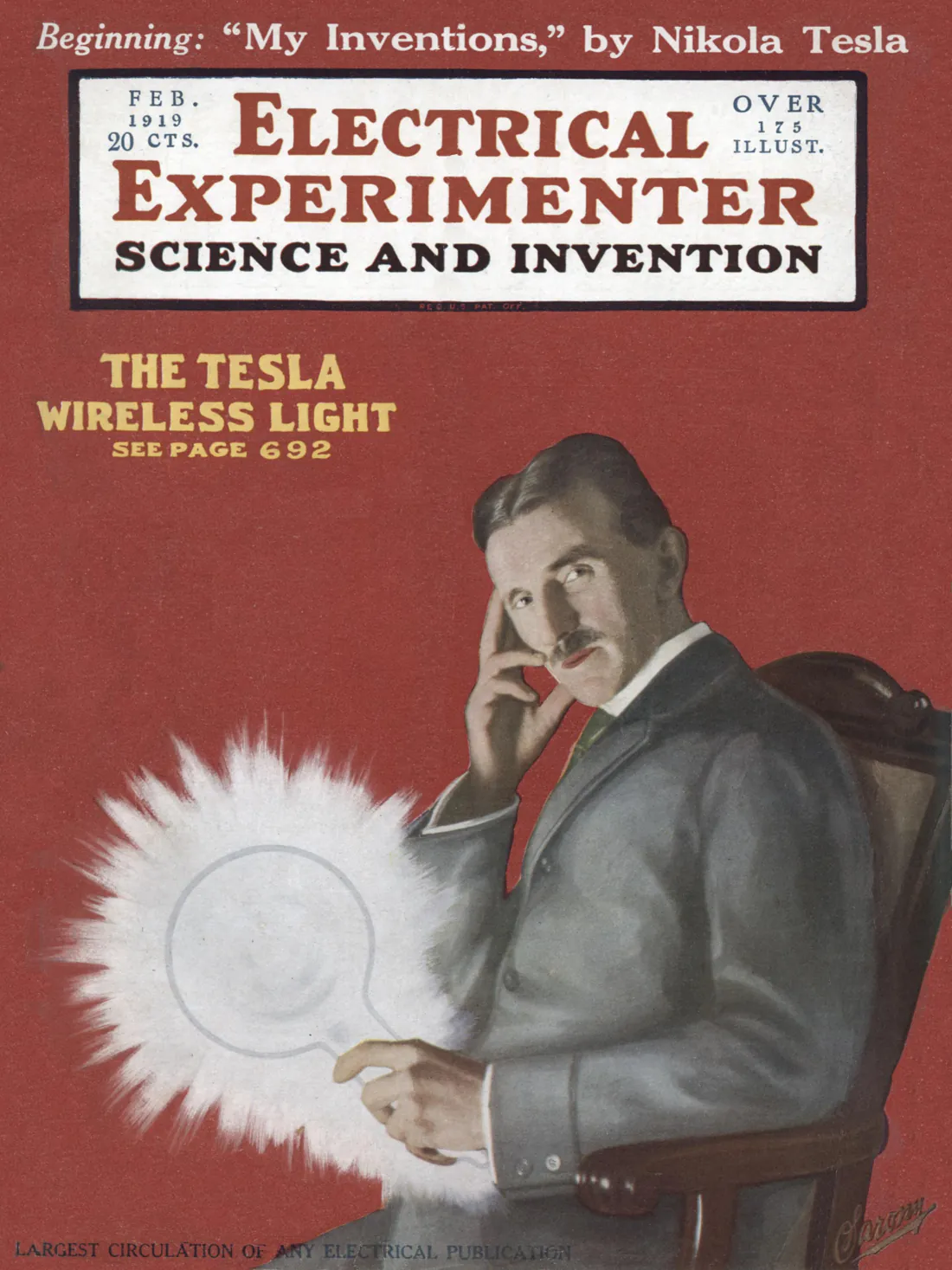
The contents page agrees: "MY INVENTIONS—NO. 1 OF A SERIES… Exclusive Feature. 696" — a numbered feature in a monthly costing twenty cents. The same issue carried a second signed Tesla article and a cover painting of him; he had six other bylines that volume-year.
Two features are worth holding on to.
The page numbers fall off a cliff between April and May because a new volume begins with the May 1919 issue. A reader given "My Inventions, 1919" has to know that before the citation resolves to anything.
And the instalments are not continuous. The sixth begins on page 506 and scatters — 550, 552, 554, 556, 600, 603 — threaded between the advertisements at the back. The final chapter of the autobiography is printed in seven places in one magazine, under a running head reading "(Continued from page 601)."
What the author and the editor each called it.
Both descriptions are on page 696, inches apart, and disagree.
Tesla's own third paragraph, the first in which he describes the thing he is writing: "In attempting to give a connected and faithful account of my activities in this series of articles which will be presented with the assistance of the Editors of the ELECTRICAL EXPERIMENTER and are chiefly addrest to our young men readers, I must dwell, however reluctantly, on the impressions of my youth…"
The magazine's panel, lower on the same page and signed "—Editor": "In his autobiography, treating mainly on his early youth, we obtain a good insight into the wonderful life this man has led. It reads like a fairy tale, which has the advantage of being true. … But—read his own words. You have never read the like before."
The word autobiography is the publisher's. The author's word is articles, and he names his collaborators and his audience in the same breath. Anyone citing My Inventions as an unmediated memoir is contradicted by its own first page.
Nor is it a one-off formula. Opening the section of Part V everyone quotes for the magnifying transmitter, he writes: "I have been asked by the ELECTRICAL EXPERIMENTER to be quite explicit on this subject so that my young friends among the readers of the magazine will clearly understand…" The commission is visible inside the text, shaping what gets treated and at what length.
Where it stops
The first five ran monthly. Then the schedule breaks, and both parties explain themselves in print.
- June 1919, page 115, announces "The 'July' Number": "'My Inventions'—Part VI—by Dr. Nikola Tesla, himself. Besides a big feature surprise article by the world's master inventor." The July issue does not carry it.
- July 1919, page 229, prints a boxed SPECIAL NOTICE withdrawing the promise: "Last month we announced another special feature article by Mr. Tesla, which altho made in good faith by us was not authorized by him. Due to very important duties of Mr. Tesla, it was impossible for him to furnish his historical article this month… An important historical article will appear in the August issue.—Editor." The same issue's forthcoming-contents panel, on page 240, promises Part VI yet again.
- August 1919 does not carry it, and page 298 previews the September number in twelve items without it.
- September 1919, page 404, carries a boxed letter signed by Tesla, set into an article about an airship: "I regret that owing to circumstances beyond my control it was deemed advisable to postpone the publication of the article which I had intended for your August number. But the objections to its appearance will be shortly removed and I shall be pleased to forward it in due course for embodiment in your October issue." He kept that one: Part VI ran in October. He signs off: "I am not one of those who display the sign 'Do it now' on their desks and office doors. My motto is 'Do not do it now. Think it over'."
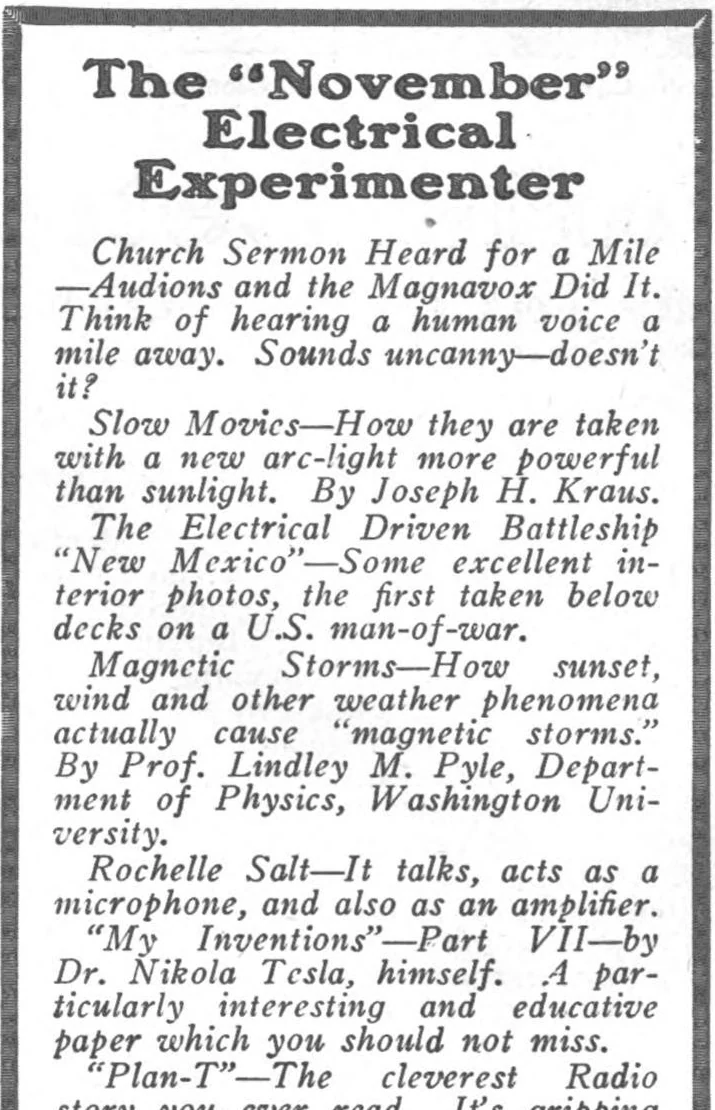
- October 1919 finally prints Part VI — and announces Part VII for November, which prints an apology instead.
The July notice is the magazine publicly correcting itself: it had announced an article Tesla had not agreed to write. And the September letter is the only account in his own voice — which explains nothing, since neither "circumstances beyond my control" nor "the objections to its appearance" names anything. It does establish that he still meant to continue.
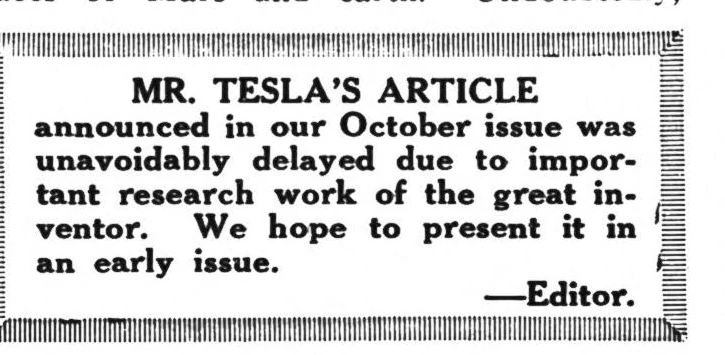
Nothing further was printed. MEASURED: all twelve 1919 issues and the eight to August 1920 were searched locally. The string my inventions occurs between four and ten times in each of the six instalment months, and zero times in each of the ten consecutive issues from November 1919 to August 1920 — the same query, with only the dates moved. The magazine then changes its name — Science and Invention from the August 1920 number, promoting a strapline the February 1919 cover already carried — and its whole numbers run straight on, 87 to 88.
How it actually ends.
Because the series stops where it stops, its last paragraph is not a conclusion to anything. It is the tail of the telautomatics chapter, beginning on page 601 of the October 1919 issue and finishing on page 603, and it is about the Treaty of Versailles. It opens by sending the reader to a newspaper article of 1914 — "many of the ablest minds are trying to devise expedients… which I have correctly predicted in an article printed in the Sun of December 20, 1914" — and then arrives at this:
… It is particularly regrettable that a punitive policy was adopted in framing the terms of peace, because a few years hence it will be possible for nations to fight without armies, ships or guns, by weapons far more terrible, to the destructive action and range of which there is virtually no limit. Any city, at a distance, whatsoever, from the enemy, can be destroyed by him and no power on earth can stop him from doing so. If we want to avert an impending calamity and a state of things which may transform this globe into an inferno, we should push the development of flying machines and wireless transmission of energy without an instant's delay and with all the power and resources of the nation.
Nikola Tesla, "My Inventions VI. The Art of Telautomatics," The Electrical Experimenter, October 1919, pages 601 and 603. The column immediately below it resumes an article called "What the X-Rays Show."
There is no retrospect, no summing up and no farewell, because none was due: the series was still supposed to be running. How much longer is a question the three commissioning documents answer three different ways, which this article quoted all of before noticing. The contract says the articles are "to run consecutively for a period not to exceed two years." Gernsback's printed pitch says they will "probably take over two years." The publishers' panel says "several years." Those are a ceiling, a floor and a vague gesture, and nothing printed in October 1919 says what anyone expected by then.
The book came in 1982, and it cuts the evidence.
"The articles will be publisht in book form later," the publishers wrote. Not by them. The Catalog of Copyright Entries shows Experimenter Publishing registering the magazine in 1919 and two books in 1920 — Sidney Gernsback's Thousand and One Formulas and H. W. Secor's The How and Why of Radio Apparatus. My Inventions is not among them, and no edition appeared anywhere in Tesla's lifetime. So the royalty he contracted for was a royalty on nothing. The earliest book form at all is a Belgrade volume of 1948, by its own subtitle a set of excerpts; the first complete English edition is Johnston's, sixty-three years after the serial.
Johnston's edition is a careful one: it keeps Tesla's reformed spellings where looser transcriptions quietly fix them, and takes its chapter titles straight from the magazine's printed headings. But his editor's note states one deliberate omission, and it is the evidence above: "Only the promotional material with which the original editor introduced each of the six serial installments has been omitted altogether." His reason is honourable — that Tesla's work should stand on its own. The effect is that the standard edition of My Inventions is the one in which Gernsback disappears.
Three things it is asked for that are not in it
The practical consequence is that My Inventions is routinely credited with content it does not contain. Three cases, each measured against the pages.
The date of the Budapest insight. Reference works give February 1882 for the afternoon in the city park when the rotating field came to Tesla, and often cite My Inventions. The serial never dates the walk. Page 909 of the April 1919 issue says: "One afternoon, which is ever present in my recollection, I was enjoying a walk with my friend in the City Park and reciting poetry… the idea came like a flash of lightning… I drew with a stick on the sand the diagrams shown six years later in my address before the American Institute of Electrical Engineers." No month, no year, no named park, no named friend; the sentence's only internal anchor is "six years later" than the lecture of 16 May 1888, which is where the 1882 is usually got from. The instalment is not silent about the period, though, and an earlier draft of this article wrongly said it was. Two pages before the walk, page 907 has him going to Prague "in 1880," then "in the year following" moving to the telephone undertaking in "Budapest, Hungary"; Part IV has him leaving for Strassburg "early in 1883." So the serial does bracket his Budapest period — between 1881 and the beginning of 1883 — and February 1882 falls inside it comfortably. What the serial will not do is pick the day, the month or the year out of that window. The month comes from somewhere else again: O'Neill's biography of 1944 gives "one late afternoon in February, 1882" and no source for it. MEASURED: 1882 occurs once in the whole twelve-issue run — an August article about the great comet of 1882 — and not once in the six issues carrying an instalment. Controls, same search across those same twelve issues: 1880 six, 1884 one, 1888 one, 1891 nine, 1893 twenty-three.
The Edison bonus. The fifty thousand dollars is in the serial, and the sentence is shorter and stranger than its reputation: "The Manager had promised me fifty thousand dollars on the completion of this task but it turned out to be a practical joke. This gave me a painful shock and I resigned my position." That is the whole of it — Part IV, May 1919, page 65. No name, no date, no account of what was said. Everything more detailed comes from somewhere other than this document.
The earthquake machine. Not there at all. The Houston Street oscillator story — a pocket machine shakes a block of buildings and Tesla destroys it with a hammer — is regularly sourced to My Inventions. The word earthquake occurs twice in twelve issues of the magazine — both times in the May number, in two other writers' articles, one about an undersea tube and one about tapping heat from the earth's interior — and nowhere in anything Tesla wrote that year. The earliest telling located is a newspaper interview of January 1901.
What happens when it can be checked.
One passage mixes what a reader can check against other documents with what only Tesla could assert — Part V, June 1919, page 178:
A plant was built on Long Island with a tower 187 feet high, having a spherical terminal about 68 feet in diameter. … The tower was destroyed two years ago.
Nikola Tesla, "My Inventions V. The Magnifying Transmitter," The Electrical Experimenter, June 1919, page 178.
Three claims, three different outcomes. The demolition checks out: the tower came down in 1917, two years before he wrote, as the contemporary press reports. The two dimensions do not corroborate him — they repeat him. The National Register nomination that gives 187 feet footnotes it to Tesla's own foreclosure testimony, and no independent source gives a terminal diameter in feet; contemporary accounts say "about 185 feet." Checking Tesla against a document that got its number from Tesla is the precise error this article is about, and this paragraph's first draft made it. The third claim is contradicted. Six sentences further down the same column — about four inches of type, and this article first said "six lines," which is wrong by a factor of six: "Mr. J. Pierpont Morgan did not interest himself with me in a business way but in the same large spirit in which he has assisted many other pioneers." The arrangement says otherwise. By a letter of 1 March 1901, accepted on the 4th, Tesla assigned Morgan "an interest of fifty-one percent in all of said patents and inventions, and also in any patents or inventions which I may hereafter secure," against $150,000 — a controlling interest in the patents, covering wireless lighting as well as wireless telegraphy, and in everything he might patent afterwards. A second correction to this article, made before publication: an earlier draft said that instrument "has never surfaced." Both letters are in the Tesla Papers at the Library of Congress and the clause has been quoted verbatim in print; what this site has not done is read a scan of it, which is a different and much smaller claim.
What it is good for
All of which argues for reading it carefully, not discarding it. It is a first-person account by the only person present for most of what it describes, written while he was alive to correct it. For the interior life — the visions, the counting, the aversions, the collapse at Budapest — there is nothing else of comparable authority.
What it is not is a considered memoir written to stand as a record. It is a monthly commission produced to a deadline, with editors whose business was selling magazines, by a man of sixty-two writing from memory about a childhood half a century behind him — and broken off while it was still, by every document that set its length, supposed to be running.
So the citation that does it justice names the magazine, the instalment and the page, and says in the sentence where a claim rests on Tesla alone. The document supports that treatment perfectly well. It is the shorthand that quietly turns six magazine articles into a finished book, and a thing the editors helped prepare into a thing he simply wrote down.
The document
The spine of this article is the 1919 volume-year of The Electrical Experimenter, 233 Fulton Street, New York — "Publisht by Experimenter Publishing Company, Inc. (H. Gernsback, President; S. Gernsback, Treasurer;)" for the January to July numbers, with "R. W. DeMott, Sec'y" added to that line from August 1919 on — monthly on the fifteenth, two dollars a year or twenty cents a copy: volume VI, whole numbers 69 to 72 (January to April 1919), and volume VII, whole numbers 73 to 80 (May to December 1919). All twelve issues were downloaded whole from the Internet Archive and read; every quotation above was taken from a page image rather than from machine-read text. That is not the same as having counted correctly on it. An adversarial check of this article against those same images found three places where it had miscounted or back-derived what it reported: a resumption page taken from a cross-reference instead of from the page the running head sits on, a panel of twelve items described as nine, and a gap of six sentences described as six lines. All three are corrected above. Reading the image prevents misquotation; it does not do the arithmetic for you.
The six instalments of My Inventions are at February 1919 page 696, March 1919 page 776, April 1919 page 864, May 1919 page 16, June 1919 page 112 and October 1919 page 506, with continuations scattered through the back of each issue. The commissioning article is January 1919 pages 614–615, continued page 657. The announcement of the seventh instalment is October 1919 page 510; the editorial note that replaced it is November 1919 page 641. Each issue is a separate Internet Archive item: February, March, April, May, June and October.
The search log
- Part VII of My Inventions. NOT PUBLISHED, and the negative covers ten consecutive issues. All twelve 1919 issues, the seven 1920 issues of The Electrical Experimenter and the first issue of its successor Science and Invention (August 1920) were downloaded whole and searched locally. The string my inventions returns 0 in every issue from November 1919 to August 1920 inclusive. Control, same query with only the dates moved: the identical string returns 4, 5, 5, 5, 4 and 10 in the six instalment months, and 4 in the January 1919 issue that announced the series. Limit, stated rather than smoothed: this establishes that no instalment appeared in those ten issues, not that Tesla never wrote one; whether a draft exists in the Belgrade archive was not investigated here.
- A date for the Budapest park insight, inside the serial. NOT THERE. 1882 occurs once in the twelve-issue 1919 run, in an August article on the great comet of 1882, and zero times in the six issues carrying instalments. Controls: the same four-digit search returns 1880 6, 1884 1, 1888 1, 1891 9, 1893 23 across the run. The April 1919 text was read on the page image to confirm that no date had been lost to the machine reading. The serial dates the moment only as "six years later" than the address to the American Institute of Electrical Engineers. A NEGATIVE THIS ARTICLE STATED TOO WIDELY, caught before publication. An earlier draft said "the serial gives no date at all," which is true of the walk and false of the instalment around it: page 907, two pages earlier, has Prague "in 1880" and Budapest "in the year following," and Part IV has Strassburg "early in 1883." The serial brackets the period 1881 to early 1883 without naming a day in it. The slip is the standard one: a search for the string 1882 answers "is this year printed here," not "does this text say when."
- The one anchor the Budapest passage has, checked at the other end. 16 MAY 1888 — and the 15 May in circulation is a real meeting, just not this one. Since the serial dates the insight only as "six years later" than the address to the American Institute of Electrical Engineers, the whole reconstruction rests on that address being firmly dated, and sources give both 15 and 16 May. The Institute's own printed record settles it and explains the split, and it does so in advance of the meeting. The Transactions for May 1888 carry both notices on facing columns. First: "The Annual meeting of the Institute, for the election of officers… on Tuesday Evening, May 15th, at 8 o'clock." Then, on page 2: "The general meeting for the reading and discussion of professional papers convenes at the same place, on Wednesday, May 16th, at 10 A.M. The following papers are to be read:" — and the first one listed is "On a new system of Alternate Current Motors and Transformers," by Mr. Nikola Tesla. Two meetings on two days: the business meeting that elected the officers on the Tuesday, the meeting at which the papers were read on the Wednesday. A source giving 15 May has the right week and the wrong event. The June and July numbers then confirm it from the other side — "General Meeting, Wednesday, May 16th, 1888," called to order at 10.30 a.m., the chairman opening by explaining that Edward Weston, "elected President of the Institute last night," is too ill to attend. Tesla's paper was read in the afternoon session of 16 May, named by the chair before the break as the first item after lunch. All four passages were read on the page images. A pagination trap in the same volume: this article read the issue as filmed by microfilm, which is paginated from 1 — Tesla's paper opens at page 16, and the running head "18" was read on the image to rule out a lost leading digit. The familiar citation "308–27" is the bound volume's continuous pagination, confirmed independently from the publisher's own registered metadata for the paper (DOI 10.1109/t-aiee.1888.5570379, volume V, issue 10, pages 308–327, July 1888). Both numbers are right and they are not interchangeable: a reader who follows "308" to the Internet Archive copy of the issue will not find the paper, because that printing paginates each number separately and runs it from 16.
- A correction to a page on this site, found while checking this one. The earthquake-machine article states that the word earthquake "does not occur once in the whole 1919 run" of The Electrical Experimenter. The counts it reports are correct, but the corpus it describes is not what was searched: the search was run against an Internet Archive compilation of Tesla's own 1919 contributions, not against the twelve issues of the magazine. Searched properly, the twelve issues contain the word twice, both in the May number and both in other writers' articles. And the first pass at that recount said "once" — it missed the second because the scan breaks the word across a line as earth-/quake, which is the precise caution the corrected page already carries about its own searches. Normalise the hyphenation before counting. The finding is unchanged; two sentences about it were not, and both have been corrected rather than quietly dropped.
- “There is no Wardenclyffe chapter.” THAT WAS THIS ARTICLE'S OWN FIRST DRAFT, AND IT IS WRONG. The sentence was written on the reasonable-sounding assumption that a series broken off after six instalments could not have reached 1901. It did: Part V runs from the Colorado Springs plant of 1899 straight on to the Long Island tower, its dimensions, its power, its demolition and Morgan, on pages 176 to 178 of the June 1919 issue. Controls that would have caught it sooner: Long Island returns 9 and Morgan 9 across the six instalment months, Shoreham 1, Wardenclyffe 0 — the place is in the serial under the name Tesla used for it, not the name history uses. The draft claim was cut and replaced with what the passage actually says, which is better evidence than the claim would have been. A SECOND FALSE NEGATIVE OF THE SAME SHAPE, found the same way. This article also said "September 1919 does not mention it either." It does: page 404 carries a boxed letter signed by Tesla about the delay. The search that missed it was for the string my inventions, and his letter never uses the title. The hit that would have caught it was sitting in plain view — Tesla returns 4 in that issue, and one of the four is the signature "N. TESLA." Searching for the name of a thing finds only the places that name it.
- A confirmation that turned out to be circular, and this article printed it before catching it. The draft said the serial's Wardenclyffe dimensions — a 187-foot tower with a terminal about 68 feet across — were corroborated by the independent record. They are not. The National Register nomination for the site, reference 100002744, does print "the final height of the tower came to 187'", and its footnote attributes that to Tesla's testimony during the foreclosure hearings; every other instance in the document is downstream of it. No source located gives a terminal diameter in feet at all, and the contemporary press figure is "about 185 feet." So the check was Tesla against Tesla. What is independent is the demolition: the tower was dynamited in July 1917, reported in the New York press at the time, which makes "destroyed two years ago" exact. The habit that catches this is reading the footnote on the corroborating source, not just the sentence.
- A text circulating under this title that is not this text, and the interpolation is startling. Two widely mirrored plain-text files — byte-identical, retyped in 1995 from a second-hand booklet — render the sentence about Tesla's brother as "His premature death left my earth parents disconsolate," and add a bracketed aside: "(I will explain my remark about my 'earth parents' later.)" The February 1919 page reads "my parents", which was checked on the image; the Johnston book reads "my parents"; so does the careful transcription at Twenty-First Century Books. The same file scores zero on every one of the magazine's reformed spellings and silently Briticises labour and realise. REPORTED, not established here: Twenty-First Century Books traces the family of corrupted texts to a modified version published in 1973 in a book about a Venusian spacecraft. That provenance is their account, not a finding of this article; the interpolation itself is measured.
- How it is actually cited. A SAMPLE OF ELEVEN, and it is reported as a sample. Of eleven citations collected from scholarly books, a museum catalogue, a journal article and an encyclopedia: seven name The Electrical Experimenter; five give instalment months and only four give them correctly; three cite the instalments individually; and none cites it as a bare 1919 book. The dominant form is the 1982 Hart Brothers edition or a later reprint, with the serial origin as a gloss at most — Carlson's abbreviation list, for instance, gives the Hart Brothers edition and his short-form page references are to its pagination. The limit is the sample size: eleven careful sources are not a measurement of how the title circulates generally, and no claim about general practice is made above beyond what the book history itself shows.
- What Tesla was paid for the series. ANSWERED — AND THE FIRST PASS OF THIS ARTICLE SAID IT WAS NOT LOCATED. That entry was written after searching the magazine, where no fee appears anywhere in twelve issues. The fee is not in the magazine because there was none: the contract of 27 November 1918, held by the Nikola Tesla Museum and published online, has Tesla supplying his material "all free of charge" against "ten percent author’s remuneration on all books sold." The lesson is the ordinary one and it cost this article a wrong sentence: a negative is only as wide as the corpus searched, and the corpus here was the wrong one — the terms of a commission are in the correspondence, not in the publication. Still not located: Tesla’s letter of acceptance, which the contract asks for and which is not digitised. THE LIMIT ON THIS ONE IS WORTH STATING PLAINLY, BECAUSE IT IS THIS ARTICLE'S LARGEST NEW CLAIM. The Google Arts & Culture asset is an image only. None of the wording quoted here — "not to exceed two years", "all free of charge", "ten percent author's remuneration on all books sold" — exists as text anywhere this article could reach, and no secondary source was found quoting it. The transcription above is one reading of one scan, made at full resolution and checked twice, and nobody else's reading was available to check it against. The other half of the contrast is on much firmer ground: "ALL accepted contributions are paid for on publication" appears in the colophon of all twelve 1919 issues.
- A caution about the machine-read text of these scans, with a worked example. The optical character recognition of the January 1919 announcement drops the word "years", turning "which articles will run for several years" into "which articles will run for several." That is the single most important word in the sentence for this article's purpose, and it is missing from the text layer and plainly present on the page. Every quotation above was taken from the page image for this reason.
- A quotation for the checker. NO NEW ENTRY — but seven existing ones were sharpened. Nothing adjudicated here is a floating quotation attributed to Tesla, so no verdict was added. What did change is the citations: seven entries in the quote checker cited their source as "My Inventions, The Electrical Experimenter, 1919", which is exactly the shorthand this article argues against. Each now carries the instalment and the printed page, located by word coordinates in the scans and confirmed — Part 1 at February 1919 pages 696 and 746, Part IV at May 1919 page 16, Part V at June 1919 page 177, Part VI at October 1919 page 552.
Primary documents
- Nikola Tesla, "My Inventions," The Electrical Experimenter, six instalments — 1. MY EARLY LIFE, February 1919, page 696; 2. MY FIRST EFFORTS IN INVENTION, March 1919, page 776; III. MY LATER ENDEAVORS over its upper-and-lower-case subtitle The Discovery of the Rotating Magnetic Field, April 1919, page 864; IV. THE DISCOVERY OF THE TESLA COIL AND TRANSFORMER, May 1919, page 16; V. THE MAGNIFYING TRANSMITTER, June 1919, page 112; VI. THE ART OF TELAUTOMATICS, October 1919, page 506. Headings transcribed from the page images, which set them in full capitals.
- H. Gernsback, "Nikola Tesla and His Inventions: An Announcement," The Electrical Experimenter, January 1919, pages 614–615, continued page 657 — the commissioning account, the quoted pitch, the Modern Electrics meeting, and the statement that Tesla "agreed to prepare each article personally with the Editors' collaboration." The issue.
- "BY special arrangement…", unsigned panel over the signature THE PUBLISHERS, The Electrical Experimenter, January 1919, page 615 — "which articles will run for several years" and "The articles will be publisht in book form later." The source of Fig. 2, and the sentence this article argues from.
- Forthcoming-contents panels, all read as page images: The Electrical Experimenter, June 1919, page 115 ("The 'July' Number of the Electrical Experimenter … 'My Inventions'—Part VI—by Dr. Nikola Tesla, himself. Besides a big feature surprise article by the world's master inventor"); July 1919, page 240 ("'My Inventions' Part 6—by Dr. Nikola Tesla himself"); August 1919, page 298 ("September Number of the Electrical Experimenter" — twelve items, the last of them inside the bottom border, and the series is not among them); and October 1919, page 510 ("The 'November' Electrical Experimenter … 'My Inventions'—Part VII—by Dr. Nikola Tesla, himself"). The last is the source of Fig. 4, above.
- "MR. TESLA'S ARTICLE," editorial note, The Electrical Experimenter, November 1919, page 641 — "announced in our October issue was unavoidably delayed due to important research work of the great inventor. We hope to present it in an early issue." The source of Fig. 4, below, and the last word on the series in the ten issues searched. The issue.
- The Electrical Experimenter, whole numbers 69 to 87, January 1919 to July 1920 — volume VI to number 72, volume VII from 73, volume VIII from 85 — and Science and Invention, August 1920, whole number 88. The whole-number sequence runs straight through the retitling, which is how one can tell it is the same magazine renamed. These are the twenty issues searched for this article, each a separate Internet Archive item under electrical-experimenter-YYYY-MM.
- Nikola Tesla, "My Inventions V. The Magnifying Transmitter," The Electrical Experimenter, June 1919 — page 176 for "I have been asked by the ELECTRICAL EXPERIMENTER to be quite explicit on this subject so that my young friends among the readers of the magazine will clearly understand…", and page 178 for the Long Island plant, the 187-foot tower, the 68-foot terminal, the destruction of the tower "two years ago," and the characterisation of J. Pierpont Morgan. Note on the two dimensions: the National Register nomination for the site, reference 100002744, prints 187 feet but footnotes it to Tesla's own foreclosure testimony, and gives no terminal diameter in feet; the contemporary press says "about 185 feet." They are not independent of him. The issue.
- The Electrical Experimenter, February 1919, front cover — "Beginning: 'My Inventions,' by Nikola Tesla" above the masthead, the price of twenty cents, the strapline SCIENCE AND INVENTION, the cover line "THE TESLA WIRELESS LIGHT — SEE PAGE 692", the line "LARGEST CIRCULATION OF ANY ELECTRICAL PUBLICATION" along the foot, and the Sarony signature in the painting. The source of Fig. 3.
- The Electrical Experimenter, January 1919, page 622 — "An All-Electric Hot Air Balloon," which is what the issue's own contents page gives as the location of the Tesla announcement. The announcement is on pages 614–615.
- The Electrical Experimenter, February 1919, page 682 — the contents page carrying the masthead line ("Publisht by Experimenter Publishing Company, Inc. (H. Gernsback, President; S. Gernsback, Treasurer;) 233 Fulton Street, New York"), the volume line ("Vol. VI · Whole No. 70 · FEBRUARY, 1919 · No. 10"), the contents entry "MY INVENTIONS—NO. 1 OF A SERIES … Exclusive Feature. 696" (full capitals on the page, and "Exclusive Feature." in roman, not italic), the cover credit ("Nikola Tesla and His Wireless Light … From a painting by George Wall"), Gernsback's signed editorial "The New Wireless", and the colophon giving the price and the copyright in E. P. Co., Inc.
- Hugo Gernsback to Nikola Tesla, 27 November 1918, on Experimenter Publishing Co., Inc. letterhead, addressed to 8 West 40th Street and signed by Gernsback as President — the agreement itself: two years of monthly articles "and to be thereafter printed in book-form"; Tesla's material supplied "all free of charge"; "ten percent author's remuneration on all books sold"; and a reversion clause if no book followed within a year. Nikola Tesla Museum, Belgrade, whose stamp is on the sheet; published on Google Arts & Culture, where it was read. Not reproduced here: a private letter of 1918 is not a published work of its period, and its copyright position is not the magazine's.
- SPECIAL NOTICE, The Electrical Experimenter, July 1919, page 229 — the magazine withdrawing its own announcement: "which altho made in good faith by us was not authorized by him." Printed beside Tesla's "Electrical Oscillators" on the same page.
- Nikola Tesla, letter to the editor, The Electrical Experimenter, September 1919, page 404 — boxed, signed "N. TESLA.", not indexed on the issue's contents page: "owing to circumstances beyond my control… the objections to its appearance will be shortly removed." The only statement in his own voice about the delay.
- Nikola Tesla's other signed articles in the same volume-year: "The Effect of Statics on Wireless Transmission," January 1919, page 627 (the issue's contents page indexes this as "My Radio 'Static Eliminator'" — the article's own printed title is the former); "Famous Scientific Illusions," February 1919, page 692; "The Moon's Rotation," April 1919, page 866 and again June 1919, page 132; "The True Wireless," May 1919, page 28; "Electrical Oscillators," July 1919, page 229. Six further bylines beside the six instalments: the relationship was continuous and commercial, not a single event. "Tesla's Egg of Columbus," March 1919, page 774, is NOT among them — the contents page credits it to him, but the article carries no byline and is written about him in the third person.
- Nikola Tesla, My Inventions: The Autobiography of Nikola Tesla, edited with an introduction by Ben Johnston, 1st Hart Bros. ed., Williston, Vermont: Hart Brothers, 1982; 111 pages. LCCN 82082495, OCLC 9281231. The first complete book edition, and the one nearly all modern citation rests on. Its title-page verso records that the text "originally appeared in the Electrical experimenter magazine in 1919," and its editor's note records what was removed.
- Catalog of Copyright Entries, Library of Congress — 1919 Periodicals (new series vol. 14 part 2) and 1920 Books (new series vol. 17 part 1). The Experimenter Publishing Company registered The Electrical Experimenter and Radio Amateur News as periodicals, and in 1920 registered two books, Sidney Gernsback's Thousand and One Formulas and H. W. Secor's The How and Why of Radio Apparatus. No registration for My Inventions appears. The Catalog records registrations rather than every publication, which is the limit on that negative.
- Моји проналасци: одломци Теслине аутобиографије, Belgrade: Друштво "Никола Тесла", 1948; 78 pages — the earliest appearance of the text in book form anywhere, and by its own subtitle a selection of excerpts rather than the whole. COBISS.SR 16713735.
Further reading
- The earthquake machine, and the birthday party it comes from — where that story actually comes from, and why it is not in My Inventions.
- Did Tesla invent alternating current? — US 381,968 and the lecture of 16 May 1888, which is the only anchor the Budapest passage has.
- The war of the currents was an argument about copper — the fifty thousand dollars, and what rests on Tesla's telling alone.
- What the tower at Shoreham was for — the 187-foot tower the serial describes, and the Morgan agreement of March 1901 that it does not.
- Quotes Nikola Tesla never said — how to date an attributed passage against the archives.
The record on this article
- Misleading “My Inventions is Nikola Tesla's autobiography, published in 1919.” In 1919 it was six articles in a monthly magazine, commissioned by that magazine's editor, and — on the statements of both parties printed in it — prepared with its editors. Tesla's own third paragraph calls it "this series of articles which will be presented with the assistance of the Editors." The word autobiography on that page is the publisher's.
- False “My Inventions is a complete work.” A seventh instalment was announced in the October 1919 issue, page 510. The November issue carried an editorial note on page 641 saying it had been "unavoidably delayed" and promising it "in an early issue." It never appeared: the string my inventions returns zero across the ten consecutive issues from November 1919 to August 1920. Six instalments exist, against a series the commissioning documents describe as running "not to exceed two years" (the contract), "over two years" (the editor's pitch) and "several years" (the publishers' panel) — three different lengths, none of them six months.
- False “My Inventions dates the rotating-field insight to February 1882.” The serial never dates the walk itself: the April 1919 instalment places it only "six years later" than the address to the American Institute of Electrical Engineers of 16 May 1888, in an unnamed "City Park" with an unnamed friend. It does bracket the period — Prague "in 1880," Budapest "in the year following," Strassburg "early in 1883" — so February 1882 fits the window the serial gives. It is not a date the serial supplies. The string 1882 appears nowhere in any of the six issues carrying an instalment.
- False “The earthquake-machine story is in My Inventions.” It is not. The word earthquake appears twice in the whole twelve-issue 1919 run of the magazine — both in the May number, one in an article on an undersea tube and one on tapping heat from the earth's interior — and in nothing Tesla published that year. The story's earliest located trace is a newspaper interview of January 1901.
- False “My Inventions says J. Pierpont Morgan backed Wardenclyffe out of generosity rather than business.” It does say that, in Part V, June 1919, page 178: Morgan "did not interest himself with me in a business way but in the same large spirit in which he has assisted many other pioneers." By a letter of 1 March 1901, accepted on the 4th, Tesla assigned Morgan "an interest of fifty-one percent in all of said patents and inventions, and also in any patents or inventions which I may hereafter secure," against $150,000 — the patents, including wireless lighting, and not merely wireless telegraphy. Both letters are in the Tesla Papers at the Library of Congress; the clause is quoted verbatim in print, though no scan was read for this article. The same passage dates the tower's destruction correctly, to two years before he wrote. Its two dimensions are a different case: the figures in circulation trace back to Tesla's own foreclosure testimony rather than to anything independent of him, so they neither confirm nor impeach the passage.
- Source is Tesla alone “Tesla was promised a fifty-thousand-dollar bonus and it turned out to be a joke.” The serial carries the claim, in Part IV, May 1919, page 65 — and in a single sentence that names no one: "The Manager had promised me fifty thousand dollars on the completion of this task but it turned out to be a practical joke." No date, no name, and no account of what was said. Everything more detailed than that comes from outside this document.