1885–1893 · The polyphase patents
How alternating current works, from Ørsted's needle to Tesla's motor
Four experiments, each built on the one before: a current turns a compass needle, a moving magnet makes a current, a spinning magnet makes it alternate, and two alternating currents turn a motor.
Alternating current is usually explained from the wall socket backwards. It was found forwards, in four steps, and each step needs the one before it. A current in a wire turns a compass needle. A moving magnet makes a current in a coil. A magnet that spins makes a current that flows one way and then the other. And two of those currents, a quarter of a cycle apart, turn a motor whose rotor nothing touches.
Each step rests on a document that can still be read, and each one can be built by hand in this publication's workshop: a three-dimensional bench where the reader winds the coils, carries the wires to the posts and turns the cranks. This article is the explanation behind each bench, and an account of what the benches simplify.
What does a current do to a compass needle?
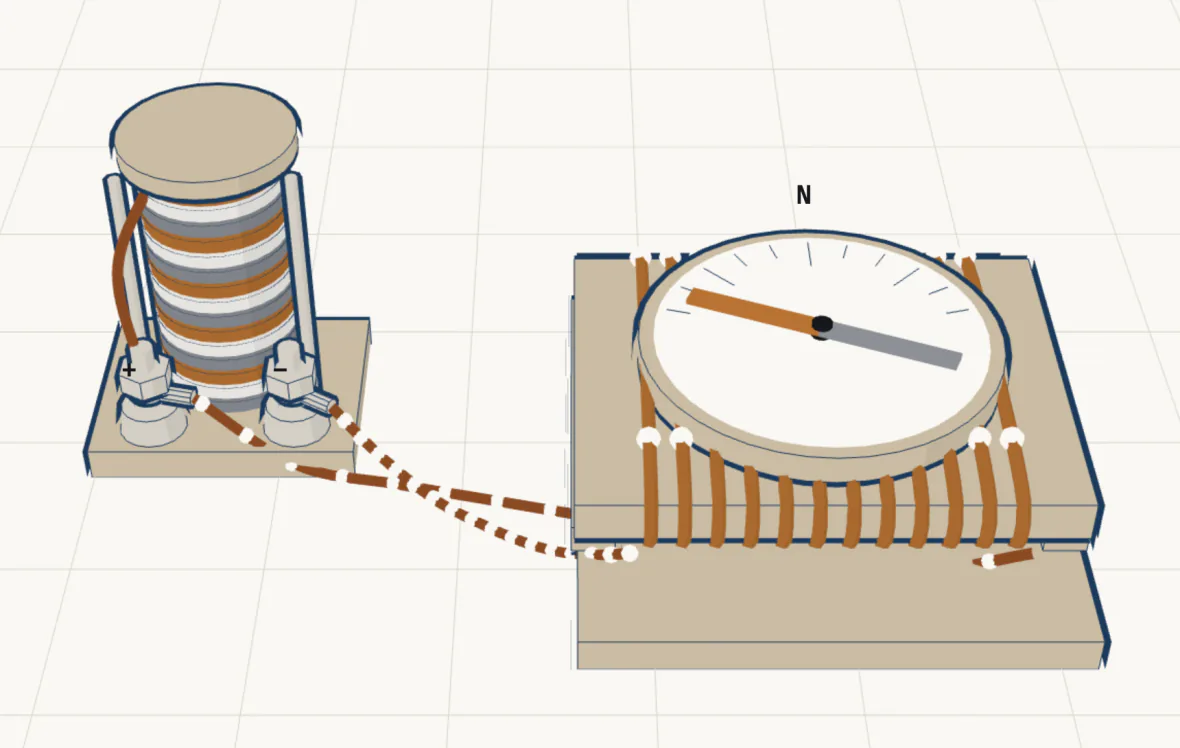
It turns it. A current in a wire makes magnetism that circles the wire. A compass needle is a small magnet, so it turns to line up with that magnetism. The turn lasts only as long as the current: break the circuit and the needle swings back to north. Reverse the current and the needle turns the other way.
Hans Christian Ørsted, professor of physics at Copenhagen, published the effect on 21 July 1820 in a four-page pamphlet in Latin, Experimenta circa effectum conflictus electrici in acum magneticam. His wire joined the two ends of a voltaic battery and ran over a compass needle, parallel to it. The needle turned away from north, and it turned the other way when the wire passed under the needle instead of over it.
One wire turns a needle only a little. Within two months Johann Schweigger, at Halle, had wound the wire round the needle many times, so that every turn added its own pull. He presented the instrument there on 16 September 1820 and called it a multiplier. It is usually counted as the first galvanometer: a meter that shows a current, and which way it flows.
Michael Faraday's meter of 1831 was the same instrument, made by hand. He describes it in the paper that announced induction: copper wire covered with silk, making “sixteen or eighteen convolutions”, and two magnetised sewing-needles fixed on a stem of dried grass and hung by a silk fibre,
so that the lower needle should be between the convolutions of the multiplier, and the upper above them.
Michael Faraday, Experimental Researches in Electricity, First Series, paragraph 87; Philosophical Transactions of the Royal Society 122 (1832), 125–162.
How does a moving magnet make a current?
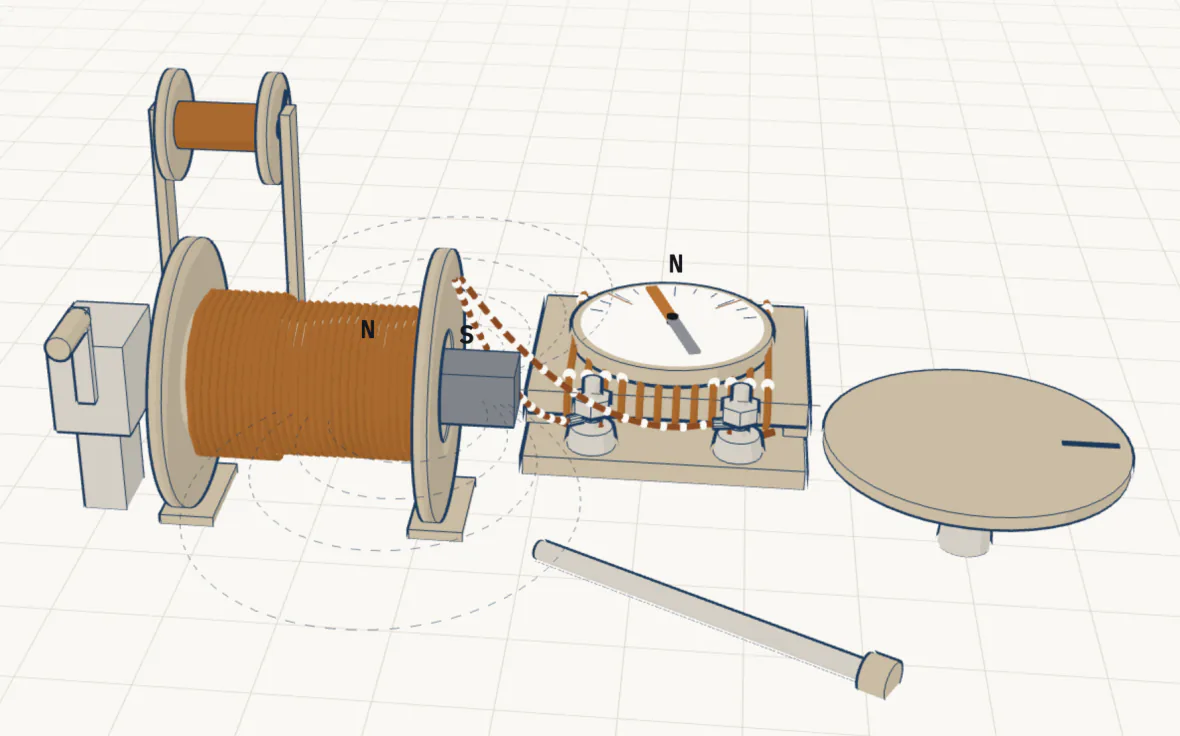
It changes the magnetism passing through a coil, and a change in that magnetism pushes a current round the coil. How much magnetism there is does not matter. How fast it changes does. Push a magnet into a coil and the meter kicks; hold it still inside and the meter goes back to zero; pull it out and the meter kicks the other way. Push faster and the kick is larger. Wind more turns and it is larger again. Turn the magnet round and push it into the same end, south pole first, and every kick reverses.
Faraday found it in 1831 and read the paper to the Royal Society on 24 November: the First Series of his Experimental Researches in Electricity, printed in the Philosophical Transactions for 1832. The plainest experiment in it uses a cylindrical magnet “three quarters of an inch in diameter and eight inches and a half in length” and a hollow coil wired to a galvanometer:
the magnet was suddenly thrust in; immediately the needle was deflected … Being left in, the needle resumed its first position, and then the magnet being withdrawn the needle was deflected in the opposite direction.
Michael Faraday, Experimental Researches in Electricity, First Series, paragraph 39; Philosophical Transactions of the Royal Society 122 (1832), 125–162.
“These effects were not great,” the same paragraph goes on, which is why the meter of 1820 mattered: a current far too small to feel was still enough to turn a needle inside a multiplier. And the middle sentence of the quotation holds the next sixty years. A magnet at rest inside a coil makes nothing. To keep a current coming, the magnetism through the coil has to keep changing.
Why does the current alternate?
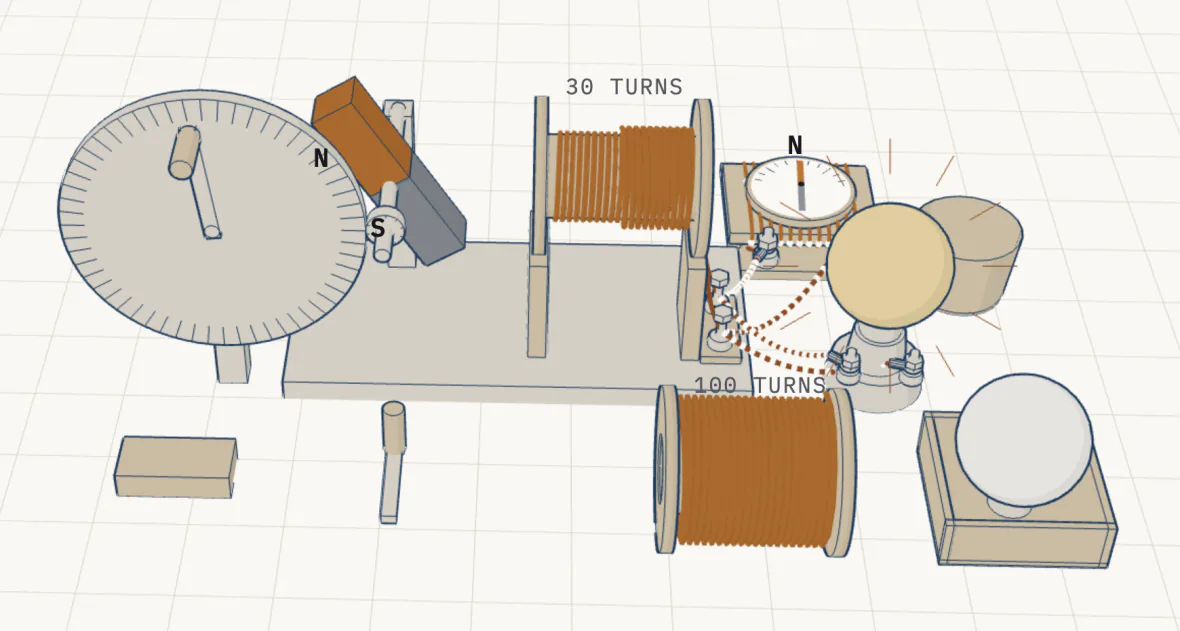
Because the only way to keep the magnetism through a coil changing is to move the magnet back and forth, or round and round. Spin a magnet beside a coil and, through each turn, the magnetism in the coil rises, falls, reverses and comes back. The current follows the change: one way while the magnetism grows, the other way while it shrinks. One turn gives one full wave. That is alternating current, and it is what a spinning magnet makes without being asked.
Spin faster and two things change together. The waves come more often, which is the frequency. And each wave is taller, because the magnetism changes faster, which is the voltage. More turns of wire also make the voltage higher. The voltage follows the turns multiplied by the speed of the change.
One of the first machines to do this with a hand crank was built in Paris in 1832 by the instrument maker Hippolyte Pixii: a horseshoe magnet, turned by a geared handle under a pair of coils on an iron core. Its current reversed every half turn. On a suggestion from André-Marie Ampère, a rocking switch was added that reversed the connections in step with the magnet, so that the current came out one way. Ampère's note on the machine is in the Annales de chimie et de physique for that year. On this machine, in other words, direct current was the modification; the longer version of that story is in Did Tesla invent alternating current?
A lamp shows the wave well. A filament heats whichever way the current runs, so it brightens twice in every turn, once for each half of the wave, and dims between. Turned by hand at a few turns a second it flickers; turned fast enough, the dimming is too quick to see. A gear that spins the magnet eight times for each turn of the handle reaches that speed, but it also makes the voltage eight times higher. That is why the workshop's lamp burns out until the reader swaps in a coil with fewer turns.
How does alternating current turn a motor?
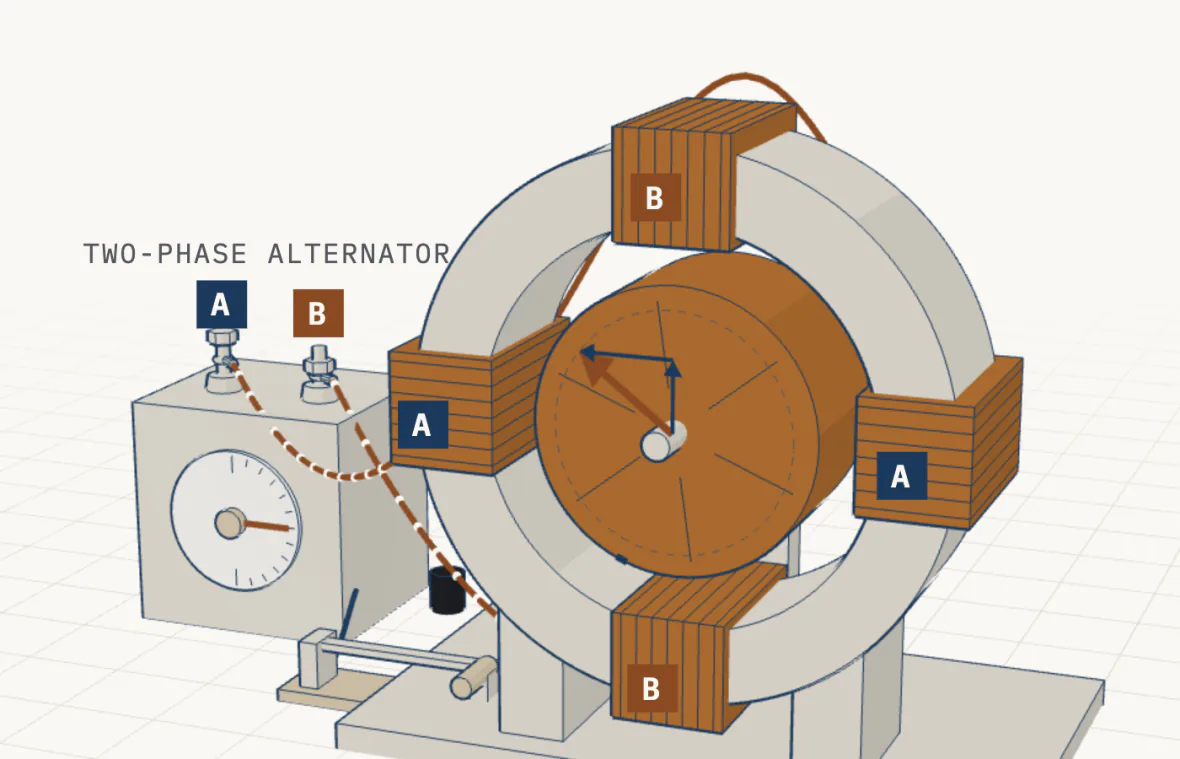
A motor needs a pull that goes round. One alternating current in a pair of coils makes a magnetic pole that only swings back and forth along one line, and a rotor at rest is pulled both ways at once and goes nowhere. Two alternating currents a quarter of a cycle apart, in two pairs of coils set at right angles, make a pole that walks round the ring: while one pair is at its strongest, the other is at zero, and the strength passes from one pair to the next and on round.
Put a copper rotor inside and the walking field sweeps through it. That is the 1831 step again. The magnetism through the copper keeps changing, so currents flow round in the copper, and the field pulls on those currents and drags the rotor after it. Nothing touches the rotor. It always runs a little behind the field, because if it ever caught up, the magnetism through the copper would stop changing and the pull would stop with it.
The document is US 381,968, Electro-Magnetic Motor, filed by Nikola Tesla on 12 October 1887 and granted on 1 May 1888. It describes two or more independent circuits “through which alternate currents are passed at proper intervals”, “for the purpose of effecting a progressive shifting of the magnetism or of the lines of force”. Galileo Ferraris had made a rotating field turn a copper cylinder in Turin in 1885 and read his paper on it on 18 March 1888; how the credit divides is set out in the article on the patent.
What do the benches simplify?
Five things, on purpose. In each case the physics is computed, not animated: the needles, the waves, the flicker and the rotor's lag on the benches follow from the rules described above.
The 1820 needle sits on top of the coil, where it can be seen. In Schweigger's multiplier the needle hung inside the winding, and in Faraday's meter one needle hung inside and a second above. A needle above a coil is turned by the turns just beneath it, more weakly than one inside.
The 1831 coil is one wire on one bobbin, and sixty turns is a number for the game. Faraday's coil for paragraph 39 was a compound helix of several wires, with all their like ends bound together.
The lamp on the 1832 bench is borrowed from later. There was no electric lamp to light in 1832; the practical incandescent lamp dates from 1879. It stands in for any load, because a filament shows the flicker of an alternating current better than a needle can. And where Pixii turned a horseshoe magnet under two coils on an iron core, the bench spins a bar magnet past one coil, which makes the same kind of wave.
The 1887 alternator has a dial that sets the angle between its two windings. A real two-phase alternator has them fixed, a quarter of a cycle apart; the dial is there so that the in-step case can be seen to fail. Each pair of coils has one wire to the alternator, where a real circuit needs a pair of wires.
And the 1887 bench runs slowly. Its supply makes six-tenths of a cycle a second, so the eye can follow the pole. On a sixty-cycle supply the pole goes round sixty times a second.
The document
US 381,968 — Electro-Magnetic Motor. Filed 12 October 1887, granted 1 May 1888. Two circuits carrying alternating currents a quarter of a cycle apart, a field that walks round a ring, and a rotor that nothing touches.
With it, the three earlier documents that the workshop's benches follow: Ørsted's pamphlet of 21 July 1820, Faraday's First Series, read to the Royal Society on 24 November 1831, and Ampère's 1832 note on Pixii's machine. All four are in the public domain.
The benches themselves are in the workshop. They open in order, 1820 first.
Primary documents
- H. C. Ørsted, Experimenta circa effectum conflictus electrici in acum magneticam (Copenhagen, 21 July 1820), four pages; the Smithsonian Libraries copy is digitised at the Internet Archive. An English translation, “Experiments on the Effect of a Current of Electricity on the Magnetic Needle”, appeared in Annals of Philosophy 16 (1820).
- Michael Faraday, “Experimental Researches in Electricity”, First Series, read to the Royal Society on 24 November 1831, Philosophical Transactions of the Royal Society of London 122 (1832), 125–162; collected in Experimental Researches in Electricity, vol. I (London, 1839). Quotations above at paragraphs 39 and 87.
- A.-M. Ampère, “Note sur une expérience de M. Hippolyte Pixii, relative au courant produit par la rotation d'un aimant, à l'aide d'un appareil imaginé par M. Hippolyte Pixii”, Annales de chimie et de physique 51 (1832), 76–79.
- Electro-Magnetic Motor, US Patent 381,968, filed 12 October 1887, granted 1 May 1888.
- “A New System of Alternate Current Motors and Transformers”, Transactions of the American Institute of Electrical Engineers 5, no. 10 (July 1888), 308–27; reprinted in T. C. Martin, The Inventions, Researches and Writings of Nikola Tesla (New York, 1894), 9–25.
Further reading
- National High Magnetic Field Laboratory, “Schweigger Multiplier – 1820”, Magnet Academy — the multiplier and its presentation at Halle on 16 September 1820.
- Museo Galileo, Florence, “Magneto-electric machine by Pixii” — a surviving machine of about 1832: a horseshoe magnet turned by a geared handle, and Ampère's rocking commutator.
The record on this article
- False “A magnet inside a coil makes a current.” Only while it moves. Faraday's account of the experiment, paragraph 39 of the First Series: “Being left in, the needle resumed its first position.” A current needs the magnetism through the coil to be changing.
- False “An induction motor's rotor turns as fast as its field.” Never quite. The pull on the rotor comes from currents the moving field drives round the copper, and those need the field to be sweeping past it. If the rotor caught up, the sweep, the currents and the pull would all stop, so it settles a little behind.
Read next
-
1885–1893 · The polyphase patents
Did Tesla invent alternating current?
He did not, and the thing he did invent is more interesting than the thing he is credited with.
-
1885–1893 · The polyphase patents
The war of the currents was an argument about copper
Edison was not fighting Tesla. He was fighting a rival company, over the price of transmission and how far a central station could reach.